
Safe Haven Capital Flow Regimes
G10 Safe-Haven FX Beta, NIIP & Balance-of-Payments Capital Flow Guide (2026)
Why do the Swiss franc, Japanese yen, and US dollar rally during global market crises despite radically opposite external debt positions? Decomposing NIIP creditor repatriation, Dollar Smile funding stress, and Broad Basic Balance cycles unlocks G10 capital-flow alpha.
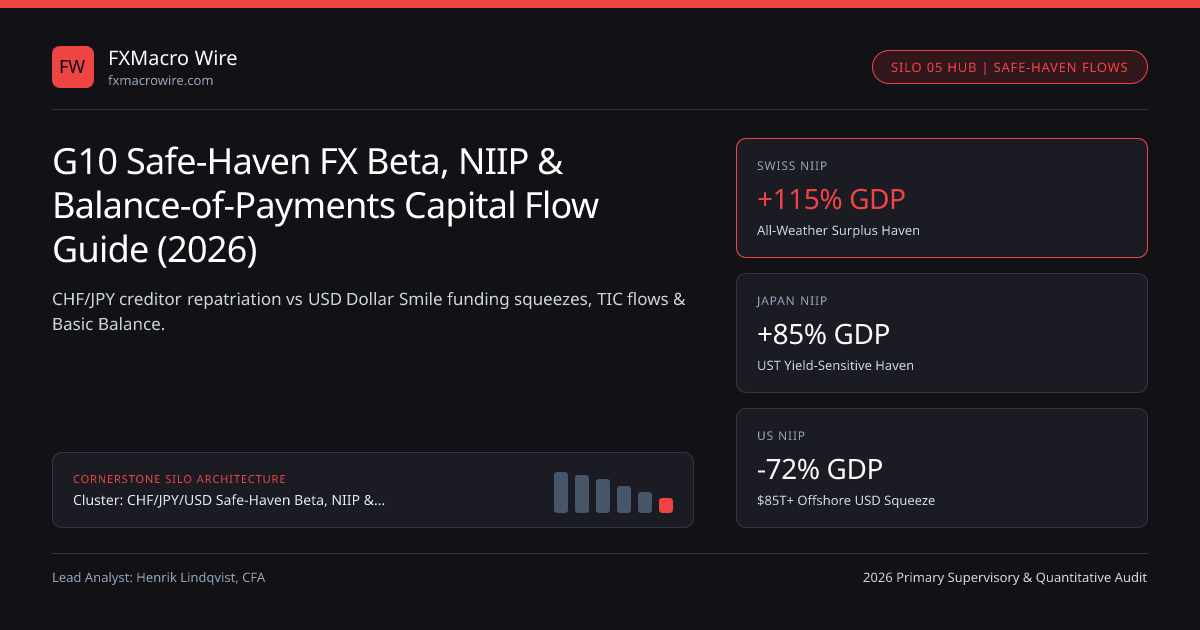
Across global macro foreign exchange, no structural puzzle confuses single-asset investors more frequently than safe-haven currency selection: why do Switzerland (USD/CHF & EUR/CHF, Net International Investment Position +115% of GDP), Japan (USD/JPY, NIIP +85% of GDP), and the United States (ICE US Dollar Index DXY, NIIP -72% of GDP—the world's largest net external debtor!) ALL rally during global equity panics, yet diverge violently from one another during stagflationary energy shocks or US Treasury yield selloffs?
This 2026 institutional pillar unifies all nineteen balance-of-payments, capital-flow, positioning, and regulatory-hedging frameworks across Silo 5 (CHF/JPY/USD Safe-Haven Beta, NIIP & Balance-of-Payments Cycles): from positive-NIIP creditor repatriation vs offshore USD debt short-covering to US Treasury TIC Form SLT portfolio decompositions, Broad Basic Balance (Current Account + Net FDI) anchors, month-end WMR 16:00 London equity FX rebalancing, Eurozone TARGET2 capital-flight gauges, and Solvency II 25% FX capital charges.
1. Two Distinct Safe-Haven Mechanisms: Creditor Repatriation (CHF/JPY) vs Funding-Debtor Squeeze (USD)#
Institutional FX desks supervised across European and global regulatory hubs (European Central Bank, FINMA Switzerland, BCBS / BIS, and BaFin, routing execution across Credit Suisse / UBS institutional desks, Blocksize Capital, and Bequant) never lump CHF, JPY, and USD into a single "risk-off" bucket:
- Net External Creditor Havens (CHF & JPY): Decades of cumulative current-account surpluses left Swiss and Japanese households, insurers, and corporations owning trillions more foreign assets than foreigners own inside Switzerland or Japan—analyzed in NIIP creditor repatriation in CHF and JPY vs the USD debtor! When VIX spikes, domestic investors unwind overseas exposure or raise FX hedge ratios, repatriating capital home—though structural shifts differentiate Switzerland’s +9.5% GDP pharmaceutical surplus from Japan’s digital/energy deficit and overseas FDI reinvestment.
- Global Funding Currency Squeeze (The Left Wing of the Dollar Smile): Despite running a -$21+ trillion negative NIIP, the United States issues the unit of account for >$16 trillion in offshore dollar loans and >$70 trillion in FX swaps! During global liquidity panics, non-US borrowers scramble to buy greenbacks to service dollar liabilities, powering the left wing of Stephen Jen's framework in the Dollar Smile across US exceptionalism and global funding stress and US exorbitant privilege and NIIP valuation cycles.
2. Balance-of-Payments Accounting: Broad Basic Balance, TIC Flows & Valuation Flip#
Headline quarterly current-account deficits routinely mislead macro novices unless paired with autonomous long-term capital flows and terms-of-trade regime filters:
- Broad Basic Balance (Current Account + Net FDI + Sticky Portfolio): Explains why countries funding a -2.5% CA deficit with +3.0% greenfield factories enjoy rising currencies, whereas twin-deficit sovereigns reliant on fickle foreign bondholders suffer violent betas—detailed in Broad Basic Balance as a G10 FX anchor, UK twin deficits and 31.4% foreign gilt share sterling beta, and US fiscal deficits vs private FX-hedged Treasury demand.
- Official Cross-Border Bond & Reserve Trackers: Separate hedged vs unhedged institutional flows using US Treasury TIC Form SLT cross-border portfolio decompositions, Eurozone TARGET2 central bank balance-sheet flight signals, Gulf petrodollar and sovereign wealth fund G10 FX recycling, and post-NIRP Eurozone bond repatriation and Bund yield support for EUR.
- The 2022–2026 Terms-of-Trade Safe-Haven Flip: Discover why imported LNG/oil shocks broke JPY's safe-haven correlation during 2022 while boosting USD and CHF in energy supply shocks and the terms-of-trade safe-haven flip.
| Safe-Haven / Flow Archetype | Representative Currency | Net International Investment Position | Primary Crisis Rally Mechanism | Achilles Heel / Failure Regime |
|---|---|---|---|---|
| Surplus + Low-Energy-Intensity Haven | Swiss Franc (CHF) — USDCHF-SNB | +105% to +120% of GDP | Pharma +9.5% CA surplus + European deposit flight | SNB rate cuts to 0.00% + active FX reserve buying |
| Carry-Funding Creditor Haven | Japanese Yen (JPY) — USDJPY-TONA | +80% to +90% of GDP (~$3.4T) | Global JPY carry short-squeeze when US yields drop! | Fails during oil/LNG shocks or rising US 10Y yields! |
| Global Reserve & Debt Unit Haven | US Dollar (USD) — DXY Index | -68% to -75% of GDP (-$21T) | $16T+ offshore USD debt & $70T FX swap short-cover | Soft-landing global synchronized PMI recovery (Smile trough) |
| Repatriating Reserve Bloc | Euro (EUR) — EURUSD-ESTR | +3% to +8% of GDP | Post-NIRP €4T bond repatriation + +2.5% CA surplus | TTF gas spikes or Eurozone sovereign spread fragmentation |
3. Master Balance-of-Payments & Safe-Haven Beta Decomposition Equation#
Institutional macro models express spot G10 currency returns as the sum of Broad Basic Balance autonomous flows, FX-unhedged portfolio reallocations, passive month-end equity hedge rebalancing, and state-contingent VIX / Rate-Vol safe-haven betas:
- NIIPChange = CurrentAccountFlow + [ ForeignAssets * RForeignFX - ForeignLiabilities * RDomestic ] [Valuation Dominance!]
- Worked Safe-Haven Regime Split During Two Distinct +12-Point VIX Shocks:
- 1. Deflationary Credit Shock (VIX +12 pts, US 10Y Yield -45 bps, Brent Crude -18%):
- USD/JPY = -0.35(+12) + 6.8(-0.45) = -4.20% - 3.06% = -7.26% violent JPY surge! EUR/CHF drops -2.9%!
- 2. Stagflationary Energy Shock (VIX +12 pts, US 10Y Yield +35 bps, Brent Crude +25%):
- DXY surges +4.1% on energy + rate advantage; USD/CHF dips -1.4% (CHF holds!); USD/JPY JUMPS +3.8% (JPY safe haven FAILS!)
4. Systematic Flow Signals: WMR Fixings, CFTC Positioning, M&A, Solvency II & Option Skew#
Beyond slow-moving quarterly BoP accounts, Silo 5 equips institutional execution desks with six high-frequency capital-flow engines:
- Calendar & Liquidity Pulses: Model passive pension equity hedge flows in month-end WMR 16:00 London Fix equity-FX rebalancing and broad risk-asset liquidity cycles in Global M2 money-supply impulses and AUD/NZD/CAD betas.
- Positioning & Derivatives Pricing: Separate fast-money trend followers from real-money hedgers in CFTC Traders in Financial Futures (TFF) Leveraged Funds vs Asset Managers and price crash protection via FX 25-delta risk reversals and butterfly volatility surfaces.
- Corporate & Regulatory Balance-Sheet Flows: Capture multi-billion-dollar cross-border deal flows in M&A deal-contingent FX forwards and mandatory European insurer hedging in Solvency II 25% FX capital charges.
5. Navigating the Silo 5 Institutional Research Suite#
Every spoke in this cluster pairs structural IMF Balance of Payments Manual (BPM6) accounting with actionable trading thresholds. Dive into all nineteen specialist guides via our safe-haven FX & capital-flow regimes hub, audit underlying exchange-rate series in FX datasets, and review cross-border data standards in our methodology documentation.
Frequently asked questions
Why is the US dollar a safe-haven currency despite America’s -$21 trillion negative NIIP?
Because over $16 trillion in non-US bank/corporate debt and >$70 trillion in off-balance-sheet FX swaps are denominated in US dollars; during global credit crunches, global borrowers must buy USD cash to roll maturing dollar liabilities.
Why did the Swiss franc outperform the Japanese yen so dramatically between 2021 and 2026?
Switzerland relies on domestic hydro and nuclear power alongside price-inelastic pharmaceutical exports (+9.5% GDP CA surplus) and proactive SNB FX sales, whereas fossil-fuel-importing Japan suffered massive LNG/crude import deficits while overseas FDI profits stayed reinvested abroad.
What is the "Broad Basic Balance" in institutional FX analysis?
Broad Basic Balance sums the Current Account plus Net Foreign Direct Investment (and often long-term unhedged bond flows), isolating sticky autonomous currency demand that does not flee overnight on minor rate shifts.
How do US equity bull markets affect month-end G10 FX flows at the 16:00 London WMR fix?
When S&P 500 market value rises +5% in a month, foreign pension funds maintaining fixed 50%-100% FX hedge ratios become under-hedged on their USD equity gains and must mechanically SELL USD at month-end.
Publication record
- Published
- 14 November 2026
- Updated
- 14 November 2026
- Author
- Henrik Lindqvist, CFA
- Review
- Review not recorded
- Automated fact check
- Passed in the stored pipeline record
- Source URLs
- 3 recorded
AI assistance recorded: anthropic/claude-opus-4.6. This field does not establish human review or source verification.
Academic & Institutional Attribution
Cite This Research & Embed Live Data Card
Standard academic & institutional research paper citation format.
Henrik Lindqvist, CFA. (2026, November 14). G10 Safe-Haven FX Beta, NIIP & Balance-of-Payments Capital Flow Guide (2026). FXMacro Wire. https://fxmacrowire.com/wire/safe-haven-fx-beta-niip-balance-of-payments-guideRelated Safe Haven Capital Flow Regimes & Institutional Briefings
Explore Safe Haven Capital Flow Regimes Hub (20) →Safe Haven Capital Flow Regimes
NIIP Creditor Repatriation (CHF & JPY) vs USD Debtor Safe-Haven MechanicsSafe Haven Capital Flow Regimes
The Dollar Smile Framework: US Exceptionalism vs Global Funding StressSafe Haven Capital Flow Regimes
US Treasury TIC Form SLT Flows: FX-Hedged vs Unhedged UST & Equity DemandSafe Haven Capital Flow Regimes
Broad Basic Balance (BBoP): Current Account + Net FDI as a G10 FX AnchorSafe Haven Capital Flow Regimes
Swiss Franc Real Safe-Haven Math: +9.5% Pharma Surplus, CPI Gap & EUR/CHFSafe Haven Capital Flow Regimes
Japan’s Structural Yen Drag: Digital Deficit, Energy Bill & Unrepatriated FDISafe Haven Capital Flow Regimes
Month-End WMR 16:00 London Fix: Equity-FX Hedge Rebalancing SignalsSafe Haven Capital Flow Regimes
Eurozone TARGET2 (T2) Balances: Reading Intra-Euro Capital Flight & EUR/USDG10 Central Bank Rate Divergence
EUR/USD Two-Year ESTR-SOFR OIS Spread Elasticity Across Macro RegimesMarket Insights
Nikkei 225 gains 0.53% as yen pressure and tech volatility shape Friday trade - ad-hoc-news.deG10 Central Bank Rate Divergence
ECB Transmission Protection Instrument, BTP-Bund Spreads & Euro FX RiskCross Border Payments
Bank of England, Singapore and Thailand Advance Cross-Border FX Settlement Ahead of 2028 Rollout - CoinGape
FXMacro Wire Data, Benchmarks & Contributor Records
CC BY 4.0 Open Data
Open Institutional Datasets (CSV / JSON) →
Download desk-compiled quantitative series & schemas.
2026 Reference Matrix
2026 Institutional Benchmarks & Thresholds →
Statutory capital, clearing, margin & rate conventions.
Editorial Records
Authors & Review Records →
View named contributors where those records are available.
Complete Index
Master Research & Dossier Archive →
Browse all published briefings by topic pillar & date.