
Safe Haven Capital Flow Regimes
The Dollar Smile Framework: US Exceptionalism vs Global Funding Stress
Formulated by currency economist Stephen Jen in 2001, the Dollar Smile explains why the greenback rallies at both extremes of the global macro spectrum—crushing peers during acute global recessions AND roaring higher during US productivity booms.
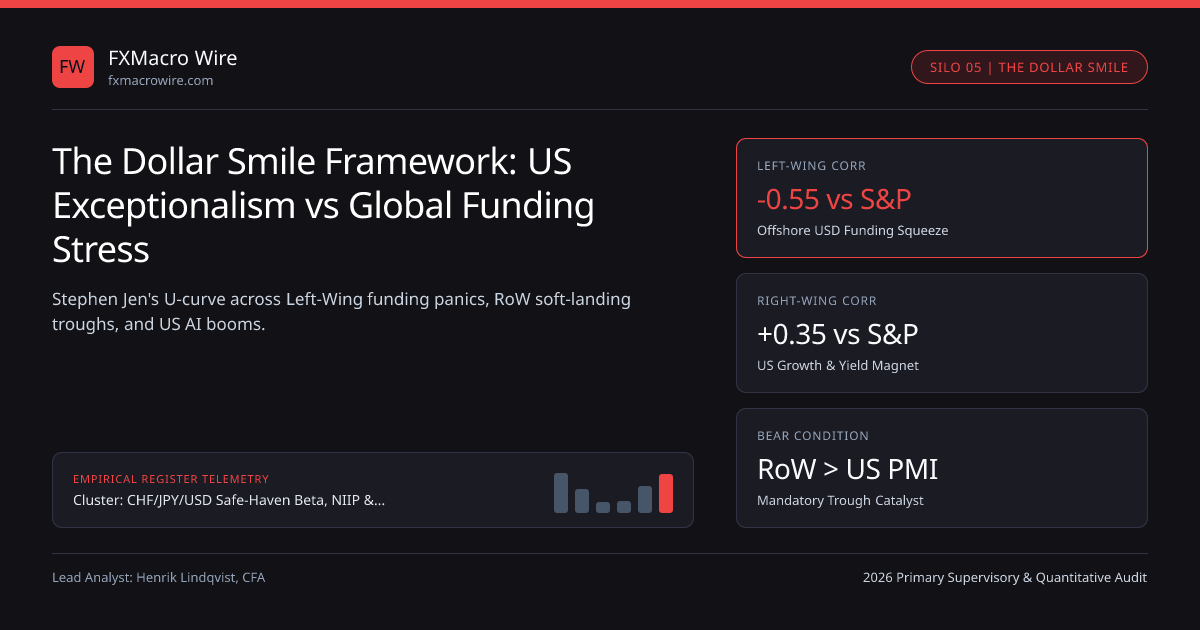
Why do simple linear regressions of FinDB's ICE US Dollar Index (DXY) (DXY 2026 Benchmark Standard) onto global GDP growth fail with an R-squared near zero? Because the relationship between the US dollar and global economic growth is profoundly NON-LINEAR—shaped like a U-curve ("The Dollar Smile"), first formalized by Morgan Stanley / Eurizon SLJ economist Stephen Jen in 2001!
Across every macro cycle of the past quarter-century, DXY and EUR/USD rotate systematically across three distinct quadrants:
- Left Wing of the Smile (Global Recession / Liquidity Crisis — USD RALLIES Hard!)
- Bottom Trough of the Smile (Synchronized Global Rest-of-World Recovery — USD FALLS!)
- Right Wing of the Smile (US Growth & Yield Exceptionalism — USD RALLIES Steadily!)
Deconstructing the Three Quadrants of the Dollar Smile#
Institutional macro pods regulated under ECB, BCBS / BIS, and BaFin standards (executing G10 spot and options across Blocksize Capital, Bequant, and CMC Central) map which currency pairs win inside each quadrant—because trading the Left Wing with Right-Wing pairs loses money!
Quadrant-by-Quadrant Macro Observables & Optimal Pair Selection!#
Notice the crucial nuance between the Left Wing and Right Wing: on the Left Wing (2008 GFC, March 2020 COVID), USD/JPY FALLS (yen beats dollar!), whereas on the Right Wing (2021–2024 US Tech/Fiscal Exceptionalism), USD/JPY SOARS +40%!
| Dollar Smile Regime | US vs RoW PMI & Yield Signal | Cross-Asset Fingerprint | Best USD Long / Short Expression |
|---|---|---|---|
| Left Wing (Risk-Off Squeeze) | Global PMIs <47; Fed slashing rates; 3M EUR/USD XCCY basis < -35 bps | S&P 500 down, UST 10Y yields down, VIX >28 | Long USD vs AUD, NZD, CAD, GBP, MXN (Avoid USD/JPY!) |
| Smile Trough (Soft Landing) | RoW Composite PMI > US ISM by +1.5 pts; Fed cutting toward neutral | Non-US equities outperform S&P 500; copper rallies | Short DXY: Buy EUR/USD, AUD/USD, KRW, BRL |
| Right Wing (US Exceptionalism) | US GDP/Productivity > Eurozone/Japan by +1.8%; US 2Y/10Y yields lead | Nasdaq / S&P 500 up, US real yields >1.8%, VIX <16 | Long USD/JPY, Short EUR/USD, Long USD/CHF |
| Left-to-Trough Inflection! | Heavy draws on Fed C7 Standing USD Swaps peak & roll over | XCCY basis heals rapidly; credit spreads peak | Flip from Long USD to Long AUD/USD & EM FX within 10 days! |
Quantitative Piecewise Non-Linear Dollar Smile Regression Model#
How do systematic FX quants encode the Dollar Smile mathematically so linear trend models don't whipsaw at transitions? By interacting US-minus-RoW Growth Surprises (G_Diff) with a Quadratic Global Risk Factor (Z_Stress^2):
- ZFinancialStresst = 0.40 * Z(VIX) + 0.35 * Z(USHYOAS) - 0.25 * Z(EURUSD3MXCCYBasis)
- Worked Regime Verification Across All Three Smile Zones:
- 1. Right Wing (US Growth - RoW = +2.0%, Rate Spread Change = +75 bps, Z_Stress = -0.5 [Calm]):
- E[ Delta DXY ] = +1.8(+2.0%) + 3.2(+0.75%) + 0 = +3.60% + 2.40% = +6.00% Right-Wing USD Bull!
- 2. Smile Trough (US Growth - RoW = -1.2% [Europe/China Stimulus!], Rate Spread = -50 bps, Z_Stress = 0.0):
- E[ Delta DXY ] = +1.8(-1.2%) + 3.2(-0.50%) + 0 = -2.16% - 1.60% = -3.76% Trough USD Bear!
- 3. Left Wing (Global Recession: US - RoW = 0.0%, Fed Cuts -125 bps, BUT Z_Stress = +2.8 SD!):
- E[ Delta DXY ] = 0 + 3.2(-1.25%) + 1.15(2.8^2) = -4.00% + 9.02% = +5.02% Left-Wing Funding Surge despite Fed cuts!!
Why "Fed Rate Cuts = Weak Dollar" Fails Half the Time!#
Look at the #1 analytical mistake Wall Street consensus makes at the start of every Federal Reserve easing cycle: forecasting a mechanical dollar bear market solely because the Fed is cutting!
- If the Fed cuts because global demand is cracking (Eurozone & Chinese PMIs falling even faster than US PMIs), you slide UP the Left Wing of the Dollar Smile (USD rallies!)!
- The Dollar ONLY enters the bearish Smile Trough when TWO conditions hold simultaneously: (1) the Fed eases without credit-spread contagion (US HY OAS < 400 bps), AND (2) Rest-of-World growth engines (Eurozone fiscal expansion or Chinese demand) accelerate ABOVE US growth!
Integrating Dollar Smile Signals With TIC Flows & Positioning#
Combine this Dollar Smile compass with our safe-haven FX & BoP hub guide, US TIC Form SLT equity vs hedged bond inflows, and CFTC TFF Asset Manager vs Leveraged Fund USD positioning to time regime inflections across our safe-haven FX & capital-flow regimes hub!
Frequently asked questions
Who created the Dollar Smile theory and when?
Currency economist Stephen Jen introduced the Dollar Smile framework at Morgan Stanley in 2001 to explain why the US dollar strengthened during both the late-1990s US productivity boom and the 2001 global downturn.
How does the correlation between the S&P 500 and DXY tell you which wing of the Dollar Smile is active?
On the Left Wing (global risk-off liquidity squeeze), DXY correlates negatively with the S&P 500 (~-0.55: stocks down, dollar up); on the Right Wing (US exceptionalism), DXY correlates positively (~+0.35: US stocks and dollar rise together!).
Why aren’t Federal Reserve interest-rate cuts enough by themselves to weaken the US dollar?
FX rates are relative: if the ECB, BoE, and EM central banks cut just as fast because foreign growth is weaker than US growth, or if global VIX stress rises, the economy stays on the Smile’s wings rather than entering the bearish trough.
Why does ICE DXY weight the Euro at 57.6%?
When six European legacy currencies merged into the Euro in 1999, their 1973 Bretton Woods weights were combined into a single 57.6% EUR weight—meaning Eurozone-vs-US growth divergence dominates DXY.
Publication record
- Published
- 13 November 2026
- Updated
- 14 November 2026
- Author
- Henrik Lindqvist, CFA
- Review
- Review not recorded
- Automated fact check
- Passed in the stored pipeline record
- Source URLs
- 3 recorded
AI assistance recorded: anthropic/claude-opus-4.6. This field does not establish human review or source verification.
Academic & Institutional Attribution
Cite This Research & Embed Live Data Card
Standard academic & institutional research paper citation format.
Henrik Lindqvist, CFA. (2026, November 14). The Dollar Smile Framework: US Exceptionalism vs Global Funding Stress. FXMacro Wire. https://fxmacrowire.com/wire/dollar-smile-us-exceptionalism-global-funding-stressRelated Safe Haven Capital Flow Regimes & Institutional Briefings
Explore Safe Haven Capital Flow Regimes Hub (20) →Safe Haven Capital Flow Regimes
G10 Safe-Haven FX Beta, NIIP & Balance-of-Payments Capital Flow Guide (2026)Safe Haven Capital Flow Regimes
US Treasury TIC Form SLT Flows: FX-Hedged vs Unhedged UST & Equity DemandSafe Haven Capital Flow Regimes
Broad Basic Balance (BBoP): Current Account + Net FDI as a G10 FX AnchorSafe Haven Capital Flow Regimes
Swiss Franc Real Safe-Haven Math: +9.5% Pharma Surplus, CPI Gap & EUR/CHFSafe Haven Capital Flow Regimes
Japan’s Structural Yen Drag: Digital Deficit, Energy Bill & Unrepatriated FDISafe Haven Capital Flow Regimes
Month-End WMR 16:00 London Fix: Equity-FX Hedge Rebalancing SignalsSafe Haven Capital Flow Regimes
Eurozone TARGET2 (T2) Balances: Reading Intra-Euro Capital Flight & EUR/USDSafe Haven Capital Flow Regimes
US Exorbitant Privilege & NIIP Valuation Effects Across Dollar CyclesMarket Insights
The science and practice of monetary policy communication - the European Central Bank experienceMarket Insights
Cash and the digital euro - two sides of the same coinRegulatory Compliance
Foundations for innovative and resilient capital marketsMonetary Policy
Why Bank of England's Lombardelli Thinks a December Rate Rise is in Play - Pound Sterling Live
FXMacro Wire Data, Benchmarks & Contributor Records
CC BY 4.0 Open Data
Open Institutional Datasets (CSV / JSON) →
Download desk-compiled quantitative series & schemas.
2026 Reference Matrix
2026 Institutional Benchmarks & Thresholds →
Statutory capital, clearing, margin & rate conventions.
Editorial Records
Authors & Review Records →
View named contributors where those records are available.
Complete Index
Master Research & Dossier Archive →
Browse all published briefings by topic pillar & date.