
Safe Haven Capital Flow Regimes
Cross-Border M&A Deal-Contingent FX Forwards: Pricing Regulatory Tail Risk
A single $30 billion cross-border cash acquisition injects unhedged, price-insensitive spot FX demand rivaling a central bank intervention—and Wall Street’s specialized Deal-Contingent FX Forward (DCF) desks warehouse the binary antitrust cancellation risk.
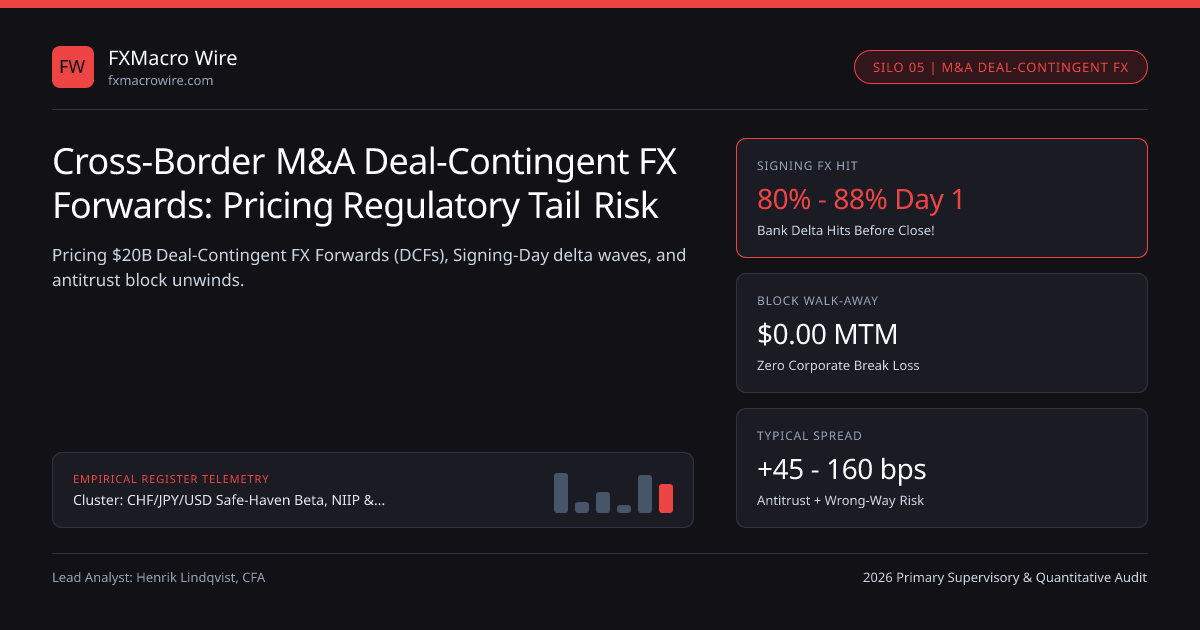
When a Japanese pharmaceutical or technology conglomerate announces a $28 billion all-cash acquisition of a British or American firm (or a US private-equity consortium bids £18 billion cash for a FTSE 100 company), spot GBP/USD or USD/JPY regularly jumps 80 to 160 pips within minutes of the Bloomberg headline!
Why does cross-border M&A move spot FX far more aggressively dollar-for-dollar than sovereign bond flows (TIC hedged bond flows)? And how can a corporate CFO hedge €20 billion of exchange-rate risk on Signing Day when US FTC, European Commission DG COMP, or UK CMA antitrust regulators might BLOCK the deal 9 months later—leaving a standard FX forward with a catastrophic $1.5 billion mark-to-market loss on a cancelled deal? Enter one of investment banking's highest-margin bespoke derivatives: the Deal-Contingent FX Forward (DCF)!
Cash vs Stock M&A Deals & The Acquirer's Cruel Hedging Dilemma!#
Institutional M&A advisory and G10 exotic FX desks supervised under ECB, BaFin, AMF France, and FINMA standards (alongside execution ecosystems including Credit Suisse / UBS, Blocksize Capital, and CMC Central) start with two cardinal screening rules:
- Only CASH Consideration Moves FX (All-Stock Share Swaps = Zero FX Trade!): If a European buyer pays 100% in its own shares, zero euros are sold to buy dollars (unless foreign target shareholders later liquidate received shares!). An all-cash cross-border deal requires 100% physical spot/forward conversion (Broad Basic Balance Cash FDI)!
- Why Vanilla FX Forwards & Vanilla FX Options Both Fail the CFO:
- Vanilla Outright FX Forward: Zero upfront premium, but if antitrust blocks the deal after target currency drops -8%, the corporate owes $1.6 billion cash break loss on a $20B hedge!
- Vanilla Call Option: Caps downside, but buying 9-month ATM options on $20B costs 3.2%–4.5% upfront ($640M–$900M sunk cash) whether the deal closes or fails!
Comparing Corporate Cross-Border M&A Hedging Structures#
Look closely at Step 3 above—it reveals WHEN a $20 billion M&A deal actually moves EUR/USD or GBP/USD! Tourists wait 9 months for "Deal Closing Day"—completely missing the move because the Deal-Contingent Bank Desk already bought 80%–88% of the $20 billion ($16B–$17.6B!) within 48 hours of Signing Day!
| M&A FX Hedge Instrument | Upfront Cash Cost | Cost if Antitrust Blocks Deal | When Market Spot FX Impact Hits | Bank Risk-Management Challenge |
|---|---|---|---|---|
| Unhedged Until Closing | $0 | $0 | 100% at Month 9 Closing (WMR Fix wave) | Acquirer bears 100% uncapped acquisition budget risk |
| Vanilla Outright Forward | $0 | Uncapped MTM Loss (±$1B+!) | 100% on Signing Day | Zero bank exotic risk; massive corporate career risk |
| Vanilla FX Call Option | 3.0% – 4.5% Sunk ($600M+!) | Sunk premium lost | ~50% delta on Day 1; gamma adjusts daily | Standard liquid interbank vega/gamma book |
| Deal-Contingent Forward (DCF) | $0 Upfront! | $0.00 Walk-Away! | ~80%–88% on Signing Day; +12% on FTC nod! | Unhedgeable Correlation(Deal Block, Spot FX)! |
Quantitative Deal-Contingent FX Forward Pricing & "Wrong-Way Correlation" Math!#
How does a Tier-1 M&A derivatives desk price the Deal-Contingent Forward Adjustment (Spread_DCF) added onto the vanilla 9-month forward rate F9M? Suppose the antitrust merger-arbitrage desk estimates an **18% probability (pFail = 0.18)** that regulators block the deal (so p_Close = 0.82):
- If the bank simply hedged 82% ($16.4B) on Day 1 and Deal-Failure were uncorrelated with FX, expected break loss would be modest—EXCEPT the bank only loses money if the deal fails WHEN the target currency has crashed (or surged against the bank's hedge!)!
- Worse still: if a global crisis erupts (VIX = 35), BOTH financing/regulatory breaks rise AND safe-haven currencies (USD, CHF, JPY) gap +6% simultaneously ("Wrong-Way Correlation" rho_{Fail,FX}):
- DCFForwardStrike = FVanillaT + ( ExpectedBreakCost + CapitalChargeBuffer ) / p_Close
- Worked $10.0 Billion EUR->USD Cash Acquisition DCF Pricing (Vanilla 9M EUR/USD Fwd = 1.1000, Vol = 7.5%):
- 1. Merger-Arb Implied Regulatory Block Probability (from target equity deal spread) = pFail = 15.0% (pClose = 85.0%)
- 2. Expected Conditional FX Unwind Loss + Wrong-Way Risk Buffer = 0.85% of Notional ($85M expected tail reserve)
- 3. DCF Spread Charged Only on Closing = 0.85% / 0.85 = +1.00% (+110 pips worse than Vanilla Forward -> Strike = 1.0890!)
- 4. Day-1 Bank Spot/Fwd Execution: Desk sells €7.7B / buys $8.5B immediately over Days 1-3 via TWAP!
Event-Driven FX Alpha: Trading Surprise Antitrust Blocks & UK Takeover Code Rules!#
Look at Bar 4 in the chart above—it is one of the sharpest event-driven intraday trades in institutional FX:
- Suppose three syndicate banks are carrying $12 billion of long GBP/USD delta hedging a US buyer's Deal-Contingent Forward for a UK FTSE target (mandatory under UK Takeover Panel "Cash Confirmation / Certain Funds" rules!).
- At 11:00 London time, the UK Competition and Markets Authority (CMA) or US DOJ announces a surprise court injunction blocking the merger!
- Within seconds, p_Close plunges from 85% to 15%—forcing the three syndicate banks' exotic FX desks to market-sell £6B–£8B of GBP/USD immediately to flatten their orphaned DCF hedges! Fast macro desks monitoring merger-arb court dockets ride the resulting -90 pip sterling air-pocket in real time!
Strict Legal Carve-Out: Why DCFs Never Cover "Buyer's Remorse"!#
To prevent catastrophic moral hazard (where a buyer intentionally sabotages its own acquisition just to walk away from an underwater $2B FX forward!), ISDA Deal-Contingent confirmations strictly limit zero-cost cancellation to objective third-party conditions precedent (antitrust prohibition, CFIUS national-security veto, or target shareholder rejection)—connecting corporate M&A microstructure directly to our safe-haven FX & BoP hub guide, Broad Basic Balance FDI flows, and safe-haven FX & capital-flow regimes hub!
Frequently asked questions
Why can’t a corporation cancel a Deal-Contingent Forward simply because target earnings deteriorated?
Allowing discretionary walk-aways would create extreme moral hazard whenever FX moves against the hedge; DCF contracts strictly restrict zero-cost termination to objective third-party blocks such as antitrust vetoes or failed target shareholder votes.
How do bank DCF desks hedge the binary risk of an antitrust merger block?
Banks syndicate $10B+ deals across 3-5 lead M&A lenders, dynamically delta-hedge (1 - p_Fail) in FX markets, and occasionally short the target-acquirer equity merger-arb spread as a partial proxy hedge against regulatory failure.
Why do UK public M&A acquisitions generate particularly heavy upfront GBP hedging flows?
Under Rule 2.7 and Rule 24.8 of the UK City Code on Takeovers and Mergers, a cash bidder’s financial adviser must legally guarantee "Certain Funds" in sterling upon formal offer announcement—compelling immediate FX hedging.
What is a Deal-Contingent Cross-Currency Swap?
Used when an acquirer plans to issue bonds in its home currency (e.g., EUR) and swap proceeds into target currency (USD) for 5-10 years upon deal closing—locking in both spot FX and the 5-year cross-currency basis conditionally.
Publication record
- Published
- 13 November 2026
- Updated
- 14 November 2026
- Author
- Henrik Lindqvist, CFA
- Review
- Review not recorded
- Automated fact check
- Passed in the stored pipeline record
- Source URLs
- 3 recorded
AI assistance recorded: anthropic/claude-opus-4.6. This field does not establish human review or source verification.
Academic & Institutional Attribution
Cite This Research & Embed Live Data Card
Standard academic & institutional research paper citation format.
Henrik Lindqvist, CFA. (2026, November 14). Cross-Border M&A Deal-Contingent FX Forwards: Pricing Regulatory Tail Risk. FXMacro Wire. https://fxmacrowire.com/wire/cross-border-ma-deal-contingent-fx-forward-hedgingRelated Safe Haven Capital Flow Regimes & Institutional Briefings
Explore Safe Haven Capital Flow Regimes Hub (20) →Safe Haven Capital Flow Regimes
G10 Safe-Haven FX Beta, NIIP & Balance-of-Payments Capital Flow Guide (2026)Safe Haven Capital Flow Regimes
Solvency II 25% FX Capital Charge: Why European Insurers Hedge 95% of USDSafe Haven Capital Flow Regimes
FX 25-Delta Risk Reversals & Butterflies: Reading Safe-Haven Tail SkewSafe Haven Capital Flow Regimes
Sovereign Wealth Fund & Petrodollar Recycling: ADIA, PIF, QIA & NBIM FX FlowsSafe Haven Capital Flow Regimes
Post-NIRP Eurozone Bond Repatriation: Positive Bund Yields & Structural EUR SupportSafe Haven Capital Flow Regimes
US Fiscal Deficits, Term Premium & Private FX-Hedged UST Demand: Dollar EndgameSafe Haven Capital Flow Regimes
NIIP Creditor Repatriation (CHF & JPY) vs USD Debtor Safe-Haven MechanicsSafe Haven Capital Flow Regimes
The Dollar Smile Framework: US Exceptionalism vs Global Funding StressMonetary Policy
Japan Spent Record $50 Billion in Single Day to Bolster YenMonetary Policy
A Democratic Senate majority would be the broadest check yet on the president’s efforts to control the central bankRegulatory Compliance
Nigeria sets new crypto licensing rules, bans algorithmic stablecoinsForeign Exchange
China Forex Reserves Edged Up in October
FXMacro Wire Data, Benchmarks & Contributor Records
CC BY 4.0 Open Data
Open Institutional Datasets (CSV / JSON) →
Download desk-compiled quantitative series & schemas.
2026 Reference Matrix
2026 Institutional Benchmarks & Thresholds →
Statutory capital, clearing, margin & rate conventions.
Editorial Records
Authors & Review Records →
View named contributors where those records are available.
Complete Index
Master Research & Dossier Archive →
Browse all published briefings by topic pillar & date.