
Safe Haven Capital Flow Regimes
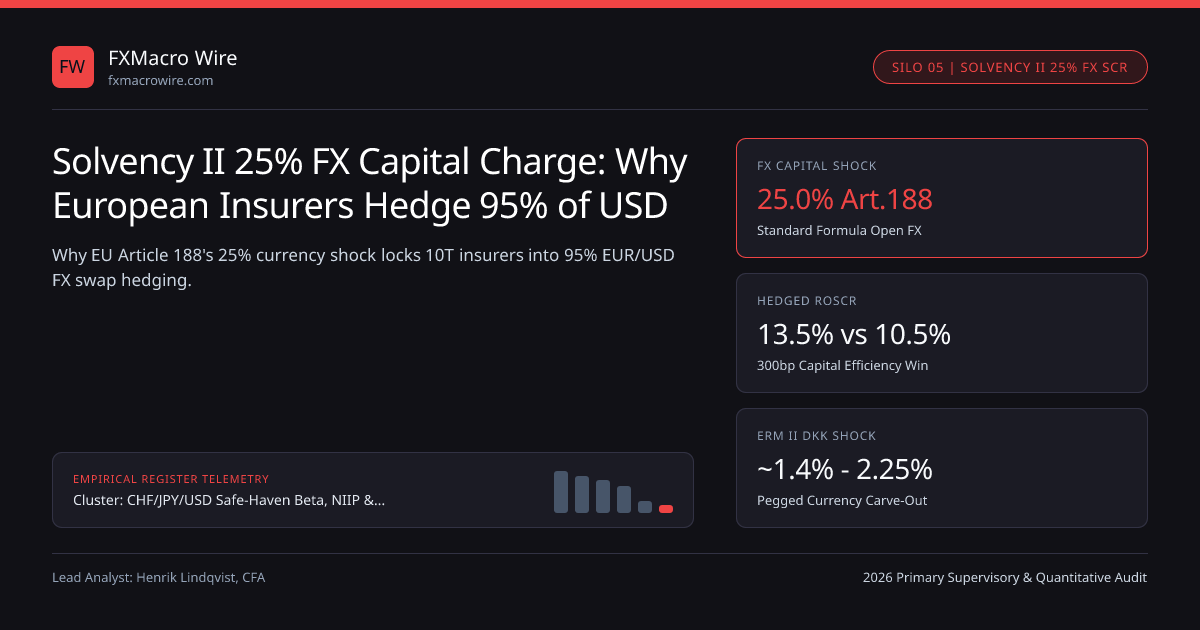
Solvency II 25% FX Capital Charge: Why European Insurers Hedge 95% of USD
Under Article 188 of the European Union’s Solvency II prudential regime, unhedged foreign-currency assets trigger a punitive 25% instantaneous capital charge—explaining why €10 trillion European insurers roll >$1.5 trillion of EUR/USD FX swaps regardless of hedging cost.
Why do continental Europe's €10+ trillion insurance giants (Allianz, AXA, Generali, Zurich EU, NN Group—supervised by BaFin Germany, ACPR France, CONSOB / IVASS Italy, DNB Netherlands, and NBB Belgium under EIOPA Solvency II) persistently hedge 92% to 98% of their US corporate bond and US Treasury portfolios, even during periods when inverted yield curves make 3-month EUR/USD FX Swap Hedges cost -180 to -220 bps per year?
Compare that to Japanese life insurers (who drop FX hedge ratios to 45% when hedging gets expensive!) or Korean/Australian pension funds (who hold 60%–90% of US assets unhedged!). What forces European insurers to behave as price-insensitive buyers of EUR/USD forwards across G10 Cross-Currency Swap Curves? Article 188 of Commission Delegated Regulation (EU) 2015/35: the Solvency II Standard Formula 25.0% Currency Risk Solvency Capital Requirement (SCR)!
Regulatory Mathematics of Solvency II Article 188 (25% Currency Shock vs ERM II Exceptions!)#
Walk onto the Asset-Liability Management (ALM) desk of a Munich or Paris life insurer executing FX overlays via institutional liquidity venues (Blocksize Capital, Boursorama, Bolero) and compare the Solvency Capital Requirement (SCR) of buying a 10-year A-rated US Corporate Bond FX-unhedged versus FX-hedged:
- Credit Spread SCR on a 10Y A-Rated Bond: Roughly ~8.5% to 10.5% of market value.
- Unhedged USD Currency Risk SCR (Article 188): An immediate 25.0% instantaneous shock to net open USD exposure! Even after Solvency II's Market Risk correlation matrix diversification credit (~0.25 correlation between interest/spread and currency modules), leaving the USD bond unhedged MORE THAN DOUBLES regulatory capital consumption (~10% -> ~24% SCR!)—destroying Return on Solvency Capital (RoSCR)!
- Crucial Statutory Carve-Out (ERM II Pegged Currencies!): Under EIOPA Implementing Technical Standards, currencies formally pegged to the Euro inside ERM II enjoy drastically lower shocks—specifically 0.39% to 2.25% for Danish krone (EUR/DKK)! That tiny ~1.4%–2.25% DKK SCR vs 25.0% USD SCR is why European insurers gorge on Danish AAA callable mortgage bonds!
Global Regulatory Comparison: Why Europe Hedges 95% While Asia & Pensions Float!#
Look at how divergent prudential solvency formulas across Frankfurt, Tokyo, Taipei, and Sydney create structurally different G10 spot and FX swap market behaviors:
| Institutional Investor Bloc | Governing Capital Regime | Unhedged USD FX Capital Charge | Observed Fixed-Income Hedge Ratio | Macro FX Market Footprint |
|---|---|---|---|---|
| Eurozone Insurers (€10T+) | EU Solvency II (Art. 188) — ECB / EIOPA | 25.0% Standard Formula (Internal Models ~15%-20%) | 92% – 98% Hedged! | Price-insensitive structural payers of EUR/USD XCCY basis |
| Swiss Insurers (CHF 750B) | Swiss Solvency Test (SST) — FINMA | 99% Expected Shortfall (~14%-18% FX VaR) | 85% – 92% Hedged | Structural sellers of USD/CHF & EUR/CHF 3M forwards |
| Japanese Lifers (¥390T) | J-ICS / Economic Solvency (FSA Japan) | Lower risk weight + domestic accounting buffers | 42% – 65% Dynamic! | Cut hedges when SOFR-TONA >4%; add hedges when <2.75%! |
| EU / Dutch Pensions (IORP II) | FTK (DNB) / National Funding Ratios | Funding-ratio buffer (lower on equities) | Bonds ~85% / Equities ~35%-55% | Drive month-end WMR 16:00 Fix (WMR rebalancing)! |
Quantitative Return-on-Solvency-Capital (RoSCR) Optimization Proof!#
Why wouldn't a French insurer leave US bonds unhedged to save 177 bps/yr of forward hedge cost? Compute Net Spread Return Divided by Solvency Capital Required (RoSCR) at a 10% Cost of Insurer Tier-1 Equity Capital:
- RoSCRHedged = ( NetHedgedEURYield - y10YBundRiskFree ) / SCRCreditSpreadOnly
- RoSCRUnhedged = ( y10YUSDCorp - E[USDDepr] - y10YBund ) / sqrt( SCRSpread^2 + SCRFX25Pct^2 + 20.25SCRSpread*SCRFX )
- Worked €100M US Single-A Corporate Bond Allocation (yUSD = 5.35%, yBund = 2.30%, Hedge Cost = 1.77%, SCR_Spread = 9.5%):
- 1. 100% FX-Hedged: Net EUR Yield = 5.35% - 1.77% = 3.58% (+128 bps excess over Bund); SCR = 9.5% -> RoSCR = 1.28% / 9.5% = 13.47%!!
- 2. 0% Unhedged (Assuming 0% expected FX drift): Excess over Bund = +305 bps, BUT Combined SCR jumps to 29.0%!
- > Unhedged RoSCR = 3.05% / 29.0% = 10.52% (Worse capital efficiency + massive quarterly solvency ratio volatility!)

The Hidden Liquidity Trap: Variation Margin (VM) Calls When EUR/USD Plunges!#
Even though a 100% FX-hedged US bond book has zero economic FX P&L, notice the acute cash-liquidity mismatch under EMIR / UMR daily Variation Margin CSAs:
- Suppose EUR/USD plunges -10% (from 1.12 to 1.01) during a global crisis (Left-Wing Dollar Smile)!
- On paper, the insurer's $50B US bond portfolio gained +€5B in EUR value—but those bonds aren't sold! Meanwhile, its -$50B short USD FX forward hedge lost -€5B, triggering €5.0 BILLION OF MANDATORY NEXT-DAY CASH EURO VARIATION MARGIN CALLS to counterparty banks! Consequently, European insurers now maintain dedicated overnight €STR repo lines and liquid Bund buffers (€STR liquidity) specifically to feed FX hedge CSA calls!
Connecting Solvency II to Post-NIRP Euro Repatriation#
Notice what happens when Hedged US IG Yield (3.58%) drops BELOW Domestic Euro IG Yield (3.65%): European insurers simply stop rolling maturing US bonds and bring capital home into Euro credit—linking Article 188 directly to our safe-haven FX & BoP hub guide, post-NIRP Eurozone bond repatriation, and safe-haven FX & capital-flow regimes hub!
Frequently asked questions
Does the 2026 EU Solvency II Review reduce the 25% Currency Risk capital charge?
While the EU Solvency II Review introduced lower capital charges for Long-Term Equity Investments (LTEI, 22%) and recalibrated interest-rate risk shocks, the Standard Formula Article 188 25% foreign-exchange shock remained intact.
Can large European insurance groups get lower than a 25% FX charge using Internal Models?
Yes: BaFin- or ACPR-approved Partial or Full Internal Models calibrate 1-year 99.5% VaR on historical pair volatility (often ~14%-19% for EUR/USD vs 25% Standard Formula), which is still far too high to leave bonds unhedged.
Why do European insurers hedge less of their US equity sleeve (~40%-60%) than their US bond sleeve (~95%)?
Equities already carry a 39%-49% Solvency II Equity SCR where USD’s negative risk-off correlation with S&P 500 lowers total USD-in-EUR equity volatility in Internal Models—whereas bond yield spreads are only 120 bps and get swamped by FX vol.
How does European insurer hedging affect the EUR/USD cross-currency basis?
Because European insurers collectively roll >$1.5T of Buy-Sell EUR/USD FX swaps (borrowing synthetic USD against EUR), their structural demand keeps the EUR/USD XCCY basis moderately negative (~-10 to -25 bps), especially across year-end turns.
Publication record
- Published
- 13 November 2026
- Updated
- 14 November 2026
- Author
- Henrik Lindqvist, CFA
- Review
- Review not recorded
- Automated fact check
- Passed in the stored pipeline record
- Source URLs
- 3 recorded
AI assistance recorded: anthropic/claude-opus-4.6. This field does not establish human review or source verification.
Academic & Institutional Attribution
Cite This Research & Embed Live Data Card
Standard academic & institutional research paper citation format.
Henrik Lindqvist, CFA. (2026, November 14). Solvency II 25% FX Capital Charge: Why European Insurers Hedge 95% of USD. FXMacro Wire. https://fxmacrowire.com/wire/solvency-ii-25pct-fx-capital-charge-insurer-hedgingRelated Safe Haven Capital Flow Regimes & Institutional Briefings
Explore Safe Haven Capital Flow Regimes Hub (20) →Safe Haven Capital Flow Regimes
G10 Safe-Haven FX Beta, NIIP & Balance-of-Payments Capital Flow Guide (2026)Safe Haven Capital Flow Regimes
FX 25-Delta Risk Reversals & Butterflies: Reading Safe-Haven Tail SkewSafe Haven Capital Flow Regimes
Sovereign Wealth Fund & Petrodollar Recycling: ADIA, PIF, QIA & NBIM FX FlowsSafe Haven Capital Flow Regimes
Post-NIRP Eurozone Bond Repatriation: Positive Bund Yields & Structural EUR SupportSafe Haven Capital Flow Regimes
US Fiscal Deficits, Term Premium & Private FX-Hedged UST Demand: Dollar EndgameSafe Haven Capital Flow Regimes
NIIP Creditor Repatriation (CHF & JPY) vs USD Debtor Safe-Haven MechanicsSafe Haven Capital Flow Regimes
The Dollar Smile Framework: US Exceptionalism vs Global Funding StressSafe Haven Capital Flow Regimes
US Treasury TIC Form SLT Flows: FX-Hedged vs Unhedged UST & Equity DemandMonetary Policy
A Democratic Senate majority would be the broadest check yet on the president’s efforts to control the central bankRegulatory Compliance
Nigeria sets new crypto licensing rules, bans algorithmic stablecoinsForeign Exchange
China Forex Reserves Edged Up in OctoberMonetary Policy
Waller, The Signaling Value of the Summary of Economic Projections
FXMacro Wire Data, Benchmarks & Contributor Records
CC BY 4.0 Open Data
Open Institutional Datasets (CSV / JSON) →
Download desk-compiled quantitative series & schemas.
2026 Reference Matrix
2026 Institutional Benchmarks & Thresholds →
Statutory capital, clearing, margin & rate conventions.
Editorial Records
Authors & Review Records →
View named contributors where those records are available.
Complete Index
Master Research & Dossier Archive →
Browse all published briefings by topic pillar & date.