
Cross-Currency Swap Basis, Fed Swap Lines & Global Dollar Funding Guide (2026)
Global non-US banks, insurers, and asset managers roll over tens of trillions in synthetic US dollar funding through OTC foreign exchange swaps and cross-currency basis markets anchored by Federal Reserve central bank swap lines.
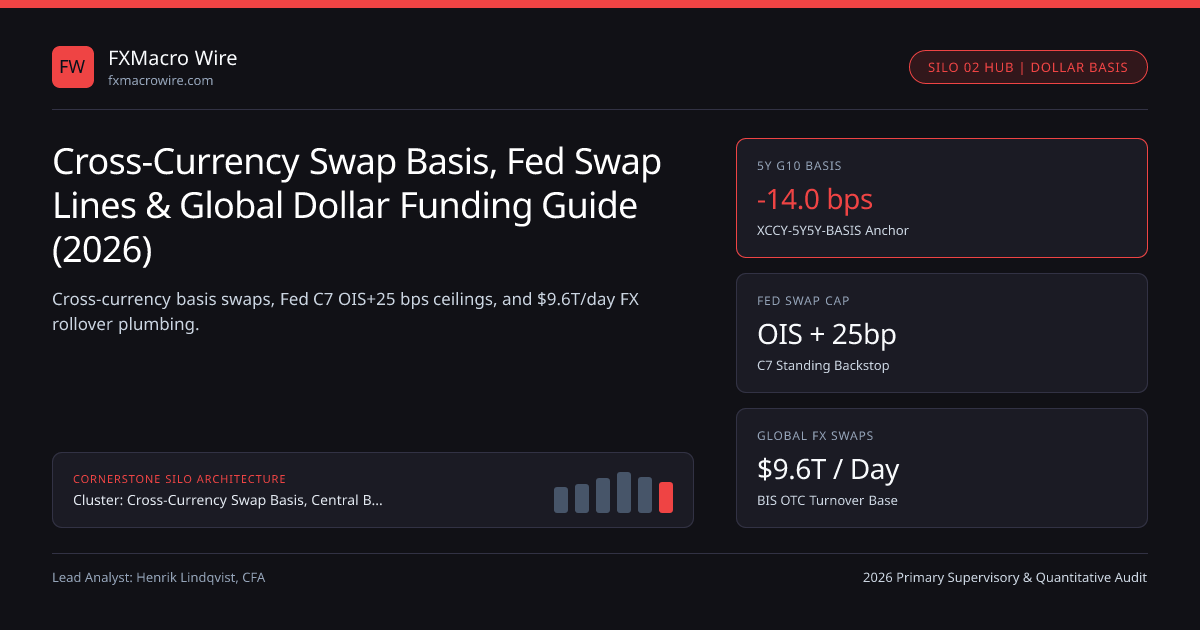
Global non-US commercial banks, life insurers, and sovereign asset managers roll over more than $65 trillion in unrecorded off-balance-sheet dollar payment obligations through foreign exchange swaps, outright forwards, and cross-currency basis swaps—anchored in 2026 by a -14.0 bps G10 5-year benchmark basis (XCCY-5Y5Y-BASIS), daily OTC FX volume averaging $9.6 trillion (BIS-FX-SWAPS-96T), and the Federal Reserve's OIS + 25 bps central bank liquidity ceiling (FED-CENTRAL-SWAPS). Whenever offshore dollar demand outstrips Global Systemically Important Bank (G-SIB) balance-sheet intermediation capacity, Covered Interest Parity (CIP) breaks open, transforming short-dated FX swap points into the fastest transmission channel of global financial stress.
Structural Mechanics of Synthetic Dollar Funding and Covered Interest Parity#
In textbook frictionless finance, borrowing euros or yen onshore and swapping them into US dollars via an FX swap should cost identically to borrowing unsecured or repo dollars directly in New York. Since the 2008 financial crisis and subsequent Basel III leverage-ratio reforms, however, a persistent cross-currency basis (b_t) has separated synthetic dollar rates from cash SOFR funding.
Because European, Japanese, Australian, and Canadian institutional investors hold multi-trillion-dollar portfolios of US Treasuries, agency MBS, and corporate credit exceeding their domestic USD deposit bases, they continuously pay a structural scarcity premium to swap local currency into dollars. Dealer desks at G-SIBs intermediate this imbalance up until regulatory balance-sheet constraints—tracked in our spoke analyses on Covered Interest Parity Basel III leverage shadow costs and EUR/USD 3-month XCCY basis G-SIB turn window-dressing—force swap spreads wider over quarter-end and year-end reporting snapshots.
Short-End FX Swaps vs Long-End Cross-Currency Basis Curves#
Institutional funding desks segment the cross-currency basis surface into two distinct maturities driven by completely different clientele:
- 1-Week to 3-Month FX Swaps: Dominated by life-insurer rolling currency hedges, money-market fund (MMF) Yankee CD/CP arbitrage, and commercial bank liquidity coverage ratio (LCR) buffers. Explored in Yankee CD and commercial paper FX swap funding spreads and US Treasury TGA rebuilds and ON RRP drain effects, front-end basis reacts violently to reserve drainage and G-SIB regulatory reporting dates.
- 5-Year to 10-Year Mark-to-Market Resetting XCCY Swaps: Governed by cross-border corporate bond issuance ("Yankee," "Reverse Yankee," "Kangaroo," and "Maple" bonds) alongside bank asset-swap books. Detailed in 5-year G10 XCCY basis and Yankee bond issuance arbitrage and SOFR-ESTR mark-to-market resetting XCCY swap conventions, when the 5-year EUR/USD basis widens beyond -22 bps, US investment-grade corporates issue euro-denominated Reverse Yankee bonds and swap proceeds back into cheap synthetic dollars, capping basis widening.
Supervisory authorities including the Basel Committee on Banking Supervision (BCBS), European Central Bank, FINMA Switzerland, and BaFin Germany monitor currency-mismatch maturity ladders across dealer and buy-side entities—from legacy lessons around Credit Suisse Group AG dollar liquidity outflows to European treasury operations at Bank Gospodarstwa Krajowego (BGK) and Boursorama.
| Funding Corridor & Benchmark | 2026 Non-Turn Basis | Primary Structural Payer of USD | Natural Arbitrage Receiver of USD | Central Bank Backstop Line |
|---|---|---|---|---|
EUR/USD 3M / 5Y (EURUSD-ESTR-SOFR) | -14.2 bps / -14.0 bps | Eurozone insurers & asset managers | US Reverse-Yankee issuers & prime MMFs | ECB 7-day USD swap (SOFR + 25 bps) |
USD/JPY 3M / 5Y (USDJPY-CARRY-TONA) | -26.5 bps / -34.0 bps | Japanese megabanks & Trust accounts | Foreign T-Bill XCCY asset-swappers | Bank of Japan weekly USD liquidity ops |
GBP/USD 3M / 5Y (GBPUSD-SONIA-BOE) | -6.8 bps / -8.5 bps | UK LDI pension global equity hedges | UK Gilts repo / Yankee bank issuers | Bank of England standing C7 USD facility |
USD/CHF 3M / 5Y (USDCHF-SARON-SNB) | -11.5 bps / -13.0 bps | Swiss wealth & private bank books | FINMA tier-1 liquidity buffers | SNB weekly 7-day USD repo-swap tender |
AUD/USD 5Y (XCCY-5Y5Y-BASIS) | +12.5 bps (positive!) | Australian Big-4 offshore USD bond issuers | Superannuation funds hedging US equities | RBA bilateral swap / NY Fed FIMA repo |
Quantitative Decomposition of Synthetic USD Borrowing Cost#
To evaluate whether borrowing foreign currency onshore and swapping into dollars beats direct SOFR issuance, treasury desks decompose the annualized FX swap-implied dollar rate (r^{USD}_{synthetic}) into the foreign risk-free rate, the OIS rate differential, and the cross-currency basis (b_{tau}):
- r^{USD}{synthetic} = r^{USD}{SOFR} - b{tau} (where negative b{tau} increases synthetic USD cost!)
- Ceiling Condition: r^{USD}{synthetic} <= r^{USD}{SOFR} + 0.25% + Spread{collateralhaircut}
- Worked 3-Month (tau = 0.25 yr) EUR/USD Synthetic Dollar Funding Audit:
- Spot EUR/USD S_t = 1.0850, 3M SOFR OIS = 3.85%, 3M ESTR OIS = 2.15%, 3M EUR/USD XCCY Basis b = -0.18% (-18 bps)
- Synthetic USD Cost = 3.85% - (-0.18%) = 4.03% annualized (18 bps premium over onshore SOFR repo)
- 3M Forward Points = 1.0850 * [ (1 + 0.03850.25) / (1 + (0.0215 - 0.0018)0.25) - 1 ] = +0.00508 (+50.84 pips)
- If acute stress pushes b -> -0.45% (4.30% implied USD), Eurozone banks tap ECB C7 line at 3.85% + 0.25% = 4.10%!
Central Bank Liquidity Backstops: C7 Standing Swap Lines vs NY Fed FIMA Repo#
Global dollar plumbing relies on a two-tier official safety net during dollar funding squeezes:
- Standing C7 Central Bank Liquidity Swap Lines: Operated jointly by the Federal Reserve, ECB, Bank of Japan, Bank of England, Swiss National Bank, and Bank of Canada. As analyzed in Fed C7 standing dollar swap line OIS + 25 bps ceilings, eligible domestic banks pledge local sovereign collateral to their home central bank to borrow 7-day US dollars, capping G10 FX basis blowouts unless stigma or intraday cutoff mismatches intervene.
- NY Fed FIMA Repo Facility: Designed for non-C7 reserve managers (in emerging markets, Asia, and Oceania) who hold unencumbered US Treasuries in custody at the Federal Reserve Bank of New York. Compared in NY Fed FIMA repo versus central bank FX swap lines, FIMA lets central banks monetize Treasuries into overnight dollars without dumping bonds onto illiquid secondary markets.
Regulatory Microstructure, Margin Rules, and Regional Corridors#
Beyond macro interest rates, derivative capital and settlement plumbing dictate cross-currency swap pricing across every major G10 and Asian financial hub:
- Off-Balance-Sheet Rollover & Settlement Risk: Our research on BIS offshore dollar FX swap debt rollover stress and CLS Payment-versus-Payment T+1 settlement cutoffs explains how shortened North American equity settlement cycles compress funding windows for European and Asian treasurers.
- Capital & Initial Margin Mechanics: SA-CCR counterparty credit capital charges on FX swap books and UMR Phase 6 initial margin thresholds for FX forwards and XCCY swaps quantify why bilateral unmargined FX forwards trade at steeper capital charges than cleared cross-currency swaps.
- Regional Currency Basis Dynamics: Explore dedicated desk deep dives covering USD/JPY TONA-SOFR basis and Japanese megabank hedging, GBP/USD SONIA-SOFR forwards and UK LDI pension rolls, USD/CHF SARON-SOFR basis on Swiss bank balance sheets, AUD/USD BBSW-SOFR positive basis from Australian bank Yankee issuance, USD/CAD CORRA-SOFR Maple pension hedging, Scandi STIBOR/NIBOR year-end FX swap squeezes, and USD/SGD SORA-SOFR swap points in Asian dollar funding.
All cross-currency basis benchmarks, entity identifiers, and regulatory disclosures can be cross-checked across our FX swap basis & dollar funding topic hub, institutional FX benchmarks directory, and quantitative methodology guide.
Frequently asked questions
What does a negative EUR/USD cross-currency basis swap spread mean?
A negative EUR/USD basis (for example -18 bps) means counterparties swapping euros into US dollars must accept ESTR minus 18 bps on their euro leg while paying flat SOFR on the dollar leg, reflecting excess offshore demand for USD funding.
Why does AUD/USD frequently trade with a positive cross-currency basis unlike EUR/USD or USD/JPY?
Australia’s four major commercial banks issue massive volumes of US dollar Yankee bonds to fund domestic AUD mortgages and swap those USD proceeds back into Australian dollars, creating natural offshore USD supply that turns the AUD/USD basis positive.
How do Federal Reserve C7 swap lines cap FX swap basis blowouts?
When market-implied dollar funding via FX swaps exceeds SOFR OIS + 25 bps, commercial banks in the Eurozone, Japan, UK, Switzerland, and Canada can borrow 7-day USD directly from their domestic central bank against local government bonds.
Why are FX swaps called missing global debt by the Bank for International Settlements?
Under GAAP and IFRS accounting, forward legs of FX swaps sit off-balance-sheet as derivative commitments despite requiring 100% gross principal repayment at maturity—functioning economically identically to short-term secured repo debt.
Publication record
- Published
- 14 November 2026
- Updated
- 14 November 2026
- Author
- Henrik Lindqvist, CFA
- Review
- Review not recorded
- Automated fact check
- Passed in the stored pipeline record
- Source URLs
- 4 recorded
AI assistance recorded: anthropic/claude-opus-4.6. This field does not establish human review or source verification.
Academic & Institutional Attribution
Cite This Research & Embed Live Data Card
Standard academic & institutional research paper citation format.
Henrik Lindqvist, CFA. (2026, November 14). Cross-Currency Swap Basis, Fed Swap Lines & Global Dollar Funding Guide (2026). FXMacro Wire. https://fxmacrowire.com/wire/cross-currency-swap-basis-fed-swap-lines-usd-guideRelated FX Swap Basis Dollar Funding & Institutional Briefings
Explore FX Swap Basis Dollar Funding Hub (20) →FX Swap Basis Dollar Funding
EUR/USD 3-Month XCCY Basis & G-SIB Year-End Balance-Sheet Window DressingFX Swap Basis Dollar Funding
5-Year G10 Cross-Currency Basis & Corporate Yankee vs Reverse-Yankee ArbitrageFX Swap Basis Dollar Funding
Federal Reserve C7 Standing Dollar Swap Lines: OIS + 25 bps Ceiling MechanicsFX Swap Basis Dollar Funding
BIS Offshore Dollar FX Swap Debt & Non-Bank Rollover Stress MechanicsFX Swap Basis Dollar Funding
USD/JPY TONA-SOFR XCCY Basis & Japanese Megabank Dollar FundingFX Swap Basis Dollar Funding
Covered Interest Parity Deviations & Basel III Leverage Ratio Shadow CostsFX Swap Basis Dollar Funding
Yankee CDs, Commercial Paper & US Money-Market Fund FX Swap SpreadsFX Swap Basis Dollar Funding
NY Fed FIMA Repo Facility vs Central Bank FX Swap Lines: Sovereign USD PlumbingSovereign FX Reserves Intervention
IMF COFER Reserves, Sterilized FX Intervention & Sovereign Gold Guide (2026)Em Carry Terms of Trade Shocks
Emerging-Market FX Carry, Commodity Terms of Trade & REER Valuation Guide (2026)Safe Haven Capital Flow Regimes
G10 Safe-Haven FX Beta, NIIP & Balance-of-Payments Capital Flow Guide (2026)G10 Central Bank Rate Divergence
EUR/USD Two-Year ESTR-SOFR OIS Spread Elasticity Across Macro Regimes
FXMacro Wire Data, Benchmarks & Contributor Records
CC BY 4.0 Open Data
Open Institutional Datasets (CSV / JSON) →
Download desk-compiled quantitative series & schemas.
2026 Reference Matrix
2026 Institutional Benchmarks & Thresholds →
Statutory capital, clearing, margin & rate conventions.
Editorial Records
Authors & Review Records →
View named contributors where those records are available.
Complete Index
Master Research & Dossier Archive →
Browse all published briefings by topic pillar & date.