
Em Carry Terms of Trade Shocks
Emerging-Market FX Carry, Commodity Terms of Trade & REER Valuation Guide (2026)
Generating institutional alpha in emerging-market foreign exchange requires normalizing real interest-rate carry by implied option volatility, filtering BIS Real Effective Exchange Rate misalignments against commodity terms of trade, and auditing offshore NDF basis spreads.
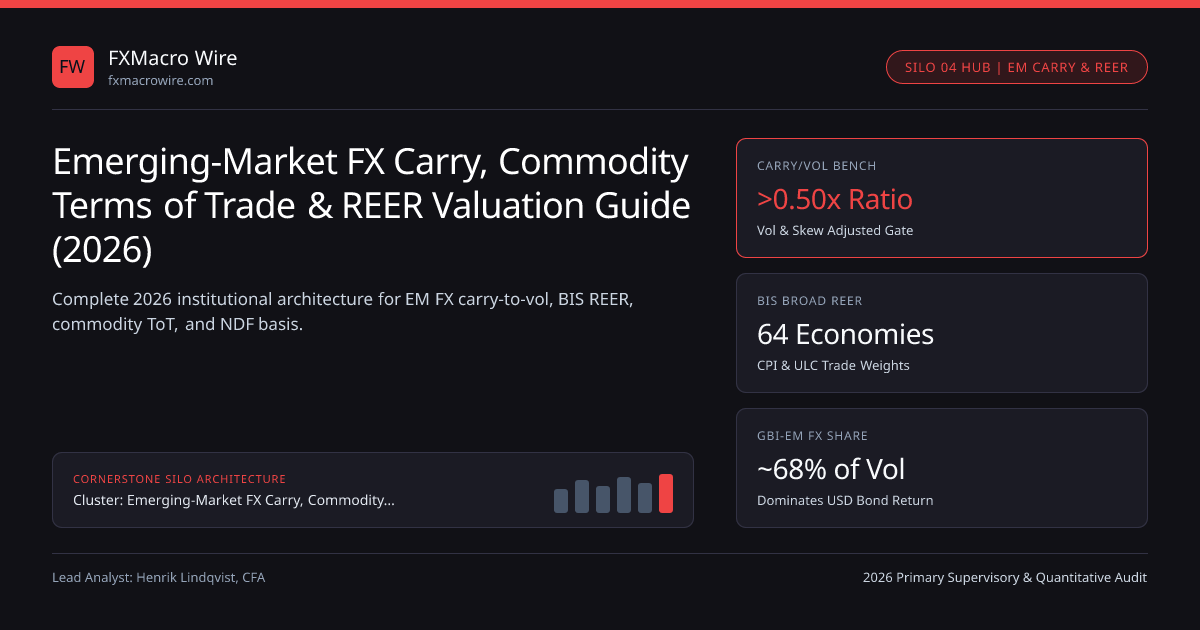
Across the global foreign exchange ecosystem benchmarked by FinDB's $9.60T Daily BIS Global OTC FX Turnover (BIS-FX-SWAPS-96T 2026 Standard), emerging-market (EM) currencies account for nearly 28% of spot and non-deliverable forward (NDF) risk transfer yet deliver over 65% of systematic macro FX carry dispersion. Naive nominal yield-chasing—buying a 12% or 45% policy rate without adjusting for inflation erosion, implied volatility, sovereign credit default swap (CDS) spreads, or commodity export prices—repeatedly wipes out multi-year coupon gains during violent three-day volatility spikes.
This 2026 institutional pillar synthesizes all nineteen specialist valuation, derivatives, and macro-flow dimensions across Silo 4 (Emerging-Market FX Carry, Commodity Terms of Trade & REER Valuation): from LatAm and CEE-3 real carry-to-volatility ratios to BIS Broad 64-economy REER misalignments, copper, oil, and semiconductor terms-of-trade betas, onshore-vs-offshore NDF segmentation, and fiscal-dominance breakdowns.
1. Real Ex-Ante Carry-to-Volatility Ratios vs Nominal Yield Illusions#
Why did institutional carry portfolios overweighting Brazilian real (USD/BRL) and Mexican peso (USD/MXN) outperform high-nominal frontier currencies over multi-year cycles, only to suffer sharp drawdowns whenever domestic fiscal anchors slipped? Because professional FX portfolio managers never rank currencies on nominal overnight rates alone:
- Ex-Ante Real Interest Differential: Subtract 12-month consensus inflation swaps (or central bank survey expectations) from the 3-month NDF-implied yield to verify genuine purchasing-power carry—explored in USD/BRL and USD/MXN real carry-to-implied-volatility ratios and Turkey CBRT swap unwind and orthodox real-rate REER math.
- Volatility & Funding-Basket Optimization: Divide annualized forward carry by 3-month at-the-money implied FX volatility and diversify the short funding leg across JPY, CHF, EUR, and CNH rather than 100% USD or 100% JPY—modeled in diversified G10/CNH FX funding baskets for EM carry and FX carry crash skewness under VIX and MOVE regime switching.
- Central European EU-Cohesion Carry: Compare high-beta LatAm carry against lower-volatility European Union convergence currencies supervised alongside CNB Czechia, MNB Hungary, and KNF Poland in EUR/PLN, EUR/CZK, and EUR/HUF CEE-3 real carry and EU fund inflows.
2. Equilibrium Exchange Rate Anchors: BIS REER, BEER, FEER & Commodity Terms of Trade#
A high carry-to-vol ratio becomes a value trap if the currency sits 20%+ overvalued relative to its structural balance-of-payments equilibrium! Institutional valuation desks triangulate three complementary frameworks:
- BIS Narrow (27) vs Broad (64) REER Indices: Distinguish CPI-deflated vs unit-labor-cost (ULC) competitiveness weights, particularly where Chinese manufacturing competition reshapes third-market export shares—detailed in BIS Broad vs Narrow REER CPI and ULC currency misalignments.
- BEER vs IMF EBA / FEER Econometric Models: Reconcile high-frequency Behavioral Equilibrium Exchange Rate regressions (driven by productivity and real yield spreads) against medium-term Fundamental Equilibrium Exchange Rate current-account norms in BEER vs IMF EBA and FEER equilibrium exchange rate models.
- Commodity & Tech Terms-of-Trade (ToT) Shocks: When copper surges +25%, Brent crude spikes $20/bbl, or AI HBM memory exports boom, fundamental fair value shifts immediately—quantified across copper terms-of-trade shocks across CLP, PEN, and AUD, Brent crude supply shocks and exporter-vs-importer FX divergence, USD/ZAR rand proxy hedging and PGM export betas, USD/KRW NPS FX swap hedging and semiconductor ToT cycles, and China credit impulse, CFETS RMB, and ASEAN EM FX spillovers.
European and global prudential authorities—including the European Central Bank, BCBS / BIS, IOSCO, BaFin, and BGK, alongside multi-asset execution venues such as Alior Trader, Blocksize Capital, and B2BX Exchange—monitor cross-border EM FX derivative clearing, MiFID II NDF transparency, and settlement pre-funding risk.
| EM FX Analytical Pillar | Primary Quantitative Metric | Typical 2026 Institutional Threshold | Representative Currency Pairs | Key Structural Pitfall |
|---|---|---|---|---|
| Carry-to-Volatility | (iNDF - iFund) / Vol3MATM | > 0.50x annualized ratio | USD/BRL, USD/MXN, EUR/HUF | Ignoring negative skewness & fiscal dominance |
| BIS Broad REER Gap | (REERSpot / BEERFair) - 1 | ±10% to ±18% mean-reversion band | USD/ZAR, USD/TRY, EUR/PLN | Comparing spot REER to 10Y average after ToT shift |
| Onshore-NDF Basis | yOffshoreNDF - yOnshoreDF | ±40 bps normal; >200 bps stress | USD/INR, USD/KRW, USD/TWD | Capital controls trapping onshore arbitrageurs |
| GBI-EM Bond Return | Coupon + Duration + FX Spot/Carry | FX drives 62%-74% of USD variance! | BRL, MXN, IDR, PLN, ZAR 5Y-10Y | Negative hedge carry wiping out local bond yield |
3. Unified Risk-Adjusted EM Total-Return Attribution Formula#
Whether trading 3-month offshore NDFs or unhedged local-currency sovereign bonds in the J.P. Morgan GBI-EM Global Diversified index (GBI-EM sovereign debt FX-hedged vs unhedged return attribution), total expected dollar excess return decomposes cleanly into carry, valuation convergence, terms-of-trade beta, and sovereign fiscal risk:
- CrashAdjustedCarry = ( y3MNDF - iFundingBasket ) / ( Vol3MATM * ( 1 + 0.25 * |RR25D / Vol3M_ATM| ) )
- Worked 2026 LatAm vs Asia NDF Carry Comparison (USD-Funded Benchmark at i_SOFR = 3.85%):
- 1. High-Yield LatAm (BRL 3M Cupom/NDF Implied = 11.65%, Vol_3M = 14.2%, 25D Risk Reversal = +2.8 vols):
- Nominal Carry = +7.80%/yr; Raw Carry/Vol = 7.80 / 14.2 = 0.549x; Skew-Adjusted Ratio = 0.523x
- 2. Managed Low-Vol Asia (INR 3M NDF Implied = 6.55%, Vol_3M = 3.60%, 25D Risk Reversal = +0.55 vols):
- Nominal Carry = +2.70%/yr; Raw Carry/Vol = 2.70 / 3.60 = 0.750x! (Superior volatility-adjusted Sharpe despite lower yield)
4. Market Microstructure: NDF Basis, Swap Cambial, Lifers & Non-CLS Settlement#
Unlike G10 spot currencies that clear seamlessly inside CLS Bank PvP windows, emerging-market FX microstructure features capital-account walls, central bank derivative auctions, and bilateral settlement drag:
- Onshore vs Offshore NDF Segmentation: Audit why offshore 1-month NDF yields blow out +300 bps above onshore forwards during risk-off squeezes in onshore forward vs offshore NDF basis spreads in INR, KRW, and BRL, USD/INR RBI NDF intervention and FAR bond inflows, and USD/TWD Taiwan life insurer proxy hedges and NDF backwardation.
- Central Bank Domestic Swap Engines: Decode Brazil's unique onshore USD derivative ecosystem in Brazil BCB Swap Cambial and Cupom Cambial (DDI) liquidity mechanics.
- Fiscal Dominance & Settlement Friction: Protect portfolios when rate hikes backfire fiscally (fiscal dominance, sovereign CDS, and the EM FX rate paradox) and quantify pre-funding balance-sheet costs in non-CLS EM FX Herstatt settlement risk and Nostro pre-funding drag.
5. Institutional Portfolio Construction & Cross-Silo Integration#
Combining high-carry EM longs with low-yielding G10/Asian funders links Silo 4 directly to ICE US Dollar Index (DXY) macro regimes. Explore every quantitative guide across our EM FX carry & terms-of-trade topic hub, inspect underlying currency benchmarks in our FX datasets directory, and verify cross-asset computation standards on our methodology page.
Frequently asked questions
What is a strong institutional Carry-to-Volatility ratio in emerging-market FX?
Institutional macro desks generally target annualized 3-month Carry-to-Implied-Volatility ratios above 0.45x to 0.50x for single pairs, and 0.70x to 1.00x for diversified multi-currency EM carry baskets funded across JPY, CHF, EUR, and CNH.
Why do BRL, INR, KRW, and TWD trade primarily as Non-Deliverable Forwards (NDFs) offshore?
Because onshore authorities restrict offshore non-residents from holding or borrowing unconstrained onshore local-currency bank balances; offshore NDFs settle the net profit or loss purely in US dollars against an official daily central bank spot fixing.
Why can comparing an EM currency’s REER to its 10-year historical average be misleading?
Permanent shifts in commodity terms of trade (such as a structural copper surge for Chile or an oil import shock for Turkey/India) or Balassa-Samuelson productivity gains shift the equilibrium exchange rate itself, requiring BEER or FEER conditioning.
Which emerging-market currencies settle inside CLS Bank Payment-versus-Payment (PvP)?
Mexican peso (MXN), South African rand (ZAR), Israeli shekel (ILS), Singapore dollar (SGD), Hong Kong dollar (HKD), Korean won (KRW onshore), and Hungarian forint (HUF) are CLS-eligible, whereas most frontier and restricted currencies require NDFs or bilateral settlement.
Publication record
- Published
- 14 November 2026
- Updated
- 14 November 2026
- Author
- Henrik Lindqvist, CFA
- Review
- Review not recorded
- Automated fact check
- Passed in the stored pipeline record
- Source URLs
- 3 recorded
AI assistance recorded: anthropic/claude-opus-4.6. This field does not establish human review or source verification.
Academic & Institutional Attribution
Cite This Research & Embed Live Data Card
Standard academic & institutional research paper citation format.
Henrik Lindqvist, CFA. (2026, November 14). Emerging-Market FX Carry, Commodity Terms of Trade & REER Valuation Guide (2026). FXMacro Wire. https://fxmacrowire.com/wire/em-fx-carry-commodity-terms-of-trade-reer-guide-2026Related Em Carry Terms of Trade Shocks & Institutional Briefings
Explore Em Carry Terms of Trade Shocks Hub (20) →Em Carry Terms of Trade Shocks
USD/BRL & USD/MXN Carry-to-Vol Ratios: Selic vs Banxico Real Yield MathEm Carry Terms of Trade Shocks
BIS Broad vs Narrow REER Indices: CPI vs ULC Currency MisalignmentsEm Carry Terms of Trade Shocks
Copper Terms-of-Trade Shocks: CLP, PEN & AUD/USD Exchange-Rate BetasEm Carry Terms of Trade Shocks
Onshore Forward vs Offshore NDF Basis Spreads: INR, KRW & BRL MechanicsEm Carry Terms of Trade Shocks
EUR/PLN, EUR/CZK & EUR/HUF: CEE-3 Real Carry & EU Recovery Fund FX FlowsEm Carry Terms of Trade Shocks
USD/ZAR Proxy Hedging, SARB Inflation Target Shift & PGM Export BetasEm Carry Terms of Trade Shocks
USD/INR Volatility Compression: RBI Two-Way NDF Intervention & FAR Bond FlowsEm Carry Terms of Trade Shocks
FX Carry Crash Skewness: VIX & ICE BofA MOVE Regime-Switching SignalsSafe Haven Capital Flow Regimes
G10 Safe-Haven FX Beta, NIIP & Balance-of-Payments Capital Flow Guide (2026)G10 Central Bank Rate Divergence
EUR/USD Two-Year ESTR-SOFR OIS Spread Elasticity Across Macro RegimesMarket Insights
Nikkei 225 gains 0.53% as yen pressure and tech volatility shape Friday trade - ad-hoc-news.deG10 Central Bank Rate Divergence
ECB Transmission Protection Instrument, BTP-Bund Spreads & Euro FX Risk
FXMacro Wire Data, Benchmarks & Contributor Records
CC BY 4.0 Open Data
Open Institutional Datasets (CSV / JSON) →
Download desk-compiled quantitative series & schemas.
2026 Reference Matrix
2026 Institutional Benchmarks & Thresholds →
Statutory capital, clearing, margin & rate conventions.
Editorial Records
Authors & Review Records →
View named contributors where those records are available.
Complete Index
Master Research & Dossier Archive →
Browse all published briefings by topic pillar & date.