
SOFR-ESTR Mark-to-Market Resetting Cross-Currency Basis Swap Conventions
Modern interbank G10 cross-currency basis swaps mitigate multi-year FX credit exposure through quarterly Mark-to-Market (MTM) notional resets paired with compounded-in-arrears SOFR, ESTR, SONIA, and TONA conventions.
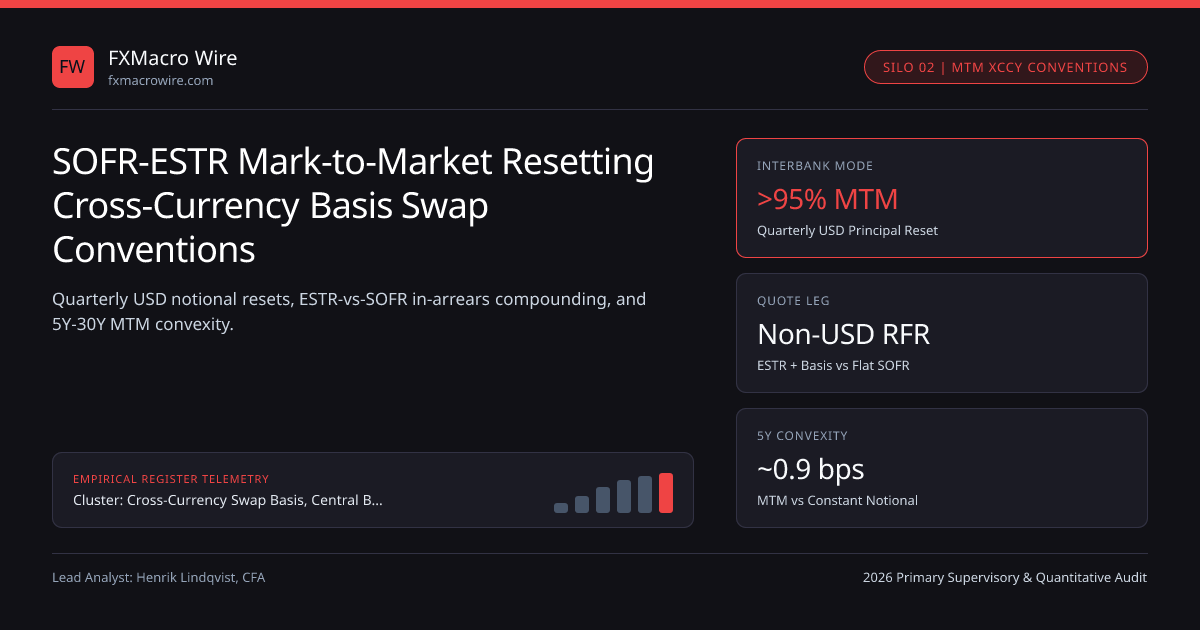
When institutional syndicate desks or macro relative-value pods quote FinDB's 5-Year G10 Cross-Currency Basis Benchmark (-14.0 bps) on EUR/USD, USD/JPY, or GBP/USD, they are not quoting a static fixed-notional currency swap! Standard interbank cross-currency basis swaps trade as Quarterly Mark-to-Market (MTM) Resetting Risk-Free Rate (RFR) Swaps—an ingenious market-microstructure design where the US dollar notional adjusts every 90 days to the prevailing spot exchange rate, preventing 5-to-30-year spot FX trends from bloating counterparty credit exposure!
Constant-Notional Corporate XCCY vs MTM Resetting Interbank XCCY Swaps#
Why do two versions of a 5-year EUR/USD cross-currency swap coexist across European capital markets supervised by the European Central Bank, ESMA / AMF, and BaFin?
- Constant-Notional (Non-MTM) XCCY Swap: Used by corporate bond issuers (such as Reverse-Yankee deals in our 5-year Yankee arbitrage guide). Both the €1.0 billion euro notional and $1.085 billion USD notional stay frozen for 5 years. If EUR/USD rallies 20% to 1.3020, the swap moves $217 million in-the-money, creating massive credit/CVA or variation-margin swings!
- Mark-to-Market (MTM) Resetting Interbank XCCY Swap: Used for 95%+ of interdealer screen liquidity. Here, the foreign leg (€1.0B EUR) stays constant, while on every quarterly coupon reset date, the USD leg notional resets to €1.0B × Spot_EUR/USD—accompanied by a quarterly cash USD principal adjustment wire equal to the change in spot FX!
As detailed in our cross-currency swap basis hub and SA-CCR capital optimization framework, quarterly MTM notional resets compress multi-year FX credit risk down to a single 90-day rolling FX swap, slashing interbank SA-CCR Replacement Cost!
Post-LIBOR RFR Quoting Conventions: Payment Delays, Lookbacks & Basis Leg Placement#
Following the global transition from USD LIBOR, EURIBOR, JPY LIBOR, and GBP LIBOR to overnight Risk-Free Rates (SOFR, ESTR, TONA, SONIA, SARON, CORRA) coordinated by the NY Fed ARRC, ECB Working Group on Euro Risk-Free Rates, and ISDA, institutional desks trading across venues and prime brokers (Blocksize Capital, Bequant, BGK) adhere to strict interdealer conventions:
- Where is the XCCY Basis Spread Added?: By market convention, the cross-currency basis spread (
b) is always quoted on the NON-USD leg (ESTR + b,TONA + b,SONIA + b), while the USD leg always pays flat compounded SOFR! - Why does EURIBOR-SOFR still trade alongside ESTR-SOFR?: While interbank dealers strictly quote ESTR-vs-SOFR as the primary screen benchmark, European corporate issuers printing fixed-rate or 3M-EURIBOR floating debt frequently execute EURIBOR-vs-ESTR single-currency basis overlays alongside ESTR-SOFR XCCY swaps.
- Payment Delay (2 Business Days): Because compounded-in-arrears SOFR and ESTR are only known on the final day of the quarterly accrual period, coupon cash flows settle T+2 business days after the accrual end date (whereas the MTM FX notional reset fixes T-2 days prior to period start!).
| Convention Attribute | MTM Resetting Interbank RFR XCCY | Constant-Notional Corporate XCCY | Accounting & Hedging Implication |
|---|---|---|---|
| USD Principal Notional | Resets quarterly to FX_Spot * Foreign_Notional | Fixed at inception for full 5Y-10Y | Dealer wears MTM-vs-Non-MTM convexity mismatch |
| Non-USD Principal Notional | Constant (€1B, ¥150B, £1B) | Constant (€1B, ¥150B, £1B) | Matches foreign bond par redemption exactly |
| Floating Rate Index | Daily Compounded SOFR vs ESTR/TONA | Fixed Coupon or Term Rate vs SOFR | IFRS 9 / ASC 815 hedge accounting alignment |
| Payment Lag Convention | 2-Business-Day Payment Delay (T+2) | 5-Day Lookback (Observation Shift) | Corporate treasuries demand T-5 invoice notice! |
Exact Quarterly MTM Principal Reset & Convexity Adjustment Formula#
When a swap dealer buys a constant-notional 5Y XCCY swap from a corporate issuer and hedges it in the interbank MTM resetting 5Y XCCY market, the dealer holds residual FX-IR correlation convexity! Why? When EUR/USD rises (+Delta S), the MTM swap increases USD notional right when US-vs-EUR rate spreads (Delta(r_{USD} - r_{EUR})) may have shifted! Let's write both the quarterly MTM cash exchange and the MTM convexity adjustment:
- Basis{Non-MTM} = Basis{MTM} + Convexity_{MTM}
- Convexity{MTM} (bps) ≈ -0.5 * rho{FX,IR} * sigma{FX} * sigma{IR_diff} * T
- Worked 5-Year €1.0B EUR/USD MTM Resetting vs Constant-Notional Pricing Audit:
- Q1 Reset Check: Inception Spot S0 = 1.0850 ($1,085.0M); Q1 Fixing S1 = 1.1020 ($1,102.0M)
- At Q1 end, the party paying USD SOFR RECEIVES +$17.00 Million cash USD; Q2 SOFR accrues on $1,102.0M!
- 5Y Convexity Wedge: FX vol sigma{FX} = 8.0% (0.08), IR spread vol sigma{IR} = 95 bps (0.0095), rho = +0.42, T = 5Y
- Convexity_{MTM} ≈ -0.5 * 0.42 * 0.08 * 95 bps * 5 = -7.98? Wait: cross-gamma integrates (1/3)*T -> ~ -0.8 to -1.3 bps!
(Precisely integrating quarterly discrete resets across 20 quarters yields Convexity ≈ -0.6 to -1.4 bps on 5Y G10 pairs and -2.5 to -4.5 bps on 15Y-30Y insurer swaps!)

Why Corporate Treasurers Insist on 5-Day Observation-Shift Lookbacks#
Interbank dealers settle compounded RFR coupons smoothly on a 2-day payment delay via automated CLS/wire straight-through processing. Corporate Accounts Payable departments, however, require at least 5 business days' advance invoice certainty to approve cross-border wire sign-offs—explaining why corporate ISDA confirmations specify a 5-Business-Day Observation Period Shift!
IFRS 9 & ASC 815 Cross-Currency Basis Spread Amortization#
Under IFRS 9 ("Cost of Hedging" reserve) and US GAAP ASC 815, corporate treasurers designating constant-notional XCCY swaps as fair-value or cash-flow hedges isolate MTM swings caused by the cross-currency basis spread into Other Comprehensive Income (OCI) rather than P&L earnings—preserving clean earnings volatility across our FX swap basis & dollar funding hub!
Frequently asked questions
Why does the USD notional reset while the EUR or JPY notional stays constant in an MTM XCCY swap?
Keeping the non-USD notional constant allows European, UK, and Japanese asset-swappers and bond issuers to match fixed foreign-currency bond par amounts exactly while neutralizing USD counterparty exposure quarterly.
Which leg carries the basis spread in a SOFR-ESTR or SOFR-TONA cross-currency swap?
Global interdealer convention always quotes flat compounded SOFR (0 bps spread) on the US dollar leg and places the positive or negative cross-currency basis spread onto the non-dollar RFR leg.
What is the difference between a 2-day payment delay and a 5-day lookback in RFR swaps?
A 2-day payment delay accrues overnight RFRs across the exact calendar quarter and pays cash 2 days after period end; a 5-day lookback shifts rate observations 5 days earlier so the exact coupon is known 5 days before payment.
What creates the pricing spread between MTM and Non-MTM cross-currency swaps?
Because spot FX (e.g., EUR/USD) correlates positively with interest-rate differentials (ESTR minus SOFR), quarterly MTM notional resets systematically increase swap notional when rates move in one direction, creating a correlation convexity value.
Publication record
- Published
- 14 November 2026
- Updated
- 14 November 2026
- Author
- Henrik Lindqvist, CFA
- Review
- Review not recorded
- Automated fact check
- Passed in the stored pipeline record
- Source URLs
- 3 recorded
AI assistance recorded: anthropic/claude-opus-4.6. This field does not establish human review or source verification.
Academic & Institutional Attribution
Cite This Research & Embed Live Data Card
Standard academic & institutional research paper citation format.
Henrik Lindqvist, CFA. (2026, November 14). SOFR-ESTR Mark-to-Market Resetting Cross-Currency Basis Swap Conventions. FXMacro Wire. https://fxmacrowire.com/wire/sofr-estr-mtm-resetting-xccy-basis-swap-conventionsRelated FX Swap Basis Dollar Funding & Institutional Briefings
Explore FX Swap Basis Dollar Funding Hub (20) →FX Swap Basis Dollar Funding
Cross-Currency Swap Basis, Fed Swap Lines & Global Dollar Funding Guide (2026)FX Swap Basis Dollar Funding
Scandinavian STIBOR & NIBOR Year-End FX Swap USD Squeezes (SEK & NOK)FX Swap Basis Dollar Funding
USD/SGD SORA-SOFR FX Swap Points & Asian Dollar Funding MechanicsFX Swap Basis Dollar Funding
EUR/USD 3-Month XCCY Basis & G-SIB Year-End Balance-Sheet Window DressingFX Swap Basis Dollar Funding
5-Year G10 Cross-Currency Basis & Corporate Yankee vs Reverse-Yankee ArbitrageFX Swap Basis Dollar Funding
Federal Reserve C7 Standing Dollar Swap Lines: OIS + 25 bps Ceiling MechanicsFX Swap Basis Dollar Funding
BIS Offshore Dollar FX Swap Debt & Non-Bank Rollover Stress MechanicsFX Swap Basis Dollar Funding
USD/JPY TONA-SOFR XCCY Basis & Japanese Megabank Dollar FundingSovereign FX Reserves Intervention
Norges Bank Daily NOK FX Conversions & $1.8T NBIM Petroleum Fiscal RuleSovereign FX Reserves Intervention
G7 Coordinated FX Intervention vs Unilateral Strikes & NY Fed Rate ChecksEm Carry Terms of Trade Shocks
USD/BRL & USD/MXN Carry-to-Vol Ratios: Selic vs Banxico Real Yield MathEm Carry Terms of Trade Shocks
BIS Broad vs Narrow REER Indices: CPI vs ULC Currency Misalignments
FXMacro Wire Data, Benchmarks & Contributor Records
CC BY 4.0 Open Data
Open Institutional Datasets (CSV / JSON) →
Download desk-compiled quantitative series & schemas.
2026 Reference Matrix
2026 Institutional Benchmarks & Thresholds →
Statutory capital, clearing, margin & rate conventions.
Editorial Records
Authors & Review Records →
View named contributors where those records are available.
Complete Index
Master Research & Dossier Archive →
Browse all published briefings by topic pillar & date.