
Federal Reserve C7 Standing Dollar Swap Lines: OIS + 25 bps Ceiling Mechanics
Operated permanently among six major central banks, Federal Reserve C7 standing dollar swap lines enforce a theoretical SOFR OIS + 25 bps ceiling over offshore G10 FX swap basis blowouts.
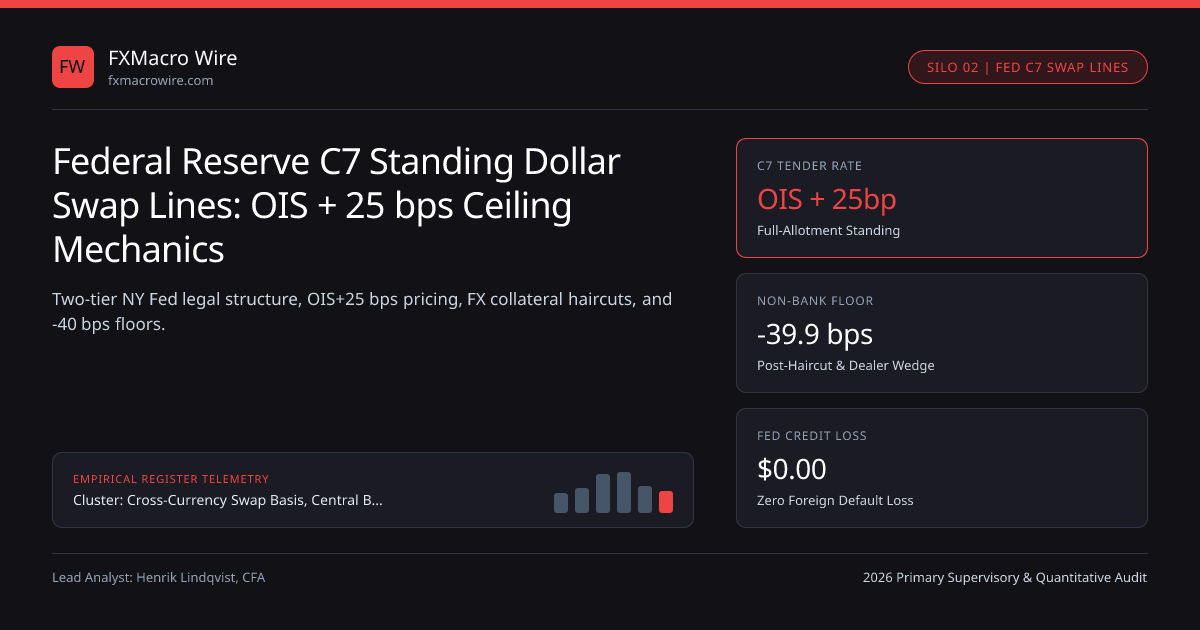
Converted from temporary crisis arrangements into a permanent standing network in October 2013—and repriced at USD OIS + 25 basis points since March 2020—the Federal Reserve's bilateral central bank liquidity swap lines with the European Central Bank, Bank of Japan, Bank of England, Swiss National Bank, and Bank of Canada (FED-CENTRAL-SWAPS / 2026 Swap Line Standard) act as the lender-of-last-resort backstop for the entire offshore Eurodollar system. Understanding exact tender schedules, sovereign collateral valuation haircuts, and regulatory stigma explains why market cross-currency basis occasionally pierces the theoretical -25 bps floor intraday before snapping back at weekly allotment cutoffs.
Two-Tier Credit Structure: Zero Foreign Credit Risk for the Federal Reserve#
Politically and legally under Section 14 of the Federal Reserve Act, the Federal Open Market Committee (FOMC) takes zero commercial-bank credit risk when extending $100 billion+ of swap liquidity abroad:
- Leg 1 (Central Bank-to-Central Bank FX Swap): The Federal Reserve Bank of New York credits US dollars to the ECB's account at the NY Fed in exchange for an equivalent amount of euros at prevailing spot EUR/USD, paired with a binding forward contract to reverse the swap in 7 days (or 84 days during crisis activations) at the exact same exchange rate plus SOFR OIS + 25 bps interest on the dollars.
- Leg 2 (Domestic Repo-Style Allotment): Frankfurt, Tokyo, London, or Zurich lends those US dollars onward to supervised commercial banks within their jurisdiction against high-quality domestic collateral (Bunds, JGBs, Gilts, or eligible ECB credit claims) subject to central bank valuation haircuts—meaning the home central bank bears 100% of any commercial counterparty default risk!
As framed in our cross-currency swap basis hub, this brilliant legal architecture bypasses cross-border bank bailout constraints while stabilizing US Treasury market functioning abroad.
Why Market FX Swap Basis Can Temporarily Trade Wider Than -25 bps#
If any Eurozone or Japanese bank can borrow 7-day dollars at SOFR OIS + 25 bps, why did 1-week EUR/USD and USD/JPY cross-currency basis briefly touch -65 to -110 bps during March 2020, March 2023 (post-Credit Suisse Group AG turmoil under FINMA oversight), or December turns? Institutional funding desks identify four structural wedges above the 25 bps headline spread:
- Tender Frequency Mismatch: Under normal standing operations, 7-day USD tenders settle once per week (typically Wednesdays/Thursdays). If dollar stress erupts on a Thursday afternoon, banks face a 5-day gap until the next allotment unless central banks switch to daily 7-day operations.
- Non-Bank Exclusion: Pension funds, life insurers, and hedge funds—explored in BIS offshore dollar FX swap rollover stress and Japanese lifer and bank USD/JPY hedging—have no direct central bank access and must pay dealer intermediation spreads on top of OIS + 25 bps.
- Collateral Currency-Mismatch Haircuts: Posting euro-denominated BTPs or OATs against a US dollar loan triggers an additional FX valuation haircut (typically 8% to 12%) on top of standard bond duration haircuts, consuming High-Quality Liquid Assets (HQLA).
- Supervisory Stigma: Treasury teams supervised by BaFin, DNB Netherlands, and OeNB Austria avoid being the sole bidder in quiet weeks lest supervisors interpret swap-line usage as acute funding fragility.
| Standing C7 Partner Central Bank | Regular Tender Schedule | Pricing Rate Formula | Primary Collateral Accepted | Historical Peak Outstanding |
|---|---|---|---|---|
| European Central Bank | Weekly 7-day (Wed bid / Thu settle) | USD SOFR OIS + 25 bps | Eurosystem eligible collateral + FX haircut | ~$145B (2020) / ~$270B (2008) |
| Bank of Japan (BoJ) | Weekly 7-day fixed-rate USD ops | USD SOFR OIS + 25 bps | JGBs & pooled BoJ home collateral | ~$225B (2020 COVID peak) |
| Swiss National Bank (SNB) | Weekly 7-day USD repo-swap | USD SOFR OIS + 25 bps | SNB GC basket (FINMA banks) | ~$11B (Mar 2023 CS episode) |
| Bank of England (BoE) & BoC | Weekly 7-day standing facility | USD SOFR OIS + 25 bps | UK Gilts / GoC Sterling & CAD pools | ~$34B BoE peak; minimal BoC |
Effective No-Arbitrage Floor for G10 Cross-Currency Basis#
Incorporating collateral HQLA opportunity cost (c_{HQLA}), the FX mismatch haircut (h_{FX}), and dealer balance-sheet pass-through (s_{dealer}) yields the true market floor (b_{floor}) for non-bank 1-week FX swap basis:
- b{floor,non-bank} = - [ 0.25% + ( c{HQLA} / (1 - h{bond} - h{FX}) ) + s_{dealer} ]
- Worked All-In Basis Floor Calculation During Moderate Stress:
- Headline Fed C7 spread = 25.0 bps; HQLA encumbrance shadow cost c_{HQLA} = 6.0 bps
- Bond haircut h{bond} = 3.0%; ECB USD FX mismatch haircut h{FX} = 10.0% (total 13% overcollateralization)
- Dealer pass-through spread to non-bank pension/insurer client s_{dealer} = 8.0 bps
- Effective Bank Cost Add-On = 25.0 + (6.0 / 0.87) = 25.0 + 6.90 = 31.9 bps over SOFR OIS
- Non-Bank FX Swap Basis Floor b_{floor} = -(31.9 + 8.0) = -39.9 bps (explaining -35 to -42 bps spikes before heavy take-up!)
Weekly Thursday NY Fed H.4.1 & ECB Allotment Signal Monitoring#
Every Wednesday/Thursday, macro FX strategists monitor the ECB and SNB 7-day USD tender allotment results hours ahead of the Federal Reserve's Thursday 16:30 ET H.4.1 balance-sheet release. Any sudden jump from $150 million of routine operational test bids ("pipes testing") to $2 billion+ signals that at least one European bank faces bilateral wholesale dollar funding resistance.
Crisis Escalation Playbook: Daily 7-Day Operations & 84-Day Term Swaps#
When wholesale dollar stress persists beyond single-week liquidity mismatches—as in March 2020—the C7 governors jointly activate daily 7-day tenders alongside 84-day (3-month) USD swap operations, flattening the entire 1-week to 3-month cross-currency curve simultaneously—serving as the ultimate macro backstop tracked across our FX swap basis & dollar funding hub and NY Fed FIMA repo comparisons.
Frequently asked questions
Which central banks belong to the standing Federal Reserve C7 swap network?
Six central banks maintain permanent standing bilateral liquidity swap arrangements: the Federal Reserve, European Central Bank, Bank of Japan, Bank of England, Swiss National Bank, and Bank of Canada (historically C6, often grouped with G7 plumbing).
Does the Federal Reserve lose money if a foreign commercial bank defaults on swap-line dollars?
No. The NY Fed’s legal counterparty is strictly the foreign central bank (such as the ECB or BoJ), which pledges its own currency and absorbs 100% of commercial counterparty credit risk against domestic collateral.
Why did central banks shift 7-day USD swap operations from weekly to daily in March 2023?
Following the Silicon Valley Bank failure and Credit Suisse weekend rescue, switching from weekly to daily 7-day operations ensured European and Swiss banks could access USD liquidity every morning without waiting five business days.
How does swap-line usage affect the spot US Dollar Index (DXY)?
Rising swap-line drawdowns initially coincide with risk-off spot USD rallies (dollar shortage), while large-scale full-allotment disbursements cap synthetic USD rates and typically mark the exhaustion peak of panic dollar buying.
Publication record
- Published
- 14 November 2026
- Updated
- 14 November 2026
- Author
- Henrik Lindqvist, CFA
- Review
- Review not recorded
- Automated fact check
- Passed in the stored pipeline record
- Source URLs
- 3 recorded
AI assistance recorded: anthropic/claude-opus-4.6. This field does not establish human review or source verification.
Academic & Institutional Attribution
Cite This Research & Embed Live Data Card
Standard academic & institutional research paper citation format.
Henrik Lindqvist, CFA. (2026, November 14). Federal Reserve C7 Standing Dollar Swap Lines: OIS + 25 bps Ceiling Mechanics. FXMacro Wire. https://fxmacrowire.com/wire/fed-c7-standing-dollar-swap-lines-ois-25bps-ceilingRelated FX Swap Basis Dollar Funding & Institutional Briefings
Explore FX Swap Basis Dollar Funding Hub (20) →FX Swap Basis Dollar Funding
Cross-Currency Swap Basis, Fed Swap Lines & Global Dollar Funding Guide (2026)FX Swap Basis Dollar Funding
BIS Offshore Dollar FX Swap Debt & Non-Bank Rollover Stress MechanicsFX Swap Basis Dollar Funding
USD/JPY TONA-SOFR XCCY Basis & Japanese Megabank Dollar FundingFX Swap Basis Dollar Funding
Covered Interest Parity Deviations & Basel III Leverage Ratio Shadow CostsFX Swap Basis Dollar Funding
Yankee CDs, Commercial Paper & US Money-Market Fund FX Swap SpreadsFX Swap Basis Dollar Funding
NY Fed FIMA Repo Facility vs Central Bank FX Swap Lines: Sovereign USD PlumbingFX Swap Basis Dollar Funding
CLS PvP Settlement Cutoffs & North American T+1 FX Swap Liquidity CompressionFX Swap Basis Dollar Funding
GBP/USD SONIA-SOFR FX Forwards & UK LDI Pension Hedging Roll MechanicsSovereign FX Reserves Intervention
SNB Sight-Deposit Tiering & Two-Way Foreign Exchange Reserve ManagementSovereign FX Reserves Intervention
Central Bank Physical Gold Accumulation, Allocated Vaulting & BIS Gold SwapsSovereign FX Reserves Intervention
IMF Special Drawing Rights (SDR): Basket Weights, SDRi Rate & FX AccountingSovereign FX Reserves Intervention
PBOC USD/CNH Daily 09:15 Parity Fixing, +/-2% Band & Counter-Cyclical Factor
FXMacro Wire Data, Benchmarks & Contributor Records
CC BY 4.0 Open Data
Open Institutional Datasets (CSV / JSON) →
Download desk-compiled quantitative series & schemas.
2026 Reference Matrix
2026 Institutional Benchmarks & Thresholds →
Statutory capital, clearing, margin & rate conventions.
Editorial Records
Authors & Review Records →
View named contributors where those records are available.
Complete Index
Master Research & Dossier Archive →
Browse all published briefings by topic pillar & date.