
Covered Interest Parity Deviations & Basel III Leverage Ratio Shadow Costs
Once considered an unbreakable textbook law of international finance, Covered Interest Parity now exhibits persistent 10-to-45 bps G10 deviations governed mathematically by dealer Basel III leverage-ratio shadow costs.
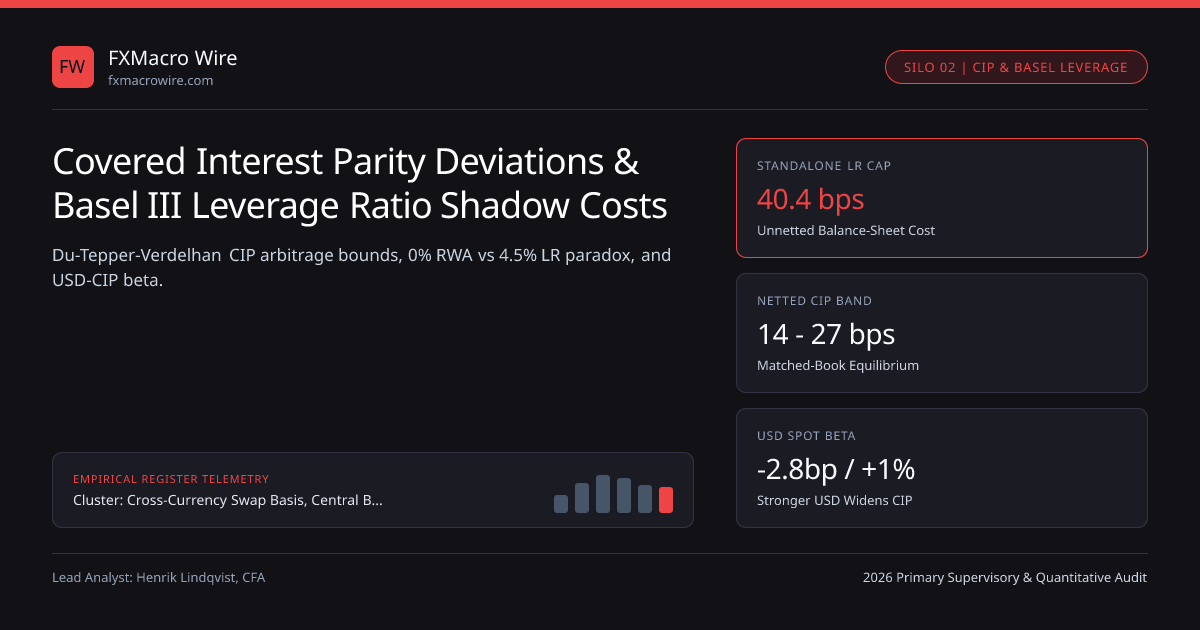
Prior to August 2007, Covered Interest Parity (CIP)—the no-arbitrage identity stating that forward FX premiums equal exact interbank interest-rate differentials—held within 1 to 2 basis points across every liquid G10 currency pair. Today, as documented in Du, Tepper, and Verdelhan's seminal framework and tracked across FinDB's BIS $9.6T OTC FX Turnover Benchmark, persistent 12 to 40 bps CIP deviations exist in tranquil markets across EUR/USD and USD/JPY without any credit default risk—representing the exact shadow price of dealer bank balance-sheet space under Basel III non-risk-weighted leverage rules.
Why Risk-Free CIP Arbitrage Consumes Non-Risk-Weighted Leverage Capital#
Suppose 3-month EUR/USD XCCY basis sits at -25 bps: an arbitrageur can borrow $100 million at 3-month SOFR repo, swap $100 million into €92 million via a 3-month FX swap, and deposit €92 million risk-free at the European Central Bank deposit facility—locking in a zero-market-risk, zero-credit-risk 25 bps annualized profit. Why don't JPMorgan, BNP Paribas, or Deutsche Bank execute $500 billion of this trade until the basis shrinks back to -1 bp?
Because under the Basel Committee on Banking Supervision (BCBS) Tier 1 Leverage Ratio (3% minimum in Europe under CRR II/III enforced by ECB, BaFin, and ACPR; 5% Supplementary Leverage Ratio eSLR for US G-SIB bank subsidiaries), risk weights do not matter! Holding €92 million at the risk-free ECB central bank balance sheet expands total Leverage Exposure by the full $100 million cash asset plus an FX derivative Potential Future Exposure (PFE) add-on—requiring $3.5 million to $5.5 million of expensive Common Equity Tier 1 (CET1) capital targeting a 12% to 15% return on equity (ROE)!
Comparing Binding Regulatory Constraints Across Dealer Jurisdictions#
Linking balance-sheet capital mechanics to our cross-currency swap basis hub, EUR/USD 3-month G-SIB turn window-dressing, and SA-CCR counterparty credit capital charges reveals why CIP basis widens whenever sovereign bond issuance floods dealer repo books: Treasuries and FX swaps compete head-to-head for the exact same non-risk-weighted leverage denominator!
Non-bank systematic liquidity providers and institutional execution specialists—including Blocksize Capital, Bequant, and Aglaia Capital operating across FINMA and CSSF ecosystems—cannot fully replace G-SIBs in CIP arbitrage because non-banks lack direct central bank reserve accounts (paying ESTR or TONA risk-free) and must instead buy T-Bills or tri-party repo at tighter spreads.
| Arbitrageur Category | Binding Capital / Funding Constraint | Access to Central Bank Deposit Rate | Minimum CIP Breakeven Hurdle | Market Role in Basis Pricing |
|---|---|---|---|---|
| US G-SIB Dealer Banks | 5% eSLR + G-SIB Method 2 score + FDIC fee | Yes (Fed IORB, ECB, BoJ branches) | 22 - 35 bps (unless netted) | Marginal price-setter in stress |
| European / Swiss Banks | 3.0% - 3.75% CRR Leverage + Dec 31 GSIB | Yes (ECB / SNB / BoE) | 15 - 24 bps mid-quarter | Active Q1-Q3; retreats on turns |
| Sovereign Wealth & Reserve Mgrs | Zero Basel LR (unlevered cash USD) | Yes (BIS / central bank custody) | 4 - 8 bps over US T-Bills | Compresses USD/JPY & EUR/USD floor |
| Relative-Value Macro Hedge Funds | Prime-broker repo haircut + margin cost | No (must buy T-Bills / repo) | 18 - 28 bps post-financing | Trades cross-tenor & cross-pair RV |
Exact Dealer Return-on-Equity (ROE) Hurdle Formula for CIP Deviations#
Let LR denote the dealer's binding Leverage Ratio requirement (e.g., 4.5%), alpha_{PFE} the SA-CCR leverage exposure add-on for a 3-month FX swap (~2.5% after alpha multiplier), f_{FDIC} wholesale assessment fees (~4 bps), and ROE_{target} the desk's pre-tax return-on-equity hurdle (e.g., 12%, net of risk-free equity return r_f or excess ROE spread lambda_{ROE}). The standalone balance-sheet breakeven CIP deviation (|b^*|) is:
- EquityLocked = LR * Notional * ( 1 + alpha{PFE} )
- |b^|_{standalone} = LR ( 1 + alpha{PFE} ) * lambda{excessROE} + f{assessment}
- Worked Standalone vs Matched-Book Dealer CIP Hurdle:
- Parameters: Binding LR = 4.5%, FX PFE add-on = 2.5%, Excess pre-tax ROE spread over cash lambda = 8.0%, Fee = 3.5 bps
- Standalone Arbitrage Hurdle |b^| = 0.045 1.025 * 800 bps + 3.5 bps = 36.9 + 3.5 = 40.4 bps!
- Internal Netting Offset (60% matched against corporate client flow):
- Effective Netted Hurdle = 0.40 * 36.9 + 1.5 = 16.3 bps (matching observed 14-26 bps G10 CIP basis equilibrium!)
The "Triangular Equivalence" Between Spot Dollar Strength and CIP Widening#
Avdjiev, Du, Koch, and Shin ("The Dollar, Bank Leverage, and Deviations from Covered Interest Parity") proved an empirical macro law: whenever the broad US Dollar Index appreciates by 1%, G10 cross-currency CIP deviations widen by ~2.8 bps intraday. Why? A stronger dollar tightens Value-at-Risk (VaR) and dollar leverage constraints on global dealer balance sheets while increasing non-US borrower hedging rollover value—connecting spot FX directly to money-market plumbing!
Implications of Potential US eSLR Reform on Cross-Currency Basis#
Should US banking regulators permanently exclude central bank reserves or Treasury repo from the Supplementary Leverage Ratio denominator, freeing G-SIB matched-book capacity would structurally compress 3-month EUR/USD and USD/JPY CIP deviations by an estimated 5 to 9 bps—a critical regulatory catalyst tracked across our FX swap basis & dollar funding hub.
Frequently asked questions
What is Covered Interest Parity (CIP) in foreign exchange markets?
Covered Interest Parity states that the interest rate differential between two currencies should equal the percentage spread between their FX forward rate and spot exchange rate, preventing riskless arbitrage.
Why did Covered Interest Parity break down permanently after 2008?
Post-2008 Basel III leverage ratios require banks to hold 3% to 6% equity against total balance-sheet assets regardless of risk weight, making low-margin cash-plus-FX-swap arbitrage too capital-intensive to compress basis to zero.
Why can’t hedge funds eliminate G10 Covered Interest Parity deviations?
Hedge funds cannot hold risk-free overnight reserve accounts at the ECB, BoJ, or SNB and must finance arbitrage via dealer prime-brokerage repo—which passes the dealer’s own Basel III leverage charge right back onto the hedge fund.
How would exempting central bank reserves from US SLR affect FX swap markets?
Exempting reserves from the Supplementary Leverage Ratio denominator lowers the capital cost of cash-reserve placement legs in CIP arbitrage, narrowing G10 FX swap basis spreads by roughly 5 to 9 bps.
Publication record
- Published
- 14 November 2026
- Updated
- 14 November 2026
- Author
- Henrik Lindqvist, CFA
- Review
- Review not recorded
- Automated fact check
- Passed in the stored pipeline record
- Source URLs
- 3 recorded
AI assistance recorded: anthropic/claude-opus-4.6. This field does not establish human review or source verification.
Academic & Institutional Attribution
Cite This Research & Embed Live Data Card
Standard academic & institutional research paper citation format.
Henrik Lindqvist, CFA. (2026, November 14). Covered Interest Parity Deviations & Basel III Leverage Ratio Shadow Costs. FXMacro Wire. https://fxmacrowire.com/wire/covered-interest-parity-basel-leverage-shadow-costRelated FX Swap Basis Dollar Funding & Institutional Briefings
Explore FX Swap Basis Dollar Funding Hub (20) →FX Swap Basis Dollar Funding
Cross-Currency Swap Basis, Fed Swap Lines & Global Dollar Funding Guide (2026)FX Swap Basis Dollar Funding
Yankee CDs, Commercial Paper & US Money-Market Fund FX Swap SpreadsFX Swap Basis Dollar Funding
NY Fed FIMA Repo Facility vs Central Bank FX Swap Lines: Sovereign USD PlumbingFX Swap Basis Dollar Funding
CLS PvP Settlement Cutoffs & North American T+1 FX Swap Liquidity CompressionFX Swap Basis Dollar Funding
GBP/USD SONIA-SOFR FX Forwards & UK LDI Pension Hedging Roll MechanicsFX Swap Basis Dollar Funding
USD/CHF SARON-SOFR Basis & Post-Merger Swiss Bank Balance-Sheet PlumbingFX Swap Basis Dollar Funding
AUD/USD Positive BBSW-SOFR Basis & Australian Bank Yankee Bond IssuanceFX Swap Basis Dollar Funding
USD/CAD CORRA-SOFR Basis, Canadian Big-6 Banks & Maple Pension HedgingSovereign FX Reserves Intervention
PBOC USD/CNH Daily 09:15 Parity Fixing, +/-2% Band & Counter-Cyclical FactorSovereign FX Reserves Intervention
MAS S$NEER Band Slope, Width & Re-Centering: Singapore Exchange-Rate PolicySovereign FX Reserves Intervention
Danmarks Nationalbank EUR/DKK ERM II Peg: Asymmetric Policy Spread DefenseSovereign FX Reserves Intervention
CNB Czechia & NBP Poland FX Reserves: Equity Tranches, Gold & EU Inflows
FXMacro Wire Data, Benchmarks & Contributor Records
CC BY 4.0 Open Data
Open Institutional Datasets (CSV / JSON) →
Download desk-compiled quantitative series & schemas.
2026 Reference Matrix
2026 Institutional Benchmarks & Thresholds →
Statutory capital, clearing, margin & rate conventions.
Editorial Records
Authors & Review Records →
View named contributors where those records are available.
Complete Index
Master Research & Dossier Archive →
Browse all published briefings by topic pillar & date.