
USD/JPY TONA-SOFR XCCY Basis & Japanese Megabank Dollar Funding
Persistent structural dollar funding deficits across Japanese megabanks, Norinchukin, and life insurers keep the USD/JPY TONA-SOFR cross-currency basis deeply negative while rewarding foreign asset-swappers buying Japanese T-Bills.
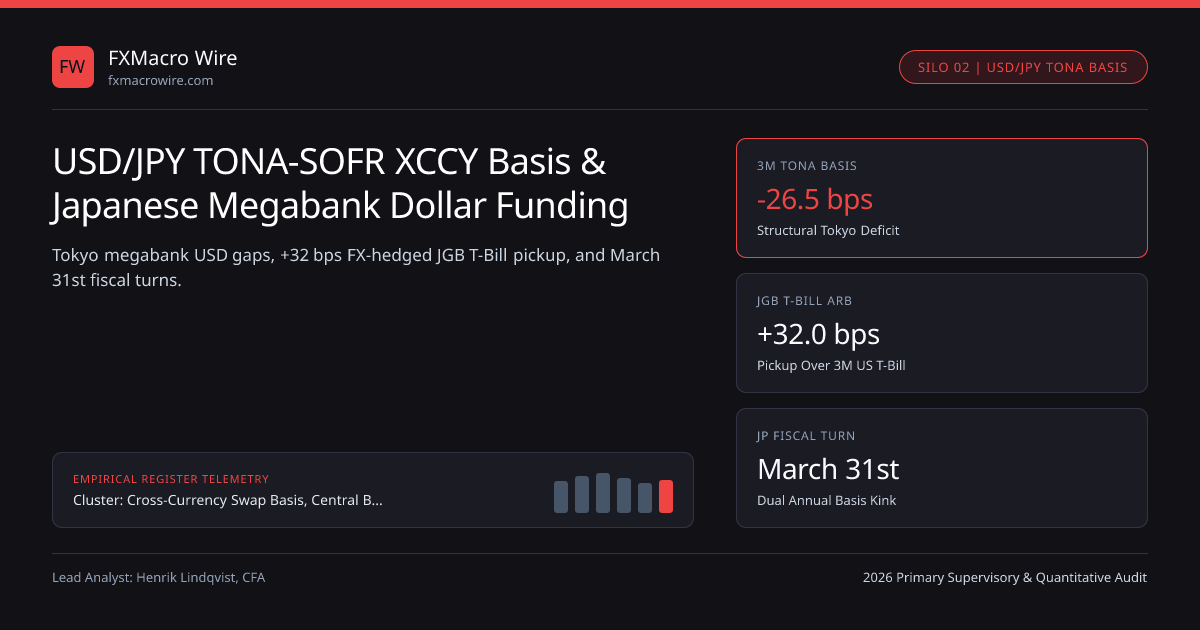
Across the entire G10 cross-currency swap complex, USD/JPY TONA-SOFR consistently exhibits the deepest structural negative basis—averaging -24 to -30 bps at the 3-month tenor and -32 to -38 bps at the 5-year benchmark (XCCY-5Y5Y-BASIS) outside year-end turns. Driven by over $2.2 trillion in overseas dollar lending, CLO holdings, and US credit portfolios across Mitsubishi UFJ, Sumitomo Mitsui, Mizuho, Japan Post Bank, and major life insurers far exceeding domestic Japanese USD retail deposits, Tokyo financial institutions act as relentless one-way payers of synthetic US dollar funding.
Structural Anatomy of Japan's $1.1 Trillion Wholesale Dollar Funding Gap#
Unlike US money-center banks funded by insured domestic dollar checking accounts, Japanese megabanks expand international project finance, syndicated US corporate loans, and agency MBS portfolios without a natural domestic USD deposit base. To close their non-JPY loan-to-deposit gap (historically 35% to 45% wholesale-funded), Tokyo bank treasurers rely on a three-pillar funding stack:
- Unsecured Yankee CDs & Eurodollar Deposits issued via New York and London branches (examined in Yankee CD and commercial paper FX swap spreads).
- Medium-Term Senior TLAC USD Bonds paired with 3-to-5-year TONA-SOFR cross-currency basis swaps.
- Rolling 3-Month FX Swaps converting surplus domestic yen deposits—bloated by decades of Bank of Japan quantitative easing—into synthetic US dollars.
As mapped in our cross-currency swap basis hub, whenever US money-market reform or credit repricing trims Yankee CD appetite, Japanese banks crowd simultaneously into the 3-month and 1-year USD/JPY FX swap market, driving the TONA-SOFR basis sharply more negative.
The Reverse Arbitrage: Why Foreigners Own Over 60% of Japanese T-Bills!#
Why would European, Middle Eastern, or US dollar bond funds buy 3-month Japanese Treasury Discount Bills (T-DBs) yielding barely 0.55% in yen when 3-month US Treasury Bills yield 3.80%? Because hedging yen back into US dollars collects both the SOFR-TONA interest differential AND the negative -26.5 bps cross-currency basis!
Institutional fixed-income desks regulated by CSSF Luxembourg, CBI Ireland, AMF France, and FINMA—clearing multi-currency repo and swaps alongside venues such as Bequant and Blocksize Capital—routinely swap cash dollars into yen for 90 days, buy risk-free Japanese government T-Bills, and lock in a synthetic USD sovereign yield 25 to 40 bps higher than equivalent-maturity US Treasury Bills! Comparing this trade with 5-year Yankee and Samurai issuance arbitrage explains why foreign investors hold over 60% of short-dated Japanese bills.
| Tokyo Balance-Sheet Cohort | Primary USD Funding Instrument | Typical Tenor Bucket | Effect on TONA-SOFR Basis | 2026 Structural Trend |
|---|---|---|---|---|
| 3 Japanese Megabanks (MUFG/SMBC/Mizuho) | Yankee CDs + 1Y-5Y XCCY swaps | 3M to 5Y laddered | Wider negative 1Y-5Y basis | Disciplined USD deposit gathering trims peak stress |
| Japanese Life Insurers (9 Lifers) | Rolling 3M-6M FX forwards/swaps | 3M / 6M rolling | Less negative vs 2022! | Hedge ratios cut from 62% to ~44% on negative carry |
| Foreign Central Banks & SWFs | Cash USD lent into 3M JGB T-Bills | 1M to 6M asset swap | Compresses 3M basis upward | Captures +29 bps pickup over US T-Bills |
| Supranational / US Samurai Issuers | JPY bond + Pay USD / Rec JPY XCCY | 3Y to 10Y term | Relieves 5Y-10Y basis | Berkshire & SSA yen bond supply arbitrage |
Exact Synthetic USD Yield Math on FX-Hedged Japanese T-Bills#
Let's verify the exact annualized dollar yield (y^{USD}_{JGB_swapped}) earned by a US dollar reserve manager swapping cash dollars into 3-month Japanese Treasury Discount Bills (y_{TDB}) when 3M TONA is r_{TONA}, 3M SOFR is r_{SOFR}, and 3M USD/JPY XCCY basis is b_{3M}:
- Excess Pickup vs UST = y^{USD}{JGBswapped} - y{UST3M}
- Worked $100 Million 3-Month FX-Hedged Japanese T-Bill Arbitrage Calculation:
- 3M US Treasury Bill Yield y{UST3M} = 3.82%; 3M USD SOFR OIS r_{SOFR} = 3.85%
- 3M Japan T-DB Yield y{TDB} = 0.58%; 3M JPY TONA OIS r{TONA} = 0.55% (+3.0 bps T-Bill spread over TONA)
- 3M USD/JPY XCCY Basis b_{3M,USDJPY} = -0.275% (-27.5 bps); Bid-ask/custody execution drag = 1.5 bps
- Swapped USD Yield = 3.85% + (0.58% - 0.55%) - (-0.275%) - 0.015% = 4.140% annualized USD return!
- Risk-Free Pickup Over 3M US T-Bill = 4.140% - 3.820% = +32.0 bps (+$80,000 extra per quarter per $100M!)
Japan's Unique March 31st Fiscal Year-End Turn vs December 31st#
Unlike European and American institutions anchored exclusively to December 31st, Japanese banks, insurers, and corporations close their statutory fiscal year on March 31st under Financial Services Agency (JFSA) accounting. Consequently, USD/JPY FX swaps display two major annual turn kinks: the global G-SIB snapshot on December 31st AND a uniquely Japanese balance-sheet repatriation/funding kink crossing March 31st (first visible in 3-month USD/JPY forwards during late December!).
Why Japanese Lifer Unhedged Shifts Prevented a 2024-2026 Basis Blowout#
Paradoxically, even as Federal Reserve rates stayed high above BoJ rates, 3-month USD/JPY basis narrowed from -55 bps (2016-2018) to -26.5 bps in 2026 because Japanese life insurers slashed currency-hedged foreign bond allocations (where SOFR minus TONA carry exceeded 3.5%), shifting into super-long 30-year domestic JGBs—reducing buy-side USD swap demand on our FX swap basis & dollar funding hub and BoJ C7 USD liquidity lines.
Frequently asked questions
Why do foreign investors buy low-yielding Japanese T-Bills and hedge them into US dollars?
When swapping cash USD into yen, investors receive the full SOFR-TONA interest rate differential plus the negative USD/JPY cross-currency basis (~27.5 bps), generating a synthetic USD sovereign yield ~32 bps higher than US T-Bills.
Why is the USD/JPY cross-currency basis consistently more negative than EUR/USD?
Japanese banks and institutional investors hold roughly twice as much net foreign dollar credit relative to domestic USD deposits as Eurozone peers, creating larger structural demand to pay USD in FX swaps.
Why does the USD/JPY swap curve kink across March 31st every year?
March 31st marks Japan’s statutory fiscal year-end; Tokyo banks ration cross-border balance-sheet intermediation on that audit snapshot date, spiking overnight implied dollar rates across April 1st.
How did Bank of Japan rate hikes affect the USD/JPY cross-currency basis?
Narrower SOFR-TONA differentials slightly revive hedged US credit appetite, while Japanese lifers buying 2.3%+ 30-year domestic JGBs keep overall Tokyo FX swap demand balanced.
Publication record
- Published
- 14 November 2026
- Updated
- 14 November 2026
- Author
- Henrik Lindqvist, CFA
- Review
- Review not recorded
- Automated fact check
- Passed in the stored pipeline record
- Source URLs
- 3 recorded
AI assistance recorded: anthropic/claude-opus-4.6. This field does not establish human review or source verification.
Academic & Institutional Attribution
Cite This Research & Embed Live Data Card
Standard academic & institutional research paper citation format.
Henrik Lindqvist, CFA. (2026, November 14). USD/JPY TONA-SOFR XCCY Basis & Japanese Megabank Dollar Funding. FXMacro Wire. https://fxmacrowire.com/wire/usdjpy-tona-sofr-xccy-basis-japanese-bank-hedgingRelated FX Swap Basis Dollar Funding & Institutional Briefings
Explore FX Swap Basis Dollar Funding Hub (20) →FX Swap Basis Dollar Funding
Cross-Currency Swap Basis, Fed Swap Lines & Global Dollar Funding Guide (2026)FX Swap Basis Dollar Funding
Covered Interest Parity Deviations & Basel III Leverage Ratio Shadow CostsFX Swap Basis Dollar Funding
Yankee CDs, Commercial Paper & US Money-Market Fund FX Swap SpreadsFX Swap Basis Dollar Funding
NY Fed FIMA Repo Facility vs Central Bank FX Swap Lines: Sovereign USD PlumbingFX Swap Basis Dollar Funding
CLS PvP Settlement Cutoffs & North American T+1 FX Swap Liquidity CompressionFX Swap Basis Dollar Funding
GBP/USD SONIA-SOFR FX Forwards & UK LDI Pension Hedging Roll MechanicsFX Swap Basis Dollar Funding
USD/CHF SARON-SOFR Basis & Post-Merger Swiss Bank Balance-Sheet PlumbingFX Swap Basis Dollar Funding
AUD/USD Positive BBSW-SOFR Basis & Australian Bank Yankee Bond IssuanceSovereign FX Reserves Intervention
IMF Special Drawing Rights (SDR): Basket Weights, SDRi Rate & FX AccountingSovereign FX Reserves Intervention
PBOC USD/CNH Daily 09:15 Parity Fixing, +/-2% Band & Counter-Cyclical FactorSovereign FX Reserves Intervention
MAS S$NEER Band Slope, Width & Re-Centering: Singapore Exchange-Rate PolicySovereign FX Reserves Intervention
Danmarks Nationalbank EUR/DKK ERM II Peg: Asymmetric Policy Spread Defense
FXMacro Wire Data, Benchmarks & Contributor Records
CC BY 4.0 Open Data
Open Institutional Datasets (CSV / JSON) →
Download desk-compiled quantitative series & schemas.
2026 Reference Matrix
2026 Institutional Benchmarks & Thresholds →
Statutory capital, clearing, margin & rate conventions.
Editorial Records
Authors & Review Records →
View named contributors where those records are available.
Complete Index
Master Research & Dossier Archive →
Browse all published briefings by topic pillar & date.