
Sovereign FX Reserves Intervention
IMF COFER Reserves, Sterilized FX Intervention & Sovereign Gold Guide (2026)
Global central banks manage $13.22 trillion in IMF COFER foreign exchange reserves (56.70% USD share) alongside record physical gold accumulation and sterilized intervention frameworks that police currency volatility worldwide.
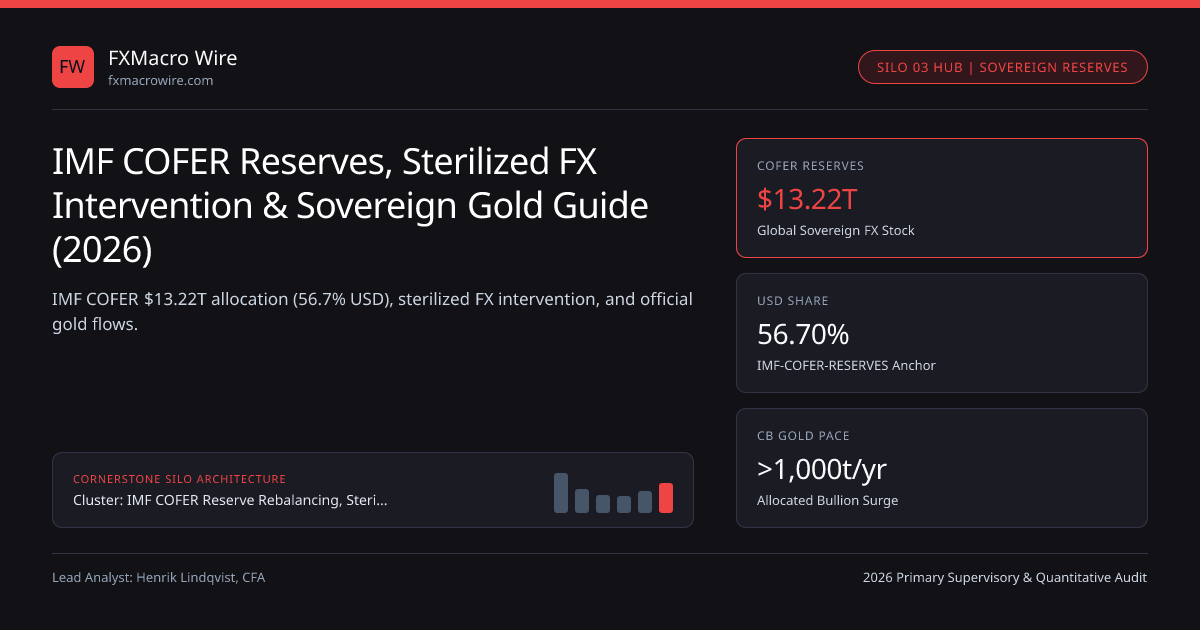
Global monetary authorities steward $13.22 trillion in reported foreign exchange reserves—benchmarked in FinDB's IMF COFER $13.22T Sovereign FX Reserve Allocation and 2026 COFER Benchmark Standard—with 56.70% allocated to US dollar claims, ~19.8% to euro sovereign debt, ~11.5% across non-traditional secondary reserve currencies (AUD, CAD, JPY, GBP, CNY, SGD, CHF), and an accelerating physical bullion tranche exceeding 1,000 metric tons of net annual central bank purchases. Far from passive buy-and-hold savings accounts, sovereign reserve portfolios serve as active operational balance sheets deployed via sterilized spot sales, daily reference-rate fixings, and off-balance-sheet forward books to stabilize exchange rates without surrendering domestic monetary policy autonomy.
Structural Evolution of IMF COFER Reserve Shares: USD, EUR, Non-Traditionals & Gold#
Over the past quarter-century, the US dollar's headline share of allocated IMF Currency Composition of Official Foreign Exchange Reserves (COFER) declined gradually from 71.5% in 2001 to 56.70% in 2026. Crucially, however, that 14.8 percentage-point rotation did not flow into the euro (whose share remained range-bound near 19.5%-20.5% due to sovereign bond fragmentation analyzed in Euro COFER reserve shares and Bund safe-asset scarcity).
Instead, reserve diversification bifurcated across two distinct institutional channels:
- Non-Traditional Liquid Reserve Currencies: Roughly three-quarters of active FX diversification flowed into AAA/AA+ higher-yielding commodity and regional safe-haven bond markets—specifically the Australian dollar, Canadian dollar, Singapore dollar, South Korean won, and Nordic sovereigns—mapped in IMF COFER valuation-adjusted USD reserve flows and non-traditional COFER reserve currencies (AUD, CAD, SGD).
- Allocated Physical Gold Bullion: Emerging-market and Central European central banks seeking sanction-proof, zero-counterparty-risk reserve anchors shifted structural surpluses into allocated London and domestic gold vaults—explored in central bank gold accumulation and vaulting mechanics and CNB Czechia and NBP Poland gold reserve strategies.
Sterilized vs Unsterilized FX Intervention Mechanics#
When a central bank sells $20 billion of US dollar reserves to buy its own depreciating currency, whether it sterilizes the domestic monetary base impact determines whether intervention works through interest rates or pure portfolio-balance channels:
- Unsterilized FX Intervention: When the central bank sells USD and withdraws the purchased domestic currency permanently from commercial bank reserves, domestic interbank liquidity contracts and overnight rates spike—exemplified mechanically by currency boards such as HKMA USD/HKD Linked Exchange Rate HIBOR pass-through and Danmarks Nationalbank EUR/DKK ERM II peg defense.
- Sterilized FX Intervention: Practiced by inflation-targeting G10 and Asian authorities including Tokyo's Ministry of Finance (Japan MoF FEFSA sterilized yen intervention on USD/JPY) and Zurich (SNB sight-deposit tiering and CHF reserve sales). Here, domestic open-market operations immediately re-inject (or drain via central bank bills) the exact domestic cash absorbed by FX trades—leaving the domestic policy interest rate unchanged while altering private-sector bond holdings and signaling policy pain thresholds (portfolio-balance versus signaling FX intervention channels).
Supervisory institutions across Europe and global reserve hubs—including the European Central Bank, BCBS / Bank for International Settlements, CNB Czechia, MNB Hungary, and FINMA, alongside sovereign development entities such as BGK, Central Bank of Malta, and Bank of Latvia—publish standardized IMF SDDS reserve templates audited monthly by macro FX desks.
| Sovereign Reserve Regime | Representative Authority | Primary Policy Instrument | Sterilization Method | FX Market Footprint |
|---|---|---|---|---|
| Free-Floating Episodic Defense | Japan MoF / BoJ (USDJPY) | FEFSA US T-Bill liquidation | 100% sterilized via T-DB rolloffs | $30B-$65B multi-day shock waves |
| Active Two-Way Balance Sheet | Swiss National Bank (USDCHF) | Spot CHF sales / FX reserve trim | SNB Bills & tiered sight deposits | Smooths real CHF REER inflation |
| Managed Basket Crawl Band | MAS Singapore (USDSGD) | S$NEER +/-2% band intervention | MAS Bills & daily FX swaps | Endogenous SORA rate adjustment |
| Daily Counter-Cyclical Parity | PBOC China (USDCNH) | 09:15 CST midpoint + state banks | CNH bills & onshore FX swaps | Caps +/-2.0% daily onshore band |
| Hard Bilateral / ERM II Peg | HKMA (HKD) / Danmarks (DKK) | Automatic band-edge convertibility | Unsterilized Aggregate Balance / CD | Direct overnight rate convergence |
Reserve Accounting & Valuation-Adjusted Flow Decomposition#
Headline quarterly changes in IMF COFER currency shares frequently mislead commentators because exchange-rate and bond-price mark-to-market swings distort reported USD values even when central banks execute zero trades! Institutional strategists strip out currency and yield valuation effects to isolate true active sovereign rebalancing flows (Flow_i):
- ActiveFlow{i,t} = R{i,t} - R{i,t-1} * ( S{i,t} / S{i,t-1} ) * ( P{bond,i,t} / P{bond,i,t-1} )
- Worked Q4 Quarterly IMF COFER Euro Tranche Valuation vs Active Flow Audit:
- Prior Quarter Euro Reserves R_{EUR,t-1} = $2,640.0 Billion (20.00% of $13.20T total)
- During Quarter: Spot EUR/USD drops -4.0% (-0.040); Euro sovereign 3Y bond index gains +0.8% (+0.008)
- Reported Ending Euro Reserves R_{EUR,t} = $2,578.0 Billion (headline drop of -$62.0B -> media claims "Euro dumping"!)
- Passive Valuation Expected Value = $2,640.0B * (0.960) * (1.008) = $2,554.68 Billion
- True Active Central Bank Flow = $2,578.0B - $2,554.68B = +$23.32 Billion NET ACTIVE EURO BUYING into weakness!
(Notice that critical institutional insight: whenever the US dollar rallies +4% in a quarter, non-USD reserve shares mechanically shrink in USD terms—causing central banks that maintain fixed target weights to actively buy EUR, JPY, and GBP* to rebalance back to benchmark!)*
Managed Pegs, SDR Accounting, Off-Balance-Sheet Swaps & Multilateral Rules#
Complete mastery of sovereign FX flows requires tracking all nineteen operational dimensions across Silo 3:
- Managed Reference Rates & Basket Bands: Examine PBOC USD/CNH daily 09:15 parity fixing and counter-cyclical factors (USDCNH-PBOC-FIX), MAS S$NEER band slope and re-centering policy, and Norges Bank NBIM daily petroleum revenue NOK conversions.
- Accounting, Adequacy & Hidden Derivatives: Audit IMF SDR valuation weights and SDRi reserve accounting, BIS Medium-Term Instruments (MTIs) and sovereign swaps, IMF Assessing Reserve Adequacy (ARA) composite metrics, and off-balance-sheet central bank FX forwards and SDDS reporting lags.
- Geopolitics & Multilateral Intervention: Evaluate US Treasury Semi-Annual FX Report manipulation criteria alongside G7 coordinated FX intervention and NY Fed / BoJ rate checks.
Institutional Surveillance Checklist for Quarterly Sovereign Reserve Prints#
To synthesize all five official reserve datasets without confusing mark-to-market price swings for active sovereign trading, institutional macro desks follow a strict monthly and quarterly calendar:
- End-of-Month + 7 Days (National SDDS Section I): Track headline gross foreign exchange and gold holdings across Tokyo, Zurich, Singapore, Copenhagen, Warsaw, and Prague.
- End-of-Month + 30 Days (SDDS Section II.2 & MoF Confirmations): Cross-check off-balance-sheet central bank forward/swap books and Japan Ministry of Finance exact daily intervention tallies.
- End-of-Quarter + 90 Days (IMF COFER Currency Shares): Apply spot FX and 2Y-5Y sovereign bond price deflators to separate passive currency drift from contrarian central bank rebalancing flows.
Explore live sovereign reserve benchmarks, central bank profiles, and verification methodology across our sovereign FX reserves & intervention hub, global FX datasets, and benchmark methodology portal.
Frequently asked questions
What is IMF COFER and what share of global FX reserves is held in US dollars?
IMF Currency Composition of Official Foreign Exchange Reserves (COFER) is the quarterly statistical ledger of global sovereign reserves ($13.22 trillion benchmark), where US dollar assets represent roughly 56.70% of allocated holdings.
What is the difference between sterilized and unsterilized central bank FX intervention?
Unsterilized intervention alters the domestic monetary base and overnight interest rates when buying or selling foreign currency, whereas sterilized intervention uses open-market bond or bill operations to keep domestic bank reserves and policy rates unchanged.
Why does physical gold not appear inside IMF COFER currency percentages?
IMF COFER strictly measures foreign-currency-denominated financial claims (sovereign bonds, T-Bills, deposits); official physical gold reserves are reported separately in IMF International Financial Statistics (IFS) under total international reserves.
Do reserve managers chase currency momentum or rebalance contrarian?
Empirical BIS and ECB studies confirm most reserve managers maintain fixed strategic currency weights, automatically selling appreciating dollars and buying depreciating euros or yen at quarterly rebalancing windows to restore target shares.
Publication record
- Published
- 14 November 2026
- Updated
- 14 November 2026
- Author
- Henrik Lindqvist, CFA
- Review
- Review not recorded
- Automated fact check
- Passed in the stored pipeline record
- Source URLs
- 4 recorded
AI assistance recorded: anthropic/claude-opus-4.6. This field does not establish human review or source verification.
Academic & Institutional Attribution
Cite This Research & Embed Live Data Card
Standard academic & institutional research paper citation format.
Henrik Lindqvist, CFA. (2026, November 14). IMF COFER Reserves, Sterilized FX Intervention & Sovereign Gold Guide (2026). FXMacro Wire. https://fxmacrowire.com/wire/imf-cofer-reserves-sterilized-fx-intervention-guideRelated Sovereign FX Reserves Intervention & Institutional Briefings
Explore Sovereign FX Reserves Intervention Hub (20) →Sovereign FX Reserves Intervention
IMF COFER USD Share: Valuation-Adjusted vs Active Sovereign Reserve FlowsSovereign FX Reserves Intervention
Non-Traditional COFER Reserve Currencies: AUD, CAD, SGD, CNY & NordicsSovereign FX Reserves Intervention
Japan MoF FEFSA Sterilized Yen Intervention: T+2 BoJ Account MechanicsSovereign FX Reserves Intervention
SNB Sight-Deposit Tiering & Two-Way Foreign Exchange Reserve ManagementSovereign FX Reserves Intervention
Central Bank Physical Gold Accumulation, Allocated Vaulting & BIS Gold SwapsSovereign FX Reserves Intervention
IMF Special Drawing Rights (SDR): Basket Weights, SDRi Rate & FX AccountingSovereign FX Reserves Intervention
PBOC USD/CNH Daily 09:15 Parity Fixing, +/-2% Band & Counter-Cyclical FactorSovereign FX Reserves Intervention
MAS S$NEER Band Slope, Width & Re-Centering: Singapore Exchange-Rate PolicyEm Carry Terms of Trade Shocks
Emerging-Market FX Carry, Commodity Terms of Trade & REER Valuation Guide (2026)Safe Haven Capital Flow Regimes
G10 Safe-Haven FX Beta, NIIP & Balance-of-Payments Capital Flow Guide (2026)G10 Central Bank Rate Divergence
EUR/USD Two-Year ESTR-SOFR OIS Spread Elasticity Across Macro RegimesMarket Insights
Nikkei 225 gains 0.53% as yen pressure and tech volatility shape Friday trade - ad-hoc-news.de
FXMacro Wire Data, Benchmarks & Contributor Records
CC BY 4.0 Open Data
Open Institutional Datasets (CSV / JSON) →
Download desk-compiled quantitative series & schemas.
2026 Reference Matrix
2026 Institutional Benchmarks & Thresholds →
Statutory capital, clearing, margin & rate conventions.
Editorial Records
Authors & Review Records →
View named contributors where those records are available.
Complete Index
Master Research & Dossier Archive →
Browse all published briefings by topic pillar & date.