
Sovereign FX Reserves Intervention
Euro COFER Reserve Share (~20%), Bund Scarcity & Joint EU Safe-Asset Supply
Despite representing an economic bloc rivaling the United States in trade and GDP, the euro’s share of global IMF COFER reserves has remained capped near 19.5%-20.5% due to sovereign bond fragmentation and AAA safe-asset scarcity.
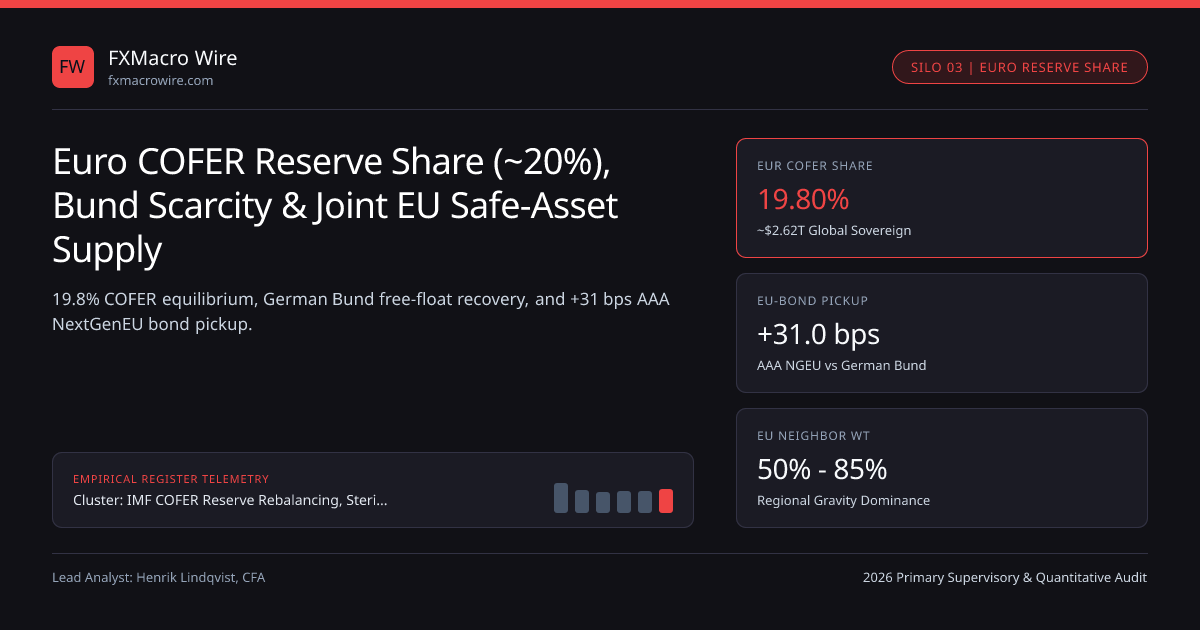
Why has the euro—backed by 350 million citizens, the world's largest merchandise export bloc, and an independent European Central Bank—remained structurally capped near 19.8% of FinDB's $13.22 Trillion IMF COFER Reserves for a quarter-century, never seriously challenging the US dollar's 56.7% crown? Fixed-income plumbing provides an unmistakable answer: reserve managers do not buy "currencies"—they buy ultra-liquid, zero-default-risk AAA sovereign bonds! Until the post-2020 expansion of joint European Union supranational issuance, the Eurozone suffered an acute AAA safe-asset supply deficit!
The Sovereign Fragmentation Bottleneck: $3.2T AAA Eurozone vs $28T+ US Treasuries#
Compare what an Asian or Latin American central bank reserve manager confronts when trying to invest $100 billion into EUR versus USD:
- In the United States: A single, homogeneous, unified $28+ trillion US Treasury market with $900B/day secondary turnover and deep FICC repo.
- In the Eurozone: 20 separate national finance ministries supervised across national markets (BaFin Germany, AMF France, CONSOB Italy, BDE Spain, DNB Netherlands). Strict central bank liquidity-tranche mandates restrict sovereign holdings to AAA / AA+ credit ratings!
- That credit filter excludes Italy (BBB), Spain (A), Portugal (A-), and Greece, leaving only German Bunds/ Bubills (~€1.9T), Dutch DSLs (~€0.4T), and select Nordic/Austrian/French AA- lines—a liquid AAA free-float (net of Eurosystem PSPP/PEPP lockups!) barely one-eighth the size of the US Treasury market!
As contextualized in our IMF COFER reserves hub and AAA non-traditional AUD/CAD/SGD reserve surge, seven years of negative ECB deposit rates (-0.50% from 2014-2022) compounded Bund scarcity—driving the euro's COFER share down from a 2009 peak of 28% (pre-Eurozone debt crisis) to a steady ~19.8% floor!
Three Post-2023 Structural Tailwinds Rebuilding Euro Reserve Appeal#
After a decade on defense, three structural breakthroughs across Frankfurt and Brussels—monitored closely by ECB International Role of the Euro reports and European primary-dealer desks (Boursorama, Bolero, BGK, Central Bank of Malta)—have stabilized and rejuvenated sovereign demand for euro debt:
- Permanent End of Negative Interest Rates (ESTR > 2.0%): Exiting NIRP restored positive nominal coupons across 3-month German Bubills and 2-to-5-year Bunds (ESTR), halting reserve-manager flight!
- ECB Quantitative Tightening (APP + PEPP Runoff): As the Eurosystem lets ~€40B/month of sovereign bonds mature without reinvestment, hundreds of billions of scarce German Bunds are returning to private repo free-float, eliminating the punitive 2022 "Bund repo specialness" squeeze (where Bund GC traded 60+ bps below ESTR!).
- Rise of the Joint AAA "EU-Bond" Curve (NextGenerationEU / SURE / European Defense): Regulated out of Brussels/Luxembourg (CSSF), the European Commission has become Europe's fastest-growing AAA issuer (€600B->€800B+ outstanding), backed by an ECB repo haircut upgrade to Category I (sovereign parity!) and dedicated primary-dealer quoting + Eurex futures!
| Euro Safe-Asset Issuer | S&P / Moody’s Rating | Marketable Stock (Est.) | 10Y Yield vs Bunds | Central Bank Reserve Liquidity Role |
|---|---|---|---|---|
Federal Republic of Germany (Bunds) | AAA / Aaa | ~€1,950B (free-float growing) | 0.0 bps (Anchor) | #1 Liquidity Tranche T+0 benchmark |
European Union (EU-Bonds / NGEU) | AAA / Aaa | ~€650B -> €800B+ | +26 to +34 bps pickup! | High-yield AAA Investment Tranche star! |
Kingdom of the Netherlands (DSLs) | AAA / Aaa | ~€410B | +14 to +18 bps | Core AAA duration supplement |
French Republic (OATs) | AA- / Aa2 | ~€2,650B (deepest repo!) | +68 to +82 bps | Deep liquidity, capped by AA- rating drift |
| EIB /ESM / KfW Supranationals | AAA / Aaa | ~€1,150B combined | +22 to +32 bps | BaFin / CSSF sovereign-guaranteed |
AAA Yield Enhancement Math: Rotating Reserve Tranches from Bunds into EU-Bonds#
Look at row 2 of the table above to see why Asian and Middle Eastern central banks absorb 35% to 45% of every primary European Union syndication: EU-Bonds carry the exact same AAA/Aaa rating as German Bunds and identical ECB Category I repo treatment, yet pay +28 to +34 bps MORE yield because MSCI and FTSE Russell initially hesitated to include supranational EU-Bonds in "pure sovereign" government bond indices! Let's quantify that AAA reserve portfolio yield enhancement:
- ExcessAAAIncomeEUR = PortfolioEUR * Delta w{Bund->EU} * ( Spread{EU-Bund} - LiquidityBidAskDiff )
- Worked €100 Billion Sovereign Euro Reserve Tranche Re-Optimization (5-Year Benchmark):
- 5Y German Bobl Yield y_{Bund} = 2.12%; 5Y AAA European Union Bond Yield = 2.43% (+31.0 bps AAA spread!)
- Bid-ask / repo financing difference post-ECB Cat-I upgrade = 1.5 bps
- Rotating 35% of €100B Euro Reserves (€35.0B) from German Bobls into 5Y AAA EU-Bonds:
- Net Risk-Adjusted Annual Income Gain = €35.0B * (31.0 - 1.5 bps) = +€103.25 Million/year with ZERO AAA credit downgrade!
The "Regional Gravity Law" of Euro Reserves vs Global Dollar Network Effects#
ECB balance-of-payments audits confirm a stark geographic split: within a 2,000-kilometer radius of Frankfurt (non-euro EU, Balkans, North Africa, Switzerland), the euro commands a 50% to 85% reserve share because bilateral trade and external debt are invoiced in euros! Across Asia and the Americas, however, dollar trade invoicing keeps EUR weights near 12%-16%.
What Would Lift the Euro's Global COFER Share Back Toward 25%?#
Institutional strategists tracking our sovereign FX reserves & intervention hub and COFER valuation-adjusted models point to a single structural catalyst: making joint EU fiscal bond issuance permanent beyond 2026 (via joint European defense/industrial financing) AND gaining full sovereign-index inclusion (FTSE WGBI / Bloomberg Global Aggregate Treasury)—transforming Brussels' €800B tranche into a permanent €2T-€3T AAA rival to US Treasuries!
Frequently asked questions
Why did the euro’s share of global FX reserves drop from 28% in 2009 to ~20% today?
The 2010-2012 Eurozone sovereign debt crisis caused peripheral bond downgrades out of AAA reserve eligibility, followed immediately by eight years (2014-2022) of negative ECB interest rates and QE Bund scarcity.
Why do AAA European Union (NextGenEU) bonds yield ~30 bps more than AAA German Bunds?
Major sovereign bond index providers classify the European Union as a supranational issuer rather than a nation-state, excluding EU-Bonds from pure passive government bond trackers—gifting central bank buyers +30 bps free pickup!
How did ECB Quantitative Tightening (QT) actually help foreign central bank reserve managers?
During QE, the Bundesbank/ECB locked up over 40% of German Bunds, driving repo rates deeply negative; QT runoff returns €350B+/yr of sovereign collateral to private markets, normalizing Bund liquidity.
Could French OAT credit rating downgrades shrink the euro’s COFER reserve share?
Most central banks retain AA-/Aa2 sovereigns inside their liquid investment tranches; only a multi-notch slide into single-A territory would force strict AA-minimum reserve mandates to rotate out of OATs into EU-Bonds and Bunds.
Publication record
- Published
- 13 November 2026
- Updated
- 14 November 2026
- Author
- Henrik Lindqvist, CFA
- Review
- Review not recorded
- Automated fact check
- Passed in the stored pipeline record
- Source URLs
- 3 recorded
AI assistance recorded: anthropic/claude-opus-4.6. This field does not establish human review or source verification.
Academic & Institutional Attribution
Cite This Research & Embed Live Data Card
Standard academic & institutional research paper citation format.
Henrik Lindqvist, CFA. (2026, November 14). Euro COFER Reserve Share (~20%), Bund Scarcity & Joint EU Safe-Asset Supply. FXMacro Wire. https://fxmacrowire.com/wire/euro-cofer-reserve-share-bund-scarcity-eu-safe-assetsRelated Sovereign FX Reserves Intervention & Institutional Briefings
Explore Sovereign FX Reserves Intervention Hub (20) →Sovereign FX Reserves Intervention
IMF COFER Reserves, Sterilized FX Intervention & Sovereign Gold Guide (2026)Sovereign FX Reserves Intervention
HKMA USD/HKD Linked Exchange Rate (7.75-7.85) & HIBOR Pass-Through MathSovereign FX Reserves Intervention
BIS Medium-Term Instruments (MTIs), Fixbis & Sovereign Reserve ConfidentialitySovereign FX Reserves Intervention
IMF Assessing Reserve Adequacy (ARA) Metric vs Guidotti-Greenspan RulesSovereign FX Reserves Intervention
Off-Balance-Sheet Central Bank FX Forwards, Swaps & IMF SDDS Reporting LagsSovereign FX Reserves Intervention
Norges Bank Daily NOK FX Conversions & $1.8T NBIM Petroleum Fiscal RuleSovereign FX Reserves Intervention
G7 Coordinated FX Intervention vs Unilateral Strikes & NY Fed Rate ChecksSovereign FX Reserves Intervention
IMF COFER USD Share: Valuation-Adjusted vs Active Sovereign Reserve FlowsEm Carry Terms of Trade Shocks
Diversified FX Carry Funding Baskets: JPY, CHF, EUR & CNH OptimizationEm Carry Terms of Trade Shocks
Fiscal Dominance & Sovereign CDS: When EM Central Bank Hikes Weaken FX!Em Carry Terms of Trade Shocks
USD/TWD & Taiwan Life Insurers: $700B USD Bond Book, Proxy Hedges & NDFsEm Carry Terms of Trade Shocks
USD/TRY Orthodox Carry Pivot: CBRT Swap Unwind, Real Lira Appreciation & REER
FXMacro Wire Data, Benchmarks & Contributor Records
CC BY 4.0 Open Data
Open Institutional Datasets (CSV / JSON) →
Download desk-compiled quantitative series & schemas.
2026 Reference Matrix
2026 Institutional Benchmarks & Thresholds →
Statutory capital, clearing, margin & rate conventions.
Editorial Records
Authors & Review Records →
View named contributors where those records are available.
Complete Index
Master Research & Dossier Archive →
Browse all published briefings by topic pillar & date.