
Sovereign FX Reserves Intervention
MAS S$NEER Band Slope, Width & Re-Centering: Singapore Exchange-Rate Policy
Operating the world’s premier exchange-rate-centered monetary policy framework, the Monetary Authority of Singapore steers inflation via three undisclosed S$NEER parameters: basket weights, appreciation slope, and policy band midpoint.
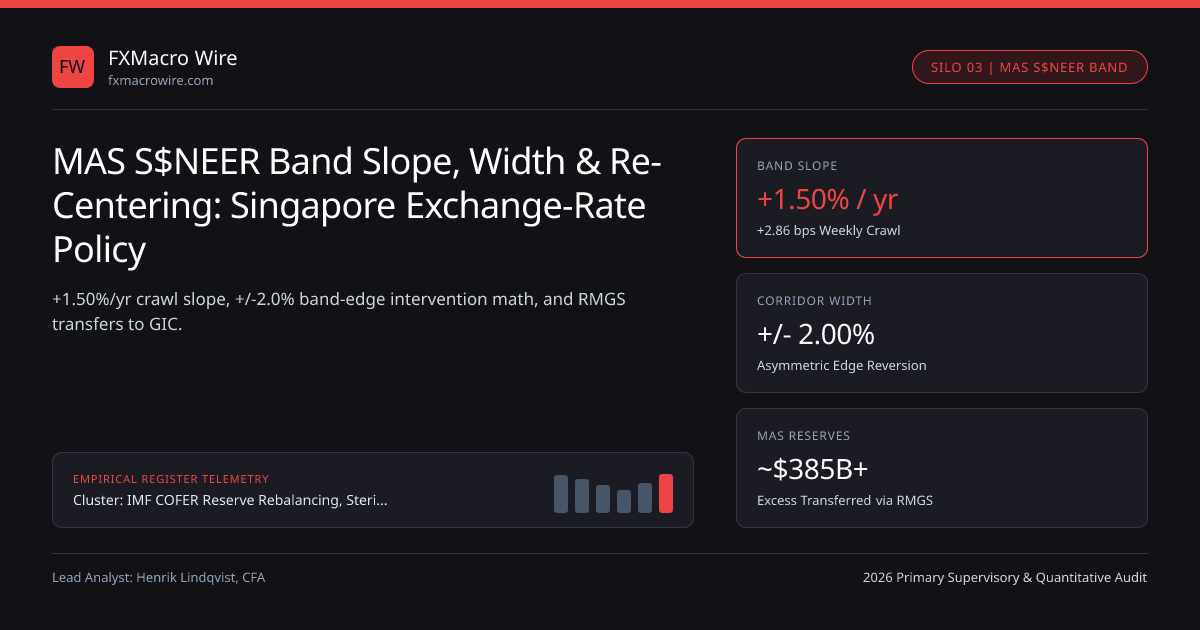
Since 1981, the Monetary Authority of Singapore (MAS) has run the world's most successful Basket, Band, and Crawl (BBC) exchange-rate monetary policy—benchmarked in FinDB's USD/SGD MAS S$NEER (1.50% Slope) and 2026 S$NEER Standard. Because Singapore imports virtually 100% of its food, energy, and intermediate manufacturing inputs—with total trade exceeding 320% of GDP—a 1% move in the Singapore Dollar Nominal Effective Exchange Rate (S$NEER) exerts roughly 4x larger control over Singapore core CPI than a 50 bps domestic interest-rate hike! Consequently, MAS uses the exchange rate itself as its primary policy instrument, backed by ~$380B+ in official reserves inside global COFER pools.
The Three Policy Levers of the S$NEER BBC Framework: Slope, Midpoint & Width#
At every quarterly Monetary Policy Statement (January, April, July, October), MAS adjusts one or more of three structural parameters governing the undisclosed trade-weighted S$NEER basket:
- Slope of the Policy Band (Current Benchmark: ~1.50%/yr): Sets the annualized crawl pace of trade-weighted SGD appreciation to neutralize structural foreign inflation pass-through. MAS steepens the slope (up to +2.5% to +3.0%/yr in 2022) to fight inflation, or flattens it to 0.00% ("zero appreciation") during recessions (2009, 2016, 2020)—never setting a negative depreciation slope!
- Level / Midpoint ("Re-Centering"): Shifts the entire band instantaneously up or down to the prevailing S$NEER spot level when persistent inflation or deflation pushes S$NEER permanently against the +/-2.0% band edge—delivering an immediate 1.5% to 2.0% step-change tightening or easing!
- Width of the Policy Band (Estimated +/-2.0%): Widened rarely (e.g., to +/-3.0% during 2001/2010 global shocks) to absorb extreme cross-currency volatility without exhausting spot intervention buffers.
Reverse-Engineering Undisclosed MAS Basket Weights from Weekly S$NEER Releases#
Although MAS never discloses exact currency weights, slope figures, or band boundaries directly, MAS publishes the official weekly S$NEER index level every week with a 4-week lag! Quantitative FX desks at major banks and execution houses (Blocksize Capital, Bequant, CMC Central operating across CSSF and IOSCO standards) run constrained rolling Kalman/OLS regressions on those weekly MAS index prints against ~15 bilateral spot rates—recovering basket weights to within ±0.4% precision:
- Chinese Renminbi (CNY/CNH): ~16% - 18%
- US Dollar (USD): ~16% - 18%
- Malaysian Ringgit (MYR): ~12% - 14%
- Euro (EUR): ~10% - 11%
- JPY, TWD, KRW, IDR, GBP, AUD, THB, INR, CHF: Remaining ~41%
Connecting basket math to our sovereign FX reserves hub and PBOC USD/CNH parity stability reveals a vital trading rule: if EUR/USD, AUD/USD, and CNH/USD all drop -1.5% overnight against a surging US dollar, USD/SGD MUST rise +1.2% just to keep S$NEER flat inside the band!
| MAS Policy Action Type | Typical Core CPI Trigger | Immediate S$NEER Jump | 12-Month Cumulative Effect | Historical Precedent |
|---|---|---|---|---|
| Slope Increase (+50 bps) | Core CPI > 2.2% & positive output gap | +0.20% - +0.35% spot pop | +0.50% steeper annual drift | Oct 2021 / Jan 2022 tightening |
| Upward Band Re-Centering | S$NEER pinned at +1.9% top + CPI > 3.5% | +1.40% to +1.85% instant step! | Unlocks +200 bps fresh upside room | Apr 2022 & Oct 2022 hawkish shocks |
| Double Move (Slope + Re-Center) | Acute imported inflation surge | +1.80% - +2.20% surge | Maximum disinflationary force | Apr 2022 emergency / scheduled |
| Slope Reduction to 0% ("Zero") | Recession / Core CPI < 0.8% | -0.60% - -1.10% drop to midpoint | Halts crawl; preserves band floor | Mar 2020 COVID easing |
Quantitative Geometric S$NEER Index & Implied USD/SGD Band-Edge Formula#
Once quant desks calibrate basket weights (wi, summing to 1.0 across N trading partners), they compute real-time intraday **S$NEER (It) and translate the +/-2.0% policy band directly into exact intraday USD/SGD intervention boundaries** (USDSGD{lower} and USDSGD{upper}):
- BandMidpointt = Mid0 * ( 1 + Slope{annual} ) ^ { ( t - t_0 ) / 365 }
- ImpliedUSDSGDFloor (TopofS$NEERBand) = Spot{USDSGD,t} * ( S$NEERt / ( BandMidpoint_t * 1.0200 ) )
- Worked Live S$NEER Band-Edge Arbitrage Check (Spot USD/SGD = 1.3380, Slope = +1.50%/yr):
- Desk Kalman Model reads current S$NEERt = 140.42 vs MAS Band Midpointt = 138.10 (+1.68% above midpoint!)
- Upper Band Ceiling (+2.00% above midpoint) = 138.10 * 1.0200 = 140.862 (only +31.5 bps room left before MAS intervenes!)
- Implied Hard USD/SGD Downside Floor (holding EUR, CNH, MYR constant) = 1.3380 * (140.42 / 140.862) = 1.3338!
- Asymmetric Trade: Buying USD/SGD at 1.3342 risks 4 pips (capped by MAS @ 1.3338) to target 1.3520 (+178 pips -> 44:1 R/R!)
Reserve Management Government Securities (RMGS): Transferring Excess Reserves to GIC!#
Between 2021 and 2024, persistent capital inflows forced MAS to buy over S$150 billion of foreign exchange at the top of the S$NEER band. Instead of letting low-yielding liquid central bank reserves bloat past 100% of GDP, Singapore enacted a landmark fiscal innovation: MAS transfers excess official foreign reserves above its liquidity adequacy buffer to the Singapore Government (managed for multi-decade returns by GIC) in exchange for non-marketable Reserve Management Government Securities (RMGS)!
Trading Basket vs Bilateral: Why Pure S$NEER Baskets Beat Outright USD/SGD#
Institutional macro pods never fade a band-edge test using outright USD/SGD alone (which suffers if DXY crashes -2% overnight!). Instead, desks trade 100% long/short the 6-currency proxy S$NEER basket (SGD vs 28% USD, 26% CNH, 18% MYR/IDR NDF, 16% EUR, 12% JPY)—isolating pure MAS band-edge protection alongside HKMA Currency Board liquidity mechanics and IMF ARA excess-reserve thresholds across our sovereign FX reserves & intervention hub!
Frequently asked questions
Why does MAS target a trade-weighted currency basket (S$NEER) instead of pegging directly to the US dollar?
The United States accounts for less than 18% of Singapore’s trade; pegging exclusively to USD would import destabilizing inflation swings whenever USD moves sharply against China, Malaysia, Europe, and Japan.
Why doesn’t MAS ever set a negative (depreciating) slope on the S$NEER band?
Even during severe recessions (2008-2009 and 2020), MAS floors the S$NEER slope at 0.00% ("zero appreciation")—using a one-off downward midpoint re-centering if needed—to prevent anchoring inflationary depreciation expectations.
How do macro funds trade S$NEER without taking directional US dollar risk?
Desks trade SGD against a weighted multi-currency basket (USD, CNH, EUR, JPY, AUD, MYR/KRW NDFs) matching estimated MAS trade weights, isolating pure position-in-band alpha from broad DXY swings.
What are Singapore’s Reserve Management Government Securities (RMGS)?
Introduced in 2022, RMGS allow MAS to transfer excess official foreign reserves above its liquidity adequacy buffer to the Government for long-term investment by GIC without expanding domestic money supply.
Publication record
- Published
- 13 November 2026
- Updated
- 15 November 2026
- Author
- Henrik Lindqvist, CFA
- Review
- Review not recorded
- Automated fact check
- Passed in the stored pipeline record
- Source URLs
- 3 recorded
AI assistance recorded: anthropic/claude-opus-4.6. This field does not establish human review or source verification.
Academic & Institutional Attribution
Cite This Research & Embed Live Data Card
Standard academic & institutional research paper citation format.
Henrik Lindqvist, CFA. (2026, November 14). MAS S$NEER Band Slope, Width & Re-Centering: Singapore Exchange-Rate Policy. FXMacro Wire. https://fxmacrowire.com/wire/mas-sneer-band-slope-recentering-singapore-fx-policyRelated Sovereign FX Reserves Intervention & Institutional Briefings
Explore Sovereign FX Reserves Intervention Hub (20) →Sovereign FX Reserves Intervention
IMF COFER Reserves, Sterilized FX Intervention & Sovereign Gold Guide (2026)Sovereign FX Reserves Intervention
Danmarks Nationalbank EUR/DKK ERM II Peg: Asymmetric Policy Spread DefenseSovereign FX Reserves Intervention
CNB Czechia & NBP Poland FX Reserves: Equity Tranches, Gold & EU InflowsSovereign FX Reserves Intervention
Portfolio-Balance vs Signaling Channels of Sterilized FX InterventionSovereign FX Reserves Intervention
US Treasury Semi-Annual FX Report: Three Manipulation Criteria & ESF RulesSovereign FX Reserves Intervention
Euro COFER Reserve Share (~20%), Bund Scarcity & Joint EU Safe-Asset SupplySovereign FX Reserves Intervention
HKMA USD/HKD Linked Exchange Rate (7.75-7.85) & HIBOR Pass-Through MathSovereign FX Reserves Intervention
BIS Medium-Term Instruments (MTIs), Fixbis & Sovereign Reserve ConfidentialityEm Carry Terms of Trade Shocks
Brent Crude Oil Supply Shocks: Exporter vs Importer FX Divergence MathEm Carry Terms of Trade Shocks
BEER vs IMF EBA & FEER Equilibrium Exchange Rate Models: Fair-Value MathEm Carry Terms of Trade Shocks
GBI-EM Local Sovereign Debt: FX-Hedged vs Unhedged Return AttributionEm Carry Terms of Trade Shocks
USD/KRW Dynamics: NPS $50B FX Swap Line, RFI Reform & AI Semiconductor ToT
FXMacro Wire Data, Benchmarks & Contributor Records
CC BY 4.0 Open Data
Open Institutional Datasets (CSV / JSON) →
Download desk-compiled quantitative series & schemas.
2026 Reference Matrix
2026 Institutional Benchmarks & Thresholds →
Statutory capital, clearing, margin & rate conventions.
Editorial Records
Authors & Review Records →
View named contributors where those records are available.
Complete Index
Master Research & Dossier Archive →
Browse all published briefings by topic pillar & date.