
Sovereign FX Reserves Intervention
US Treasury Semi-Annual FX Report: Three Manipulation Criteria & ESF Rules
Under the Omnibus Trade and Competitiveness Act of 1988 and the Trade Facilitation and Trade Enforcement Act of 2015, the US Treasury audits 20 major trading partners twice yearly against three quantitative currency-manipulation thresholds.
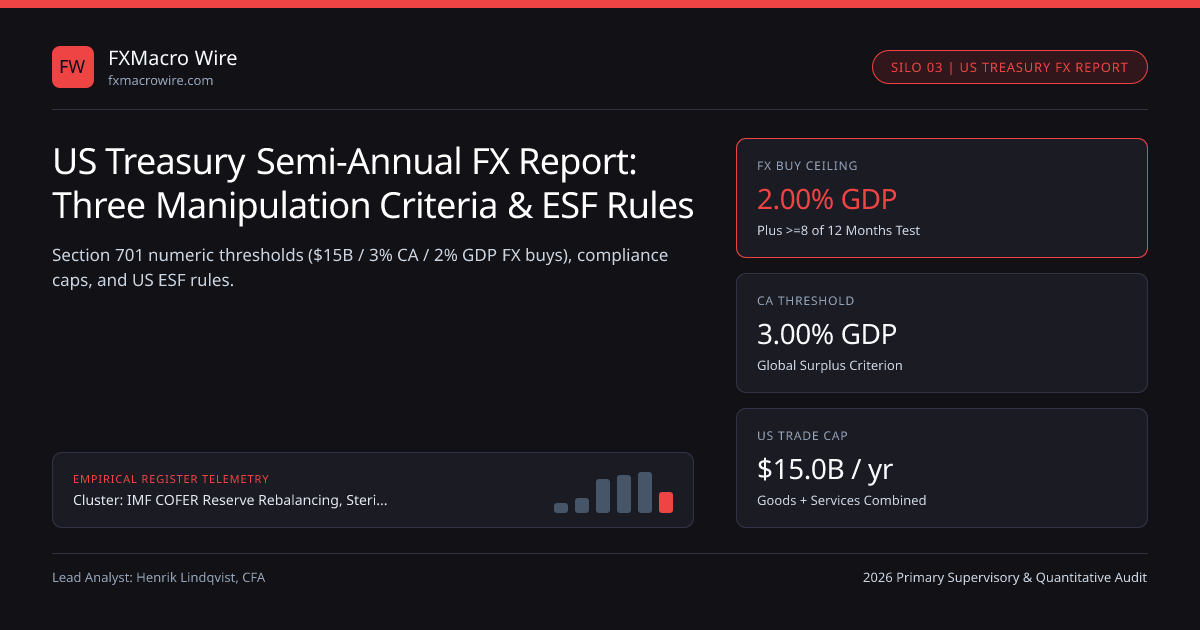
Twice every calendar year, reserve managers in Tokyo, Zurich, Singapore, Taipei, Beijing, Frankfurt, and Seoul audit every dollar of their spot and forward intervention books against a single Washington statutory yardstick: the US Department of the Treasury's Semi-Annual Report on Macroeconomic and Foreign Exchange Policies of Major Trading Partners of the United States. Enforced under the 1988 Act and codified quantitatively by Section 701 of the Trade Facilitation and Trade Enforcement Act of 2015, breaching two of Washington's three numeric thresholds places a nation on the Monitoring List—while breaching all three triggers mandatory "Enhanced Analysis" / Currency Manipulator designation, bilateral IMF consultations, and potential USTR/OPIC trade and procurement penalties!
The Exact Three Quantitative Thresholds of the 2015 Act (2026 Benchmarks)#
Treasury's Office of International Affairs screens all major US trading partners (goods + services bilateral trade > $40 billion) across three strict 4-quarter rolling metrics:
- Criterion 1 — Significant Bilateral US Trade Surplus: Goods and services trade surplus with the United States >= $15 billion over a 12-month period.
- Criterion 2 — Material Current Account Surplus: Economy-wide global current-account surplus >= 3.0% of GDP (accompanied by Treasury's global External Balance Assessment gap check).
- Criterion 3 — Persistent, One-Sided FX Intervention: Net purchases of foreign currency (weakening the domestic currency!) totaling >= 2.0% of GDP over 12 months AND conducted net-positive in at least 8 out of 12 months!
Look closely at Criterion 3's exact wording—connected to our sovereign FX reserves hub, Japan MoF FEFSA yen buying, and Swiss National Bank CHF policy—to grasp a massive institutional distinction: SELLING US dollar reserves to DEFEND and STRENGTHEN your currency (like Japan in 2022-2024 or SNB in 2022-2023) goes NEGATIVE on Criterion 3 and NEVER triggers US manipulation penalties! Criterion 3 exclusively polices persistent FX BUYING (>= 2.0% of GDP) aimed at holding a currency artificially weak!
How Central Banks Stay Legally Under Criterion 3 ("1.8% GDP & 7-Month Pacing")#
Because Switzerland (USD/CHF), Singapore, Taiwan, Vietnam, Germany, China (USD/CNH), Japan, and South Korea almost permanently exceed Criterion 1 (> $15B US surplus) and/or Criterion 2 (> 3% GDP current account), Criterion 3 (2.0% of GDP AND 8/12 months) functions as the de-facto global speed limit on central bank FX buying!
- Historical Case Study (2020): During the COVID safe-haven shock, both Switzerland (buying CHF 110B = 14% of GDP!) and Vietnam tripped all three 2015 Act thresholds simultaneously and were formally labeled by the US Treasury in December 2020 (before transitioning in 2021 to "Enhanced Bilateral Engagement" acknowledging Switzerland's deflation mandate).
- The 1.9% GDP / 7-Month Compliance Cap: Outside extreme deflation panics, reserve managers whose countries already trip Criteria 1 and 2 carefully cap rolling 12-month net FX purchases (including net changes in off-balance-sheet FX forwards audited in SDDS forward disclosures!) below 1.85% of GDP OR concentrate purchases into 6 or 7 discrete months so they never cross the 8-of-12-months persistence test!
European Eurosystem authorities (ECB, BaFin / Germany, CBI / Ireland, DNB / Netherlands) routinely land on the Monitoring List due to bilateral US trade and current-account surpluses, yet easily record 0.00% on Criterion 3 because the ECB has not intervened unilaterally since November 2000!
| Evaluated Trading Partner | Criterion 1: US Surplus >=$15B? | Criterion 2: CA >=3% GDP? | Criterion 3: FX Buy >=2% GDP? | Typical Treasury Classification |
|---|---|---|---|---|
Germany / Ireland (EUR) | Yes ($60B+ goods/services) | Yes (4.5% - 7.0% GDP) | No (0.0% ECB intervention) | Monitoring List (2 of 3 criteria) |
Japan (USD/JPY) | Yes ($50B+ goods surplus) | Yes (~3.6% - 4.2% GDP) | No (Net FX SELLER -1.5% GDP!) | Monitoring List (2 of 3 criteria) |
Singapore (USD/SGD) | Often No (US runs services surplus!) | Yes (~18% - 19% GDP) | Yes (>4% GDP via S$NEER + RMGS) | Monitoring List (1-2 criteria) |
| Taiwan / Vietnam | Yes ($45B - $105B tech surplus) | Yes (5% - 14% GDP) | Strictly managed < 2.0% GDP! | Monitoring List / Enhanced Watch |
China (USD/CNY) | Yes ($240B+ bilateral surplus) | Borderline (1.5% - 2.6% GDP) | Opaque state-bank swap scrutiny | Permanent Statutory Monitoring! |
Maximum Compliant Monthly FX Buying Budget Formula Under Criterion 3#
For FX strategists trading USD/TWD, USD/CHF, USD/KRW, or USD/VND (via institutional desks such as Blocksize Capital and Bequant), Criterion 3 lets you calculate the exact maximum US dollar buying ceiling (Cap_{USD,12M}) a surplus central bank can execute before triggering Washington sanctions:
- SafeHarborCeilingUSD = 0.0195 * NominalGDP_{USD} (staying safely under 2.00% statutory line)
- PersistenceEscapeRule = Count( MonthswithNetFXBuys > 0 ) <= 7outof_12
- Worked Taiwan CBC / Asian Exporter Compliance Ceiling Audit (Nominal GDP = $810 Billion USD):
- Criterion 1 ($62B US trade surplus >= $15B): TRIPPED | Criterion 2 (13.8% GDP CA >= 3%): TRIPPED!
- Therefore Criterion 3 MUST NOT trip, or automatic 3-of-3 Enhanced Manipulation triggers!
- Hard 12-Month Net USD Buying Ceiling = 0.0200 * $810.0B = $16.20 Billion/year (~$1.35B/month average)!
- Trading Alpha: Once rolling 9-month central bank USD buying hits $14.8B, the central bank MUST step aside on Q4 rallies!
Inside America's Own War Chest: The US Treasury Exchange Stabilization Fund (ESF)#
Just like Japan's MoF, in the United States, primary statutory authority over US foreign exchange policy belongs to the Secretary of the Treasury via the Exchange Stabilization Fund (ESF, created by the Gold Reserve Act of 1934)—while the Federal Reserve (FOMC) participates traditionally as an equal 50/50 co-financier executed by the NY Fed Foreign Exchange Desk! Holding ~$39B-$42B in net EUR and JPY securities plus ~$160B in US SDR holdings, any hypothetical US intervention against DXY strength requires joint Treasury Secretary + Fed Chair sign-off!
Trading Implications Around Semi-Annual May/June & November/December Releases#
Macro FX Volatility desks track the rolling 4-quarter data cutoffs ahead of each May/June and November/December Treasury FX Report. Whenever an Asian export economy approaches 1.80% to 1.95% of GDP in cumulative 12-month USD purchases, state banks systematically step back from late-session USD buying bids during the final weeks of the evaluation quarter—creating asymmetric tactical downside windows in USD/TWD, USD/KRW, and USD/SGD documented across our sovereign FX reserves & intervention hub!
Frequently asked questions
What is the difference between the US Treasury’s 1988 Act and 2015 Act currency designations?
The 2015 Act sets three strict numeric thresholds (15B/3%/2%) triggering enhanced bilateral engagement and investment/procurement penalties, whereas the 1988 Act uses a broader qualitative "intent to gain unfair competitive advantage" standard (used on China in August 2019).
Why does China remain on the US Treasury Monitoring List even when meeting only one numeric criterion?
Treasury guidelines automatically retain any trading partner accounting for a disproportionate share (~30%+) of America’s overall goods trade deficit or exhibiting opaque state-bank FX intervention disclosures.
Can central banks evade Criterion 3 by intervening through FX forwards instead of spot?
No. The US Treasury explicitly sums both spot reserve intervention and net changes in aggregate short and long positions in forwards and futures (IMF SDDS Section IV) when computing the 2.0%-of-GDP threshold.
Who holds legal authority to intervene in FX markets for the United States?
Under the Gold Reserve Act of 1934, the US Secretary of the Treasury directs US exchange-rate policy via the Exchange Stabilization Fund (ESF), historically coordinating 50/50 joint execution with the Federal Reserve System.
Publication record
- Published
- 13 November 2026
- Updated
- 14 November 2026
- Author
- Henrik Lindqvist, CFA
- Review
- Review not recorded
- Automated fact check
- Passed in the stored pipeline record
- Source URLs
- 3 recorded
AI assistance recorded: anthropic/claude-opus-4.6. This field does not establish human review or source verification.
Academic & Institutional Attribution
Cite This Research & Embed Live Data Card
Standard academic & institutional research paper citation format.
Henrik Lindqvist, CFA. (2026, November 14). US Treasury Semi-Annual FX Report: Three Manipulation Criteria & ESF Rules. FXMacro Wire. https://fxmacrowire.com/wire/us-treasury-esf-fx-report-manipulation-thresholdsRelated Sovereign FX Reserves Intervention & Institutional Briefings
Explore Sovereign FX Reserves Intervention Hub (20) →Sovereign FX Reserves Intervention
IMF COFER Reserves, Sterilized FX Intervention & Sovereign Gold Guide (2026)Sovereign FX Reserves Intervention
Euro COFER Reserve Share (~20%), Bund Scarcity & Joint EU Safe-Asset SupplySovereign FX Reserves Intervention
HKMA USD/HKD Linked Exchange Rate (7.75-7.85) & HIBOR Pass-Through MathSovereign FX Reserves Intervention
BIS Medium-Term Instruments (MTIs), Fixbis & Sovereign Reserve ConfidentialitySovereign FX Reserves Intervention
IMF Assessing Reserve Adequacy (ARA) Metric vs Guidotti-Greenspan RulesSovereign FX Reserves Intervention
Off-Balance-Sheet Central Bank FX Forwards, Swaps & IMF SDDS Reporting LagsSovereign FX Reserves Intervention
Norges Bank Daily NOK FX Conversions & $1.8T NBIM Petroleum Fiscal RuleSovereign FX Reserves Intervention
G7 Coordinated FX Intervention vs Unilateral Strikes & NY Fed Rate ChecksEm Carry Terms of Trade Shocks
Brazil BCB Swap Cambial & Cupom Cambial (DDI): Onshore BRL USD LiquidityEm Carry Terms of Trade Shocks
Diversified FX Carry Funding Baskets: JPY, CHF, EUR & CNH OptimizationEm Carry Terms of Trade Shocks
Fiscal Dominance & Sovereign CDS: When EM Central Bank Hikes Weaken FX!Em Carry Terms of Trade Shocks
USD/TWD & Taiwan Life Insurers: $700B USD Bond Book, Proxy Hedges & NDFs
FXMacro Wire Data, Benchmarks & Contributor Records
CC BY 4.0 Open Data
Open Institutional Datasets (CSV / JSON) →
Download desk-compiled quantitative series & schemas.
2026 Reference Matrix
2026 Institutional Benchmarks & Thresholds →
Statutory capital, clearing, margin & rate conventions.
Editorial Records
Authors & Review Records →
View named contributors where those records are available.
Complete Index
Master Research & Dossier Archive →
Browse all published briefings by topic pillar & date.