
Sovereign FX Reserves Intervention
IMF COFER USD Share: Valuation-Adjusted vs Active Sovereign Reserve Flows
Every quarter when the IMF releases COFER reserve statistics, financial headlines conflate passive US dollar exchange-rate and bond-price mark-to-market effects with active central bank de-dollarization.
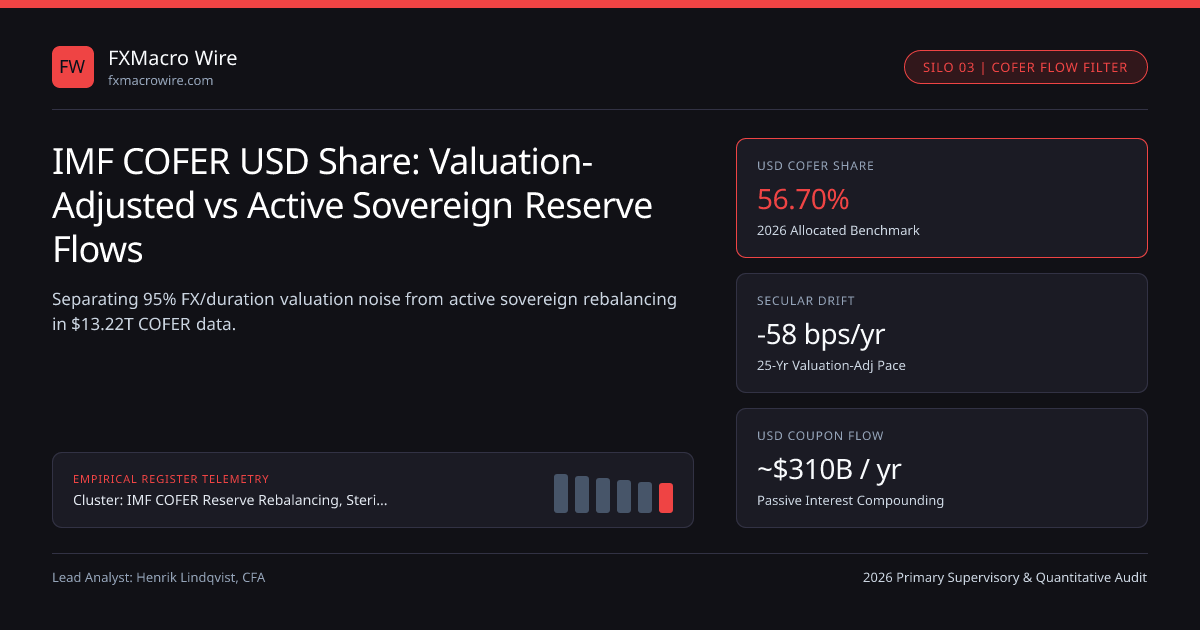
Whenever the International Monetary Fund publishes its quarterly COFER release—tracking FinDB's $13.22 Trillion Sovereign FX Reserve Allocation—sensationalist commentary inevitably misreads a 0.6% quarterly swing in the US dollar's 56.70% share as sudden geopolitical "de-dollarization" or "dollar hoarding." In reality, because all eight disclosed COFER currency buckets are converted into current US dollars at quarter-end spot exchange rates and marked to market at quarter-end sovereign bond prices, passive valuation swings across DXY and EUR/USD regularly dwarf active central bank trading by 3-to-1!
The Denominator Paradox: Why a Stronger Dollar Automatically Raises USD COFER Share!#
Consider a stylized global reserve pool holding $6.0 trillion in US Treasuries and €4.0 trillion in German Bunds (worth $4.40T at EUR/USD = 1.10, giving USD a 57.69% share). Suppose during Q3 not a single central bank buys or sells a dime, while spot EUR/USD falls -6% to 1.0340:
- The €4.0 trillion euro bond pile is now worth only $4.136 trillion in USD reporting units.
- Without a single dollar purchased, the US dollar's reported COFER share mechanically jumps from 57.69% to 59.20% (+151 bps)!
Conversely, when the dollar weakens -5% across a risk-on quarter, the USD's headline COFER share drops -125 bps—prompting erroneous claims of dollar flight! As established in our IMF COFER reserves and FX intervention hub, Arslanalp, Eichengreen, and Simpson-Bell's IMF valuation-adjusted series is mandatory before drawing macro FX conclusions.
Sovereign Contrarian Rebalancing as an Automatic G10 FX Volatility Dampener#
Most central bank investment committees—supervised by boards at the European Central Bank, CNB Czechia, De Nederlandsche Bank, Banco de Portugal, and Latvijas Banka alongside institutional reserve peers like Bank of Latvia and Central Bank of Malta—manage their investment tranches against fixed strategic currency benchmark weights (for example: 62% USD, 22% EUR, 6% JPY, 5% GBP, 5% CAD/AUD) with narrow +/-1.5% tactical drift bands.
When a sharp +6% US dollar rally pushes a central bank's actual USD portfolio weight up to 63.8% (breaching its +1.5% upper drift band), automatic compliance rebalancing compels the reserve desk to SELL US dollars and BUY euros, sterling, and Canadian dollars at quarter-end! Comparing this stabilizing flow with non-traditional AUD, CAD, and SGD reserve allocations and Eurozone safe-asset Bund scarcity explains why sovereign reserve rebalancing acts as G10 FX's largest mean-reverting buyer of beat-up major currencies!
| Quarterly Market Scenario | Raw Headline USD Share Move | Passive FX Valuation Effect | Typical Active Central Bank Action | Net Spot FX Impact at Q-End |
|---|---|---|---|---|
Broad USD Rally (DXY +5%), Flat Yields | +115 to +145 bps higher | shrinks non-USD buckets in $ | Sells USD / Buys EUR & GBP to cap weight | Dampens late-quarter USD rally |
Broad USD Drop (DXY -5%), Flat Yields | -115 to -145 bps lower | Inflates EUR/JPY/AUD in $ | Buys USD / Sells EUR to restore floor | Supports DXY into quarter-end |
UST Bear Selloff (2Y UST +60 bps) | -25 to -45 bps lower | Marks down USD bond prices | Reinvests higher 4%+ UST coupons | Neutral-to-supportive for USD |
Asian FX Defense (MoF/EM Intervention) | -35 to -70 bps lower | Minimal direct FX translation | Liquidates liquid US T-Bills for spot defense | Caps USD/JPY & USD/EM spikes |
Exact Constant-Exchange-Rate & Constant-Price COFER Share Formula#
To compute the valuation-adjusted change in USD reserve share (Delta w^{adj}_{USD}) between t-1 and t, macro quant pipelines deflate each currency bucket i by its bilateral USD appreciation factor (g^{FX}{i,t}) and sovereign bond price return (g^{Px}{i,t}):
- w^{}_{USD,t} = R^{}{USD,t} / Sum{alli} ( R^{*}{i,t} )
- ActiveShareShiftUSD = w^{*}{USD,t} - w_{USD,t-1}
- Worked Two-Bucket Stylised Global COFER Quarter (USD + Non-USD Basket = $13.00T at t-1):
- Start (t-1): USD = $7,410B (57.00%), Non-USD = $5,590B (43.00%)
- Market Shocks in Quarter t: Non-USD currencies appreciate +3.5% vs USD; UST prices -0.6%, Non-USD bond prices +0.4%
- Reported End (t): USD = $7,395B (55.85% -> headline screams "-115 bps USD share collapse!"), Non-USD = $5,845B
- Deflated R_{USD,t} = $7,395 / 0.994 = $7,439.6B (+$29.6B active buying!); R_{NonUSD,t} = $5,845 / (1.035*1.004) = $5,624.8B
- True Valuation-Adjusted USD Share w*_{USD,t} = 7,439.6 / 13,064.4 = 56.95% (just -5 bps true drift vs -115 bps headline!)
The 4.0%+ US Treasury Coupon Compounding Engine Supporting Dollar Share#
One overlooked structural pillar stabilizing the US dollar's ~56.7% share since 2023 is differential coupon compounding: earning 4.0% to 4.4% annual interest on $7.5 trillion of US dollar reserves automatically generates ~$310 billion per year of fresh USD reserve inflows, compared with ~2.3% on German Bunds and <1.0% on JGBs! Unless reserve managers actively sell ~$150 billion of that excess USD coupon income each year, higher US rates passively push the dollar's COFER weight upward!
Trading Strategy: Fade Sensationalist COFER Release Headlines#
Because IMF COFER data arrives with a three-month publication lag (Q1 data prints on the final business day of June) and reflects 90%+ passive valuation noise, institutional FX desks on our sovereign FX reserves & intervention hub never chase spot DXY breaks on COFER headline afternoons—instead modeling real-time quarter-end rebalancing flows ahead of the calendar close!
Frequently asked questions
Why does a weaker US dollar make the USD share of IMF COFER reserves fall even if nobody sells dollars?
IMF COFER reports all global reserves in US dollar equivalents; when the euro, yen, and pound rise against the dollar, non-USD reserves convert into a larger USD figure, shrinking the dollar’s percentage share of the total pie.
Does IMF COFER disclose individual country reserve breakdowns like China or Saudi Arabia?
No. Individual country COFER submissions to the IMF are strictly confidential by statute; only aggregate global (and formerly advanced vs emerging) currency shares are published, though several central banks voluntarily disclose weights in annual reports.
Why did the unallocated portion of IMF COFER shrink from 45% in 2014 to under 7% today?
Between 2015 and 2018, China’s State Administration of Foreign Exchange (SAFE) phased its ~$3 trillion reserve portfolio into voluntary IMF COFER reporting, bringing global currency allocation transparency above 93%.
How do rising US Treasury yields affect reported COFER dollar shares in the short vs medium term?
Immediately during the quarter yields jump, falling bond prices mark down the market value of 3-to-5-year Treasury holdings; over subsequent quarters, reinvesting at 4%+ coupons compounds USD reserve balances faster than low-yield peers.
Publication record
- Published
- 14 November 2026
- Updated
- 14 November 2026
- Author
- Henrik Lindqvist, CFA
- Review
- Review not recorded
- Automated fact check
- Passed in the stored pipeline record
- Source URLs
- 3 recorded
AI assistance recorded: anthropic/claude-opus-4.6. This field does not establish human review or source verification.
Academic & Institutional Attribution
Cite This Research & Embed Live Data Card
Standard academic & institutional research paper citation format.
Henrik Lindqvist, CFA. (2026, November 14). IMF COFER USD Share: Valuation-Adjusted vs Active Sovereign Reserve Flows. FXMacro Wire. https://fxmacrowire.com/wire/imf-cofer-usd-share-valuation-adjusted-reserve-flowsRelated Sovereign FX Reserves Intervention & Institutional Briefings
Explore Sovereign FX Reserves Intervention Hub (20) →Sovereign FX Reserves Intervention
IMF COFER Reserves, Sterilized FX Intervention & Sovereign Gold Guide (2026)Sovereign FX Reserves Intervention
Non-Traditional COFER Reserve Currencies: AUD, CAD, SGD, CNY & NordicsSovereign FX Reserves Intervention
Japan MoF FEFSA Sterilized Yen Intervention: T+2 BoJ Account MechanicsSovereign FX Reserves Intervention
SNB Sight-Deposit Tiering & Two-Way Foreign Exchange Reserve ManagementSovereign FX Reserves Intervention
Central Bank Physical Gold Accumulation, Allocated Vaulting & BIS Gold SwapsSovereign FX Reserves Intervention
IMF Special Drawing Rights (SDR): Basket Weights, SDRi Rate & FX AccountingSovereign FX Reserves Intervention
PBOC USD/CNH Daily 09:15 Parity Fixing, +/-2% Band & Counter-Cyclical FactorSovereign FX Reserves Intervention
MAS S$NEER Band Slope, Width & Re-Centering: Singapore Exchange-Rate PolicyEm Carry Terms of Trade Shocks
BIS Broad vs Narrow REER Indices: CPI vs ULC Currency MisalignmentsEm Carry Terms of Trade Shocks
Copper Terms-of-Trade Shocks: CLP, PEN & AUD/USD Exchange-Rate BetasEm Carry Terms of Trade Shocks
Onshore Forward vs Offshore NDF Basis Spreads: INR, KRW & BRL MechanicsEm Carry Terms of Trade Shocks
EUR/PLN, EUR/CZK & EUR/HUF: CEE-3 Real Carry & EU Recovery Fund FX Flows
FXMacro Wire Data, Benchmarks & Contributor Records
CC BY 4.0 Open Data
Open Institutional Datasets (CSV / JSON) →
Download desk-compiled quantitative series & schemas.
2026 Reference Matrix
2026 Institutional Benchmarks & Thresholds →
Statutory capital, clearing, margin & rate conventions.
Editorial Records
Authors & Review Records →
View named contributors where those records are available.
Complete Index
Master Research & Dossier Archive →
Browse all published briefings by topic pillar & date.