
Sovereign FX Reserves Intervention
IMF Assessing Reserve Adequacy (ARA) Metric vs Guidotti-Greenspan Rules
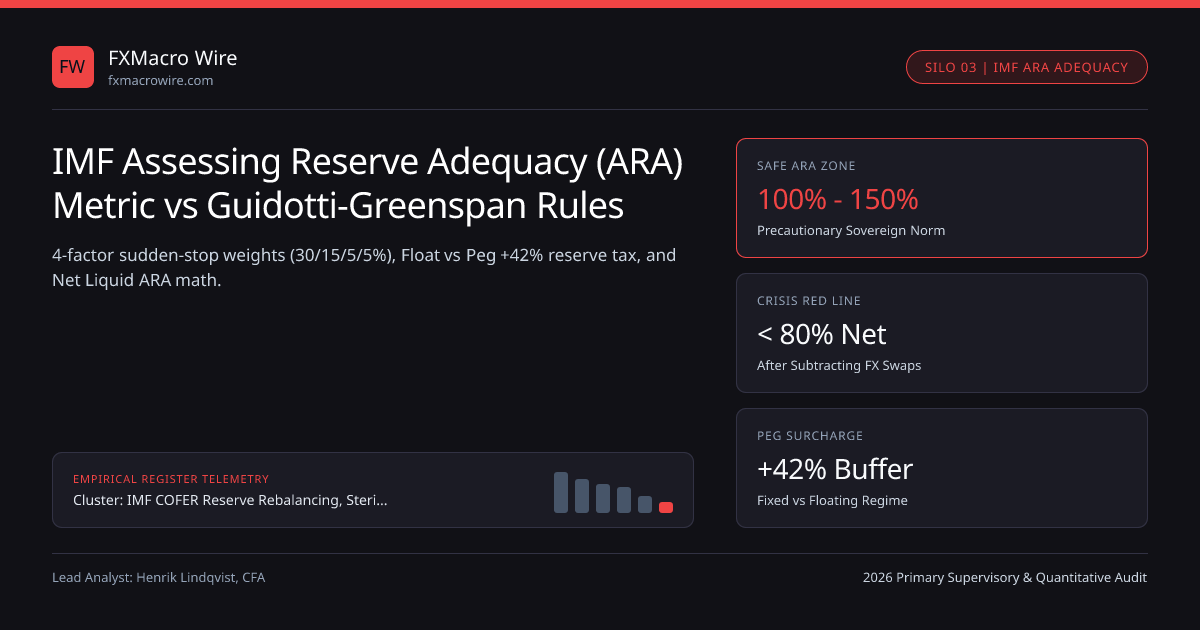
Replacing crude 3-month import-cover and 100% short-term debt rules of thumb, the IMF Assessing Reserve Adequacy (ARA) metric weights four distinct balance-of-payments drain channels to price sovereign currency crash risk.
How much of FinDB's $13.22 Trillion Sovereign FX Reserve Stock does an emerging-market or small open economy actually need to survive a sudden stop in global capital flows without suffering a 25% currency crash? Historically, sovereign credit analysts relied on two single-variable rules of thumb: 3 Months of Import Cover (trade-account focus) or the 1999 Greenspan-Guidotti Rule (reserves >= 100% of Short-Term External Debt maturing within 12 months). After the 2008 and 2013 Taper Tantrum crises exposed domestic M2 resident capital flight and foreign equity/bond portfolio redemptions as equally lethal currency killers, the International Monetary Fund codified the Assessing Reserve Adequacy (ARA) Composite Metric—today's institutional standard!
The Four Balance-of-Payments Drain Weights Inside the IMF ARA Formula#
Recognizing that fixed/managed exchange-rate regimes require thicker reserve shields than free-floating currencies (which let spot depreciation absorb half the shock), the IMF ARA metric sums four empirical 90th-percentile crisis drain risks:
- Short-Term External Debt at Remaining Maturity (STD): Rollover refusal by foreign banks and Eurobond holders (30% weight under both Floating and Fixed!).
- Other Portfolio & Long-Term Liabilities (OPL): Foreign non-resident sales of local-currency sovereign bonds and domestic equities (15% Floating / 20% Fixed).
- Broad Money Supply (M2): Domestic resident capital flight—households and local corporates converting domestic bank deposits into US dollars! (5% Floating / 10% Fixed, or 10% / 20% if capital controls exist? Wait: LOWER if capital controls bind—2.5% / 5% with strict capital controls!)
- Annual Merchandise & Services Exports (X): Terms-of-trade collapse or export trade-credit freeze (5% Floating / 10% Fixed).
An ARA Ratio (Actual Liquid Reserves / ARA Metric) between 100% and 150% marks the IMF's sovereign Adequacy Comfort Zone; falling below 80% flashes an acute currency-crisis red alert!
The China M2 Paradox: Why Capital Controls Halve the Broad-Money Weight!#
Apply the raw open-capital-account ARA formula blindly to China (USD/CNH), where domestic M2 Broad Money exceeds ¥310 trillion (~$43.5 trillion!):
- Without capital controls, 10% × $43.5T M2 = $4.35 trillion from M2 alone—making China's $3.25 trillion SAFE reserves look "inadequate" (~68% ARA)!
- Yet with strict SAFE resident capital controls ($50,000/yr individual quota and corporate documentation analyzed in PBOC fixing & capital governance), the IMF's Capital-Control-Adjusted ARA formula cuts the M2 weight in half (to 2.5% floating / 5% fixed)—lifting China's adjusted ARA adequacy comfortably past 125%!
European macro-prudential authorities—including the ECB, CNB Czechia, MNB Hungary, KNF Poland, and ASF Romania alongside regional development banks like BGK—track net liquid ARA (deducting encumbered swap lines and <1Y central bank FX forward shorts per off-balance-sheet forward rules!) ahead of every sovereign rating review.
| Reserve Adequacy Yardstick | Mathematical Formula | Primary Vulnerability Captured | Blind Spot Missed | 2026 Institutional Use |
|---|---|---|---|---|
| Import Cover Rule | Reserves / Monthly_Imports >= 3.0 | Trade balance / food-fuel crisis | Ignores $1T financial outflows! | Frontier / low-income sovereigns only |
| Greenspan-Guidotti Rule | Reserves / Short_Term_Ext_Debt >= 100% | 12-month external debt rollover | Misses resident M2 bank-run flight | Quick corporate/sovereign debt screen |
| IMF ARA (Floating FX) | 0.30*STD + 0.15*OPL + 0.05*M2 + 0.05*X | Full 4-channel BoP sudden stop | Must subtract encumbered swaps! | Gold-standard EM FX risk model |
| IMF ARA (Fixed / Peg) | 0.30*STD + 0.20*OPL + 0.10*M2 + 0.10*X | Defending hard peg without FX valve | Assumes credible rate pass-through | Pegged / crawled band audit (100-150%) |
Step-by-Step Worked Calculation: Floating vs Pegged Sovereign ARA Adequacy#
Let's audit a mid-sized emerging economy ($500B GDP) holding $92.0 billion in gross official reserves (of which $8.0B is encumbered in short 3M FX forwards, leaving $84.0B net liquid reserves) to test whether it can afford to switch from a floating exchange rate to a managed peg:
- ARA_{Fixed} = 0.30 * STD + 0.20 * OPL + 0.10 * M2 + 0.10 * Exports
- NetARARatio = ( GrossReserves - ShortFXForwards - EncumberedPledges ) / ARA_Metric
- Worked $500B GDP Emerging Economy Sovereign Stress Audit:
- Inputs: Short-Term Debt (STD) = $110B | Portfolio Liab (OPL) = $120B | Broad Money (M2) = $380B | Exports = $160B
- 1. Under Floating FX Regime:
- ARA_{Float} = 0.30(110) + 0.15(120) + 0.05(380) + 0.05(160) = 33.0 + 18.0 + 19.0 + 8.0 = $78.0 Billion required
- Net ARA Ratio (Float) = $84.0B / $78.0B = 107.7% -> PASSES (inside 100%-150% IMF safe zone!)
- 2. If Central Bank Attempts a Managed Crawl / Peg:
- ARA_{Fixed} = 0.30(110) + 0.20(120) + 0.10(380) + 0.10(160) = 33.0 + 24.0 + 38.0 + 16.0 = $111.0 Billion required!
- Net ARA Ratio (Fixed) = $84.0B / $111.0B = 75.7% -> FAILS (<80% crisis zone -> ripe for speculative FX attack!)
Commodity-Exporter ARA Add-On & Opportunity Cost Above 150%#
Notice two symmetric frontiers in IMF reserve guidance connected to our sovereign FX reserves hub and Singapore RMGS sovereign wealth transfers:
- Commodity-Intensive Exporters (Chile, Colombia, Nigeria, GCC): Must add an extra oil/metals price-crash export buffer because export revenues (X) collapse right when external credit dries up!
- Above 150% ARA ("Excess Reserves"): Holding >150% of ARA in low-yielding 3-month US T-Bills wastes taxpayer wealth (since sovereign external borrowing costs exceed T-Bill yields by 150-300 bps)—providing the exact quantitative threshold where countries launch Sovereign Wealth Funds or add equities and gold!
Early-Warning Sovereign Credit Signals When Net ARA Drops Below 80%#
Empirical IMF crisis panels demonstrate a sharp non-linear inflection once Net Unencumbered Reserves fall below 80% of the composite ARA benchmark. Above 100%, global bond funds roll local debt calmly through VIX spikes; below 80%, domestic residents accelerate M2 dollarization (5% to 10% M2 drain) at the exact moment external banks cut short-term trade lines (30% STD drain), turning manageable rate-differential pressures into disorderly currency devaluations tracked across our sovereign FX reserves & intervention hub.
Frequently asked questions
Why did the IMF replace the 3-month import rule and Greenspan-Guidotti rule with the ARA metric?
Import cover ignores financial-account sudden stops, while Greenspan-Guidotti (100% of short-term external debt) missed domestic resident deposit dollarization (M2 flight) and foreign selloffs of local-currency bonds.
What IMF ARA percentage is considered safe for an emerging-market currency?
The IMF defines 100% to 150% of the ARA metric as adequate precautionary coverage; dropping below 80% correlates strongly with elevated sovereign CDS spreads and heightened currency-crisis probability.
Why do fixed exchange rates require much higher ARA reserve weights than floating currencies?
Under a free float, immediate spot currency depreciation automatically reprices exports and penalizes late capital flight; under a fixed peg, the central bank must absorb 100% of exit demand out of FX reserves at par.
Why must analysts subtract domestic banks’ FX Required Reserves from headline central bank reserves?
In many emerging markets (e.g., Turkey, Argentina, China), commercial banks deposit mandatory USD customer reserve ratios at the central bank; spending those encumbered dollars in FX intervention creates a domestic banking USD shortfall!
Publication record
- Published
- 13 November 2026
- Updated
- 15 November 2026
- Author
- Henrik Lindqvist, CFA
- Review
- Review not recorded
- Automated fact check
- Passed in the stored pipeline record
- Source URLs
- 3 recorded
AI assistance recorded: anthropic/claude-opus-4.6. This field does not establish human review or source verification.
Academic & Institutional Attribution
Cite This Research & Embed Live Data Card
Standard academic & institutional research paper citation format.
Henrik Lindqvist, CFA. (2026, November 14). IMF Assessing Reserve Adequacy (ARA) Metric vs Guidotti-Greenspan Rules. FXMacro Wire. https://fxmacrowire.com/wire/imf-ara-reserve-adequacy-metric-external-debt-buffersRelated Sovereign FX Reserves Intervention & Institutional Briefings
Explore Sovereign FX Reserves Intervention Hub (20) →Sovereign FX Reserves Intervention
IMF COFER Reserves, Sterilized FX Intervention & Sovereign Gold Guide (2026)Sovereign FX Reserves Intervention
Off-Balance-Sheet Central Bank FX Forwards, Swaps & IMF SDDS Reporting LagsSovereign FX Reserves Intervention
Norges Bank Daily NOK FX Conversions & $1.8T NBIM Petroleum Fiscal RuleSovereign FX Reserves Intervention
G7 Coordinated FX Intervention vs Unilateral Strikes & NY Fed Rate ChecksSovereign FX Reserves Intervention
IMF COFER USD Share: Valuation-Adjusted vs Active Sovereign Reserve FlowsSovereign FX Reserves Intervention
Non-Traditional COFER Reserve Currencies: AUD, CAD, SGD, CNY & NordicsSovereign FX Reserves Intervention
Japan MoF FEFSA Sterilized Yen Intervention: T+2 BoJ Account MechanicsSovereign FX Reserves Intervention
SNB Sight-Deposit Tiering & Two-Way Foreign Exchange Reserve ManagementEm Carry Terms of Trade Shocks
USD/TRY Orthodox Carry Pivot: CBRT Swap Unwind, Real Lira Appreciation & REEREm Carry Terms of Trade Shocks
China Credit Impulse, CFETS RMB Basket & ASEAN / LatAm EM FX SpilloversEm Carry Terms of Trade Shocks
Non-CLS Emerging-Market FX Settlement: Herstatt Risk & Nostro Pre-Funding DragSafe Haven Capital Flow Regimes
NIIP Creditor Repatriation (CHF & JPY) vs USD Debtor Safe-Haven Mechanics
FXMacro Wire Data, Benchmarks & Contributor Records
CC BY 4.0 Open Data
Open Institutional Datasets (CSV / JSON) →
Download desk-compiled quantitative series & schemas.
2026 Reference Matrix
2026 Institutional Benchmarks & Thresholds →
Statutory capital, clearing, margin & rate conventions.
Editorial Records
Authors & Review Records →
View named contributors where those records are available.
Complete Index
Master Research & Dossier Archive →
Browse all published briefings by topic pillar & date.