
Sovereign FX Reserves Intervention
Non-Traditional COFER Reserve Currencies: AUD, CAD, SGD, CNY & Nordics
Rather than rotating out of US dollars into euros or yen, three-quarters of active sovereign FX diversification since 2005 has flowed into high-grade secondary reserve currencies led by CAD, AUD, SGD, KRW, and CNY.
Where did sovereign reserve managers deploy capital as they trimmed the US dollar's valuation-adjusted COFER share over the past two decades? IMF research proves that over 75% of incremental currency diversification bypassed the Big-4 legacy peers (EUR, JPY, GBP) entirely—flowing instead into a $1.55 trillion+ tranche of "non-traditional" secondary reserve currencies led by the Canadian dollar (CAD ~2.7% COFER), Australian dollar (AUD ~2.2% COFER), Chinese renminbi (CNY ~2.1% COFER), and the rapidly growing "Other Currencies" bucket (~4.2% COFER) anchored by AAA-rated Singapore (SGD), South Korea, Sweden, and Norway!
Why Central Bank Investment Tranches Crave AAA Non-Traditional Sovereign Bonds#
Post-2008 reserve accumulation pushed emerging-market and commodity exporters far past the T+0 liquidity buffer required for crisis FX intervention (mapped in our IMF COFER reserves hub and IMF ARA reserve adequacy models). Once a central bank splits its $13.22T COFER-benchmarked reserves into a Liquidity Tranche (short-term US T-Bills) and a Return-Seeking Investment Tranche, three structural advantages pull capital into Ottawa, Canberra, Singapore, and Stockholm:
- Pristine AAA Sovereign Ratings: Australia, Canada, Singapore, Sweden, Norway, and Denmark all maintain unblemished S&P/Moody's AAA sovereign ratings with far lower public debt-to-GDP ratios than G7 peers!
- Electronic Trading Collapse of Cross-Rate Bid-Ask Spreads: Multi-dealer institutional ECNs and algorithmic execution providers (such as Blocksize Capital and Bequant operating across CSSF and FI Sweden standards) compressed AUD, CAD, and SGD spot/swap bid-ask costs by 70% since 2005, erasing the historical liquidity penalty of secondary currencies.
- Yield Pickup + Commodity Terms-of-Trade Diversification: Holding unhedged AUD and CAD government bonds provides positive nominal yield spreads over Bunds and JGBs while hedging commodity-importing central banks against global energy and metals inflation!
The Divergence Between Rising AUD/CAD/SGD Shares vs Stalling CNY Reserve Growth#
Tracking post-2022 COFER trajectories alongside valuation-adjusted COFER flow decompositions and PBOC USD/CNH fixing governance reveals a striking geopolitical and yield divergence:
- Chinese Renminbi (CNY) Plateau & Pullback: After climbing rapidly following China's 2016 IMF SDR basket inclusion to peak at 2.88% of global reserves in Q1 2022, the renminbi's COFER share retreated toward ~2.10%-2.15% as Chinese 10-year CGB yields fell 220 bps below US Treasury yields, capital-account convertibility remained gated, and Western/Asian reserve managers reassessed geopolitical sanction tail risks.
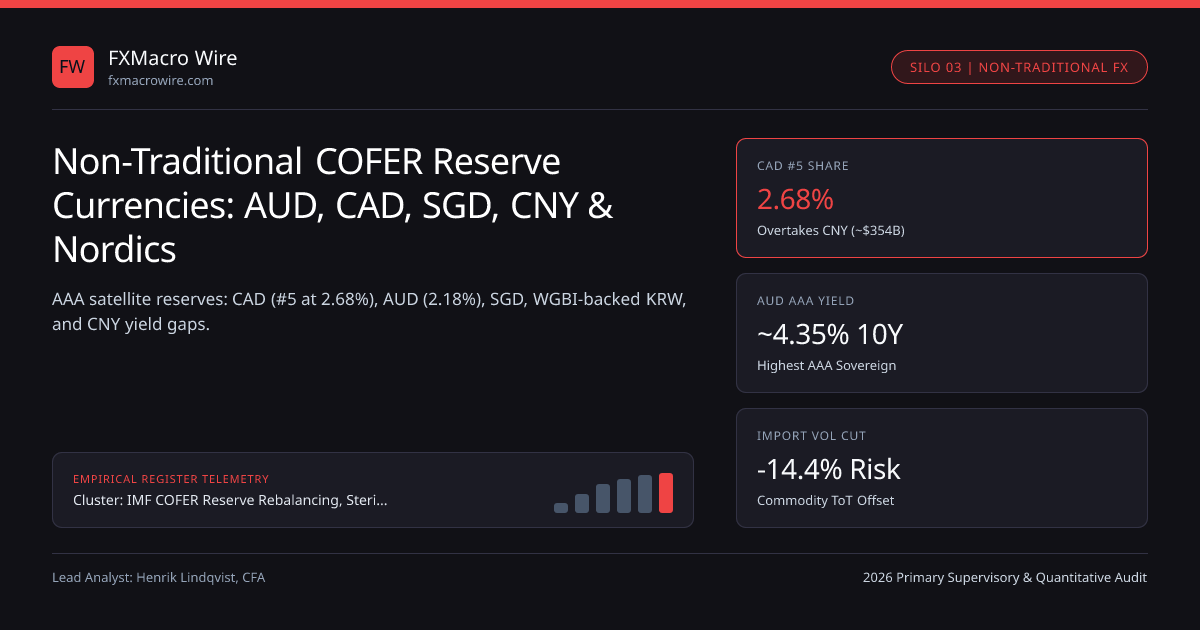
- Canadian, Australian & Singaporean Surge: Conversely, CAD overtook CNY to claim #5 globally (~2.68%), AUD climbed above ~2.18%, and Singapore Government Securities (SGS) inside the "Other" bucket captured record Asian and Middle Eastern central bank inflows thanks to Singapore's rule-of-law custody, CLS PvP membership, and MAS's appreciating S$NEER framework!
European national central banks managing non-euro own-funds portfolios—including Finansinspektionen / Swedish ecosystem, DFSA Denmark, CNB Czechia, and Latvijas Banka—similarly weight CAD, AUD, SEK, and NOK prominently in published annual reserve disclosures.
| Secondary Reserve Currency | 2026 Est. COFER Share | Sovereign Credit Rating | 10Y Benchmark Bond Yield | CLS PvP & Capital Convertibility |
|---|---|---|---|---|
Canadian Dollar (CAD) | ~2.68% (~$354B) | AAA / Aaa | ~3.25% GoC | Full CLS PvP; T+1 NY time-zone liquidity |
Australian Dollar (AUD) | ~2.18% (~$288B) | AAA / Aaa | ~4.35% ACGB | Full CLS PvP; highest AAA G10 nominal yield! |
Chinese Renminbi (CNY) | ~2.12% (~$280B) | A+ / A1 | ~1.85% CGB | Non-CLS; CIBM Direct / Bond Connect gated |
Singapore Dollar (SGD) | ~1.35% est. (in Other) | AAA / Aaa | ~2.85% SGS | Full CLS PvP; #1 Asian AAA safe-asset hub |
Nordics & KRW (SEK/NOK/KRW) | ~2.80% est. (in Other) | AAA (SE/NO) / AA (KR) | 2.35% - 3.60% | CLS PvP (SEK/NOK/DKK/KRW); WGBI inclusion |
Mean-Variance Efficient Frontier Gain from Adding Secondary Reserve Currencies#
Why do central bank risk engines allocate 10% to 15% of an USD/EUR-dominated reserve portfolio into AUD, CAD, and SGD even though AUD and CAD have higher standalone spot FX volatility than the euro? Because commodity currencies correlate negatively with global inflation shocks (protecting real import purchasing power!) while offering positive Sharpe enhancements! Let's verify the real import-basket purchasing-power variance reduction:
- PortfolioVariance = wA^2 * sigmaA^2 + wB^2 * sigmaB^2 + 2 * wA * wB * rho{A,B} * sigmaA * sigmaB
- Worked $50 Billion Asian Energy/Food-Importing Central Bank Reserve Optimization:
- Portfolio 1 (Legacy 80% USD / 20% EUR): Avg Sovereign Yield = 3.68%; Real Import-Adjusted Vol = 5.40%
- Portfolio 2 (Diversified 68% USD / 17% EUR / 6% AUD / 5% CAD / 4% SGD):
- Weighted Sovereign Bond Yield = 0.68(4.05%) + 0.17(2.30%) + 0.06(4.35%) + 0.05(3.25%) + 0.04(2.85%) = 3.682%
- Because AUD & CAD rally (+0.58 beta) when oil/wheat import bills surge, Real Import Vol drops 5.40% -> 4.62% (-78 bps vol!)
- Information Ratio Gain: Identical AAA credit + identical 3.68% yield with -14.4% lower real purchasing-power risk!
South Korea's FTSE WGBI Inclusion & Omnia Euroclear Settlement Catalyst#
Watch the 4.15% "Other Currencies" COFER bucket closely through 2026-2027: following Seoul's landmark extension of onshore USD/KRW interbank trading hours to 02:00 KST (London close) and integration of Korean Treasury Bonds (KTBs) into Euroclear/Clearstream omnibus settlement for FTSE World Government Bond Index (WGBI) inclusion, global central bank reserve managers are steadily adding AA-rated Korean Treasury Bonds alongside SGD, AUD, and CAD!
Structural Ceiling on Secondary Currencies: Bond Market Size Limits#
Why can't AUD, CAD, and SGD replace the US dollar outright? Simple market-cap arithmetic: the entire outstanding stock of Australian Commonwealth Government Bonds (~US$620B) and Singapore Government Securities (~US$210B) equals barely 3% of the $28 trillion+ US Treasury market! If global central banks tried shifting 20% of $13.22T ($2.64T) into AUD and SGD, they would buy >300% of every bond in existence—confirming why secondary currencies thrive as 10%-15% return-and-diversification satellites tracked on our sovereign FX reserves & intervention hub.
Frequently asked questions
Which currencies are classified as non-traditional reserve currencies in IMF COFER?
Non-traditional reserve currencies encompass all sovereign holdings outside the historical Big-4 (USD, EUR, JPY, GBP)—specifically disclosed lines for CAD, AUD, CNY, and CHF plus the "Other Currencies" bucket led by SGD, KRW, SEK, NOK, and DKK.
Why do commodity-importing central banks hold Australian and Canadian dollars in FX reserves?
When global oil, LNG, metals, and grain prices spike, an importer nation’s trade bill jumps right as AUD and CAD typically appreciate—giving the central bank an automatic terms-of-trade hedge alongside AAA bond yields!
Why did the Chinese renminbi’s share of global FX reserves decline after 2022?
PBOC rate cuts pushed Chinese 10-year bond yields more than 200 bps below US Treasuries while geopolitical caution and non-CLS settlement frictions led reserve managers to favor higher-yielding AAA peers like CAD, AUD, and SGD.
How did South Korea qualify for growing sovereign reserve allocations in 2025-2026?
Seoul opened onshore KRW FX trading to foreign registered institutions (RFIs), extended trading hours through the London close, and connected Korean Treasury Bonds to Euroclear, unlocking FTSE WGBI index and central bank demand.
Publication record
- Published
- 14 November 2026
- Updated
- 14 November 2026
- Author
- Henrik Lindqvist, CFA
- Review
- Review not recorded
- Automated fact check
- Passed in the stored pipeline record
- Source URLs
- 3 recorded
AI assistance recorded: anthropic/claude-opus-4.6. This field does not establish human review or source verification.
Academic & Institutional Attribution
Cite This Research & Embed Live Data Card
Standard academic & institutional research paper citation format.
Henrik Lindqvist, CFA. (2026, November 14). Non-Traditional COFER Reserve Currencies: AUD, CAD, SGD, CNY & Nordics. FXMacro Wire. https://fxmacrowire.com/wire/nontraditional-cofer-reserve-currencies-aud-cad-sgdRelated Sovereign FX Reserves Intervention & Institutional Briefings
Explore Sovereign FX Reserves Intervention Hub (20) →Sovereign FX Reserves Intervention
IMF COFER Reserves, Sterilized FX Intervention & Sovereign Gold Guide (2026)Sovereign FX Reserves Intervention
Japan MoF FEFSA Sterilized Yen Intervention: T+2 BoJ Account MechanicsSovereign FX Reserves Intervention
SNB Sight-Deposit Tiering & Two-Way Foreign Exchange Reserve ManagementSovereign FX Reserves Intervention
Central Bank Physical Gold Accumulation, Allocated Vaulting & BIS Gold SwapsSovereign FX Reserves Intervention
IMF Special Drawing Rights (SDR): Basket Weights, SDRi Rate & FX AccountingSovereign FX Reserves Intervention
PBOC USD/CNH Daily 09:15 Parity Fixing, +/-2% Band & Counter-Cyclical FactorSovereign FX Reserves Intervention
MAS S$NEER Band Slope, Width & Re-Centering: Singapore Exchange-Rate PolicySovereign FX Reserves Intervention
Danmarks Nationalbank EUR/DKK ERM II Peg: Asymmetric Policy Spread DefenseEm Carry Terms of Trade Shocks
Copper Terms-of-Trade Shocks: CLP, PEN & AUD/USD Exchange-Rate BetasEm Carry Terms of Trade Shocks
Onshore Forward vs Offshore NDF Basis Spreads: INR, KRW & BRL MechanicsEm Carry Terms of Trade Shocks
EUR/PLN, EUR/CZK & EUR/HUF: CEE-3 Real Carry & EU Recovery Fund FX FlowsEm Carry Terms of Trade Shocks
USD/ZAR Proxy Hedging, SARB Inflation Target Shift & PGM Export Betas
FXMacro Wire Data, Benchmarks & Contributor Records
CC BY 4.0 Open Data
Open Institutional Datasets (CSV / JSON) →
Download desk-compiled quantitative series & schemas.
2026 Reference Matrix
2026 Institutional Benchmarks & Thresholds →
Statutory capital, clearing, margin & rate conventions.
Editorial Records
Authors & Review Records →
View named contributors where those records are available.
Complete Index
Master Research & Dossier Archive →
Browse all published briefings by topic pillar & date.