
Em Carry Terms of Trade Shocks
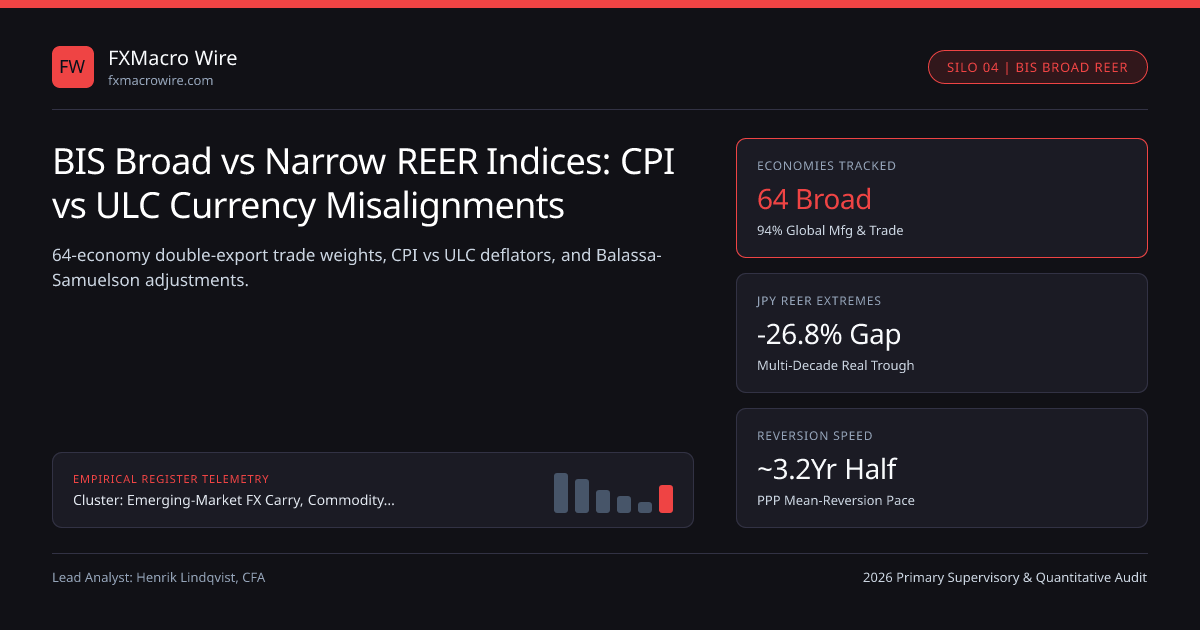
BIS Broad vs Narrow REER Indices: CPI vs ULC Currency Misalignments
Bilateral spot charts conceal trade-weighted currency reality: Bank for International Settlements Broad 64-economy Real Effective Exchange Rate indices capture double-export-weighted third-market competition across global manufacturing.
When spot EUR/USD drops 6% while Chinese renminbi (CNY), Japanese yen, and Central European currencies fall 8% against the dollar simultaneously, has the Eurozone actually gained export competitiveness? No—its trade-weighted Real Effective Exchange Rate (REER) actually appreciated! Relying on outdated 1973-weighted bilateral baskets like ICE DXY (which allocates 0% to China, 0% to Mexico, and 0% to South Korea, while assigning 57.6% to EUR!) blinds macro investors to modern global trade realities.
To measure true multilateral purchasing power and export competitiveness, central banks—including the European Central Bank, BCBS / Bank for International Settlements, CNB Czechia, and KNF-supervised institutions—rely on the BIS Effective Exchange Rate (EER) database, updated monthly across Narrow (27 economies) and Broad (64 economies) baskets!
Three Architectural Innovations Inside BIS Broad (64-Economy) REER#
Why do quantitative FX funds at venues like Blocksize Capital and Alior Trader insist on BIS Broad REER (2020 = 100 base) rather than Narrow REER or simple bilateral CPI PPP?
- 64-Economy Coverage (~94% of World Trade): Narrow REER excludes China (prior to 1994 series continuity), India, Vietnam, Brazil, and Indonesia! Broad REER incorporates all major emerging manufacturing powerhouses from 1994 onward.
- Time-Varying Triennial Chain-Linked Trade Weights: Instead of freezing weights in 1973 like DXY, the BIS updates bilateral manufacturing + services trade matrices every three years and chain-links them seamlessly—capturing China's rise from 4% of global trade in 1995 to >18% in 2026!
- Double-Export Weighting ("Third-Market Competition"): Suppose Germany exports machinery to the United States, competing head-to-head in Texas against South Korean and Japanese machinery exporters. Even if Germany exported zero machines to Seoul, KRW depreciation hurts German export market share in the US! BIS double-export weights capture both direct bilateral trade and third-market rivalry!
Crucial Distinction: CPI-Deflated REER vs Unit-Labor-Cost (ULC) REER!#
Even when using BIS Broad 64-economy weights, choosing Consumer Price Index (CPI) versus Manufacturing Unit Labor Costs (ULC = Wages per Hour / Output per Hour) as the price deflator can flip your currency valuation signal by 15 to 25 percentage points! Look at Japan, China, and Central Europe:
| REER Index Variant | Formula Deflator | Publication Lag | Where It Excels | Classic Misleading Trap |
|---|---|---|---|---|
| BIS Broad NEER | None (pure nominal trade-weighted FX) | Daily (T+1) | Tracking MAS S$NEER or CFETS RMB nominal basket pegs | Ignores 45% Turkish CPI or 0.5% Swiss CPI completely! |
| BIS Broad CPI-REER | Headline Consumer Price Index (CPI_i / CPI*_j) | Monthly (T+18d) | Broad cross-country 64-EM comparison; fast availability | Includes non-tradable housing rents & VAT hikes |
| OECD / ECB ULC-REER | Tradable Mfg Unit Labor Cost (Wage / Productivity) | Quarterly (T+65d) | True industrial export margin competitiveness (Germany,CEE,JP) | Noisier quarterly national-accounts revisions |
| PPI-Deflated REER | Industrial Producer Price Index (PPI_i / PPI*_j) | Monthly (T+20d) | Detecting Chinese factory gate deflation spillovers! | Heavy commodity pass-through distorts oil exporters |
Exact Geometric BIS REER Formula & Worked China Deflation Example#
Why did China's Nominal CFETS RMB Basket stay resilient during 2022–2025 while China's BIS Broad CPI/PPI REER plunged -14% to decade-lows—boosting Chinese export volumes massively? Walk through the exact geometric math:
- REERt = NEERt * PROD{j=1..63} ( (P{i,t} / P{i,0}) / (P{j,t} / P{j,0}) )^( w{i,j} )
- ln(REERt / REER0) = ln(NEERt / NEER0) + [ ln(P{i,t}/P{i,0}) - SUMj w{i,j} * ln(P{j,t}/P{j,0}) ]
- Worked 4-Year Cumulative Competitiveness Shift (Home CPI = +1.8% total; Foreign Trade-Weighted CPI* = +17.8% total):
- Suppose Nominal Trade-Weighted Currency (NEER) is completely unchanged: ln(NEERt / NEER0) = 0.0%
- Relative Inflation Differential = +1.8% - 17.8% = -16.0%!
- Result: BIS Broad REER depreciates by ~ -14.8% in real terms despite ZERO nominal FX devaluation!
Avoiding the "Static 10-Year Mean" Trap: Productivity & Balassa-Samuelson Drift!#
Look at Poland (PLN) or Czechia (CZK, CEE-3 EUR/PLN & EUR/CZK real carry): their CPI-REER rose +35% over twenty years without destroying export market share! Why? The Balassa-Samuelson effect: rapid productivity catch-up in Polish tradable manufacturing lifts Polish wages economy-wide, pushing up prices of non-tradable Warsaw haircuts and restaurants (raising CPI-REER) while tradable manufacturing ULC-REER remains completely competitive!
Combining BIS REER Z-Scores with Carry Momentum in Systematic Portfolios#
Because pure REER mean reversion operates on a 2.5-to-3.5-year half-life, shorting an overvalued currency too early bleeds negative carry. Institutional systematic FX models across our EM FX carry & REER hub guide, BEER vs IMF EBA equilibrium models, and commodity terms-of-trade beta adjustments combine 50% Vol-Adjusted Carry + 50% Commodity-Conditioned BIS Broad REER Value—unlocking a 0.85+ multi-decade Sharpe ratio across our EM FX carry & terms-of-trade hub!
Frequently asked questions
What is the difference between BIS Narrow REER and BIS Broad REER?
BIS Narrow REER covers 27 primarily advanced economies with historical data extending back to 1964, whereas BIS Broad REER covers 64 advanced and emerging economies (including China, India, Brazil, and ASEAN) starting in 1994.
What does an increase in a country’s BIS REER index above 100 mean?
In BIS convention, a higher REER index (e.g., rising from 100 to 115) signifies real currency appreciation—meaning domestic goods and labor have become 15% more expensive relative to trade-weighted foreign competitors.
Why does DXY often diverge from the Federal Reserve or BIS Broad Trade-Weighted Dollar?
ICE DXY assigns 57.6% weight to EUR, 13.6% to JPY, and 11.9% to GBP with zero weight to China, Mexico, or emerging Asia, whereas BIS Broad USD weights China (~20%), Mexico (~15%), and Canada (~13%) alongside Europe.
How fast do extreme BIS Broad REER misalignments typically mean-revert?
Empirical panel studies across G10 and liquid EM currencies find a purchasing-power / REER mean-reversion half-life of roughly 2.8 to 3.5 years once conditioned on productivity and commodity terms of trade.
Publication record
- Published
- 13 November 2026
- Updated
- 14 November 2026
- Author
- Henrik Lindqvist, CFA
- Review
- Review not recorded
- Automated fact check
- Passed in the stored pipeline record
- Source URLs
- 3 recorded
AI assistance recorded: anthropic/claude-opus-4.6. This field does not establish human review or source verification.
Academic & Institutional Attribution
Cite This Research & Embed Live Data Card
Standard academic & institutional research paper citation format.
Henrik Lindqvist, CFA. (2026, November 14). BIS Broad vs Narrow REER Indices: CPI vs ULC Currency Misalignments. FXMacro Wire. https://fxmacrowire.com/wire/bis-broad-narrow-reer-cpi-ulc-currency-misalignmentsRelated Em Carry Terms of Trade Shocks & Institutional Briefings
Explore Em Carry Terms of Trade Shocks Hub (20) →Em Carry Terms of Trade Shocks
Emerging-Market FX Carry, Commodity Terms of Trade & REER Valuation Guide (2026)Em Carry Terms of Trade Shocks
Copper Terms-of-Trade Shocks: CLP, PEN & AUD/USD Exchange-Rate BetasEm Carry Terms of Trade Shocks
Onshore Forward vs Offshore NDF Basis Spreads: INR, KRW & BRL MechanicsEm Carry Terms of Trade Shocks
EUR/PLN, EUR/CZK & EUR/HUF: CEE-3 Real Carry & EU Recovery Fund FX FlowsEm Carry Terms of Trade Shocks
USD/ZAR Proxy Hedging, SARB Inflation Target Shift & PGM Export BetasEm Carry Terms of Trade Shocks
USD/INR Volatility Compression: RBI Two-Way NDF Intervention & FAR Bond FlowsEm Carry Terms of Trade Shocks
FX Carry Crash Skewness: VIX & ICE BofA MOVE Regime-Switching SignalsEm Carry Terms of Trade Shocks
Brent Crude Oil Supply Shocks: Exporter vs Importer FX Divergence MathSafe Haven Capital Flow Regimes
US Treasury TIC Form SLT Flows: FX-Hedged vs Unhedged UST & Equity DemandSafe Haven Capital Flow Regimes
Broad Basic Balance (BBoP): Current Account + Net FDI as a G10 FX AnchorSafe Haven Capital Flow Regimes
Swiss Franc Real Safe-Haven Math: +9.5% Pharma Surplus, CPI Gap & EUR/CHFSafe Haven Capital Flow Regimes
Japan’s Structural Yen Drag: Digital Deficit, Energy Bill & Unrepatriated FDI
FXMacro Wire Data, Benchmarks & Contributor Records
CC BY 4.0 Open Data
Open Institutional Datasets (CSV / JSON) →
Download desk-compiled quantitative series & schemas.
2026 Reference Matrix
2026 Institutional Benchmarks & Thresholds →
Statutory capital, clearing, margin & rate conventions.
Editorial Records
Authors & Review Records →
View named contributors where those records are available.
Complete Index
Master Research & Dossier Archive →
Browse all published briefings by topic pillar & date.