
Em Carry Terms of Trade Shocks
Brent Crude Oil Supply Shocks: Exporter vs Importer FX Divergence Math
Not all $20 Brent crude rallies move currencies alike: institutional FX desks separate global-demand oil rallies from OPEC+/geopolitical supply shocks to trade high-Sharpe Energy Exporter vs Importer relative-value crosses.
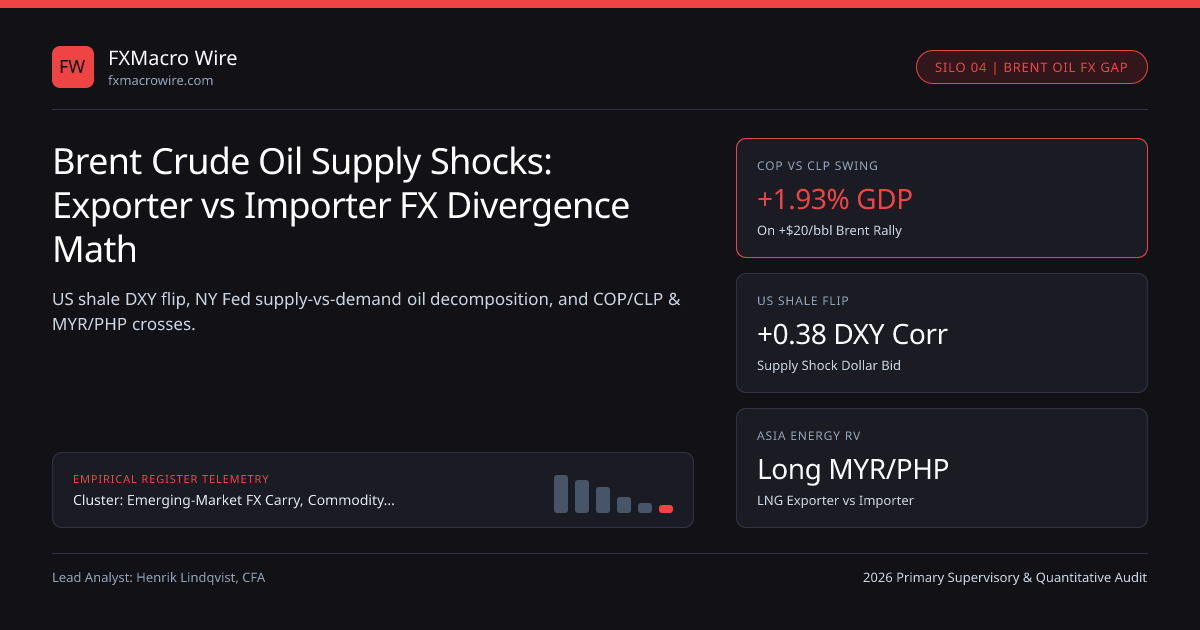
When Brent crude oil jumps +$20 per barrel (e.g., from $74/bbl to $94/bbl), novices ask "Is higher oil bullish or bearish for the US dollar?" Institutional macro FX strategists tracking USD/CAD, NOK/SEK, and DXY ask two far sharper structural questions first:
- Supply Shock vs Demand Shock: Did Brent rally because global manufacturing PMIs surged (risk-on demand pull—bearish USD, bullish all cyclical EM & commodity FX), OR because Strait of Hormuz / OPEC+ supply was curtailed (stagflationary supply tax—strongly BULLISH USD against Europe and Asia!)?
- Net Petroleum Trade Balance (% of GDP): Since the US shale revolution turned America into the world's #1 crude + NGL + LNG producer (~13.4M+ bpd crude + net hydrocarbon exporter!), higher oil prices improve US terms of trade relative to the Eurozone, Japan, India, Turkey, and South Korea—flipping the pre-2014 negative DXY-oil correlation firmly positive (+0.32 to +0.48) during supply shocks!
Net Hydrocarbon Trade Balance Leaderboard: Who Wins and Bleeds on +$20 Brent?#
Supervised European and global macro desks (ECB, FI Sweden, Norges Bank / DFSA, trading across Abonea AB, Blocksize Capital, and CMC Central) rank G10 and EM currencies strictly by Net Oil & Gas Trade Balance as % of Nominal GDP:
Comparative Petro-Sensitivity Matrix Across G10 & Emerging FX#
Notice two critical modern shifts many outdated textbooks miss: Brazil (BRL) swung from net fuel importer in 2012 to exporting >1.7M bpd net crude via Petrobras pre-salt fields, whereas Chile (CLP) and Turkey (TRY) remain acute hydrocarbon importers!
| Currency Group | Representative Currencies | Net Oil & Gas Balance (% GDP) | +$20/bbl Supply Shock FX Beta | Best Relative-Value Pair |
|---|---|---|---|---|
| Pure Hydrocarbon Exporters | NOK, COP, CAD, RUB/KZT, GCC pegs | +3.8% to +16.0% of GDP | +2.5% to +6.4% vs EUR/Importer | Long COP/CLP or Long NOK/SEK |
| Self-Sufficient / Modest Net Exp. | USD, BRL, MXN (crude vs gasoline net ~0) | +0.4% to +2.1% of GDP | +1.5% to +3.5% vs EUR/Asia | Long USD/JPY or Long BRL/TRY |
| G10 Energy Importers | EUR, JPY, SEK, GBP (near small deficit) | -1.8% to -3.6% of GDP | -2.8% to -5.2% vs USD | Short EUR/CAD or Short CAD/JPY Long |
| Acute EM Oil Importers | INR, TRY, PHP, THB, KRW, CLP, HUF | -3.5% to -5.8% of GDP | -3.5% to -7.8% vs Exporters | Long MYR/PHP or Long COP/CLP |
Quantitative Terms-of-Trade Current-Account & FX Elasticity Formula#
Institutional economists translate a Delta P_Brent price move directly into Annual Current-Account Shift (% of GDP) and Equilibrium Exchange-Rate Adjustment:
- Delta ln(FXRV) = - betaToT * ( DeltaCAExporterPctGDP - DeltaCAImporterPctGDP )
- Worked +$20/bbl Brent Supply Shock Relative-Value Trade: Long COP / Short CLP (
COPCLPNDF Cross): - 1. Colombia (Net Crude Exports ~ +215M bbls/yr on $385B GDP): +$20/bbl -> +$4.30B (+1.12% of GDP current-account boost!)
- 2. Chile (Net Oil Imports ~ -135M bbls/yr on $335B GDP): +$20/bbl -> -$2.70B (-0.81% of GDP current-account hit!)
- 3. Net Bilateral Terms-of-Trade Swing = +1.12% - (-0.81%) = +1.93% of GDP divergence!
- 4. Plus Carry Bonus: Colombia BanRep (~9.50%) pays ~ +425 bps higher NDF carry than Chile BCCh (~5.25%)!
Structural Pipeline Upgrade: Canada's Trans Mountain Expansion (TMX) & CAD Beta!#
Why did USD/CAD exhibit a muted oil beta between 2018 and 2023, only to regain stronger terms-of-trade torque in 2025–2026? Because prior pipeline bottlenecks trapped Alberta Western Canadian Select (WCS) crude at a punishing -$22 to -$28/bbl discount under WTI! Commissioning the 590,000 bpd Trans Mountain Expansion (TMX) pipeline to Pacific tidewater structurally compressed the WCS-WTI differential toward -$11 to -$13/bbl, ensuring Brent/WTI rallies flow directly into Canadian corporate USD conversions!
Three Clean Institutional Oil-FX Relative-Value Crosses#
By pairing regional neighbors on opposite sides of the hydrocarbon ledger across our EM FX carry & REER hub guide, copper vs oil CLP terms-of-trade models, and RBI USD/INR oil shock management, institutional pods neutralize broad dollar whipsaws: (1) LatAm: Long COP / Short CLP, (2) Asia: Long MYR / Short PHP (or THB), and (3) G10: Long NOK/SEK or Long CAD/JPY across our EM FX carry & terms-of-trade hub!
Frequently asked questions
Why did the correlation between Brent crude oil and the US dollar (DXY) flip positive after 2018?
Permian shale crude and Gulf Coast LNG exports transformed the US from importing >12M barrels/day net in 2006 into a net energy exporter, while DXY’s largest components—Eurozone (57.6%) and Japan (13.6%)—remain heavy fossil-fuel importers.
Why is Mexican peso (MXN) no longer a strong positive oil-exporter currency?
Declining Pemex crude export volumes combined with massive imports of US refined gasoline, diesel, and pipeline natural gas reduced Mexico’s net hydrocarbon trade balance near zero (actually a modest refined-fuel deficit).
How did Brazil’s pre-salt offshore oil fields change USD/BRL macro behavior?
Surging Petrobras pre-salt output lifted crude oil into Brazil’s #1 export commodity alongside soybeans and iron ore (>3.4M bpd production), cushioning Brazil’s trade surplus during energy price spikes.
What is the cleanest Asian FX relative-value trade for an OPEC+ supply cut?
Long Malaysian ringgit against Short Philippine peso (MYR/PHP) or Short Thai baht (MYR/THB), pairing ASEAN’s sole major net hydrocarbon/LNG exporter against pure refined-fuel importers.
Publication record
- Published
- 13 November 2026
- Updated
- 14 November 2026
- Author
- Henrik Lindqvist, CFA
- Review
- Review not recorded
- Automated fact check
- Passed in the stored pipeline record
- Source URLs
- 3 recorded
AI assistance recorded: anthropic/claude-opus-4.6. This field does not establish human review or source verification.
Academic & Institutional Attribution
Cite This Research & Embed Live Data Card
Standard academic & institutional research paper citation format.
Henrik Lindqvist, CFA. (2026, November 14). Brent Crude Oil Supply Shocks: Exporter vs Importer FX Divergence Math. FXMacro Wire. https://fxmacrowire.com/wire/brent-crude-supply-shocks-exporter-importer-fx-gapRelated Em Carry Terms of Trade Shocks & Institutional Briefings
Explore Em Carry Terms of Trade Shocks Hub (20) →Em Carry Terms of Trade Shocks
Emerging-Market FX Carry, Commodity Terms of Trade & REER Valuation Guide (2026)Em Carry Terms of Trade Shocks
BEER vs IMF EBA & FEER Equilibrium Exchange Rate Models: Fair-Value MathEm Carry Terms of Trade Shocks
GBI-EM Local Sovereign Debt: FX-Hedged vs Unhedged Return AttributionEm Carry Terms of Trade Shocks
USD/KRW Dynamics: NPS $50B FX Swap Line, RFI Reform & AI Semiconductor ToTEm Carry Terms of Trade Shocks
Brazil BCB Swap Cambial & Cupom Cambial (DDI): Onshore BRL USD LiquidityEm Carry Terms of Trade Shocks
Diversified FX Carry Funding Baskets: JPY, CHF, EUR & CNH OptimizationEm Carry Terms of Trade Shocks
Fiscal Dominance & Sovereign CDS: When EM Central Bank Hikes Weaken FX!Em Carry Terms of Trade Shocks
USD/TWD & Taiwan Life Insurers: $700B USD Bond Book, Proxy Hedges & NDFsSafe Haven Capital Flow Regimes
Energy Supply Shocks & the Safe-Haven Flip: Why JPY & EUR Broke in StagflationSafe Haven Capital Flow Regimes
UK Twin Deficits & 31.4% Foreign Gilt Share: Modeling Sterling’s Risk BetaSafe Haven Capital Flow Regimes
CFTC TFF FX Positioning: Leveraged Funds vs Asset Managers & Pain TradesSafe Haven Capital Flow Regimes
Global M2 Liquidity Impulse & Central Bank Reserves: High-Beta AUD, NZD & SEK
FXMacro Wire Data, Benchmarks & Contributor Records
CC BY 4.0 Open Data
Open Institutional Datasets (CSV / JSON) →
Download desk-compiled quantitative series & schemas.
2026 Reference Matrix
2026 Institutional Benchmarks & Thresholds →
Statutory capital, clearing, margin & rate conventions.
Editorial Records
Authors & Review Records →
View named contributors where those records are available.
Complete Index
Master Research & Dossier Archive →
Browse all published briefings by topic pillar & date.