
Em Carry Terms of Trade Shocks
BEER vs IMF EBA & FEER Equilibrium Exchange Rate Models: Fair-Value Math
Why do Wall Street currency valuation screens call a currency fairly valued on the exact same day the IMF calls it 14% overvalued? Separating short-horizon BEER regressions from flow-based FEER and IMF EBA current-account norms resolves the paradox.
Open five Wall Street macro FX strategy reports on ICE US Dollar Index (DXY), EUR/USD, or emerging-market carry currencies, and you will routinely discover a startling contradiction: Bank A's BEER model says the US dollar is only +3% above fair value, while the IMF's annual External Sector Report (EBA / FEER framework) estimates the dollar is +11% to +15% overvalued!
Who is right? Both—because BEER and FEER answer two completely different economic questions over two completely different time horizons! Institutional asset managers and central bank research divisions (ECB, BCBS / BIS, CNB Czechia, and quantitative pods executing via Blocksize Capital and Alior Trader) use BEER for 6-to-18-month tactical FX trading and FEER / IMF EBA for 3-to-7-year secular strategic hedging!
Philosophical Divide: Reduced-Form Price Fit (BEER) vs Normative Flow Balance (FEER)#
Understand the core econometric distinction first:
- Behavioral Equilibrium Exchange Rate (BEER — Clark & MacDonald, 1998): An empirical panel cointegration regression fitting actual observed REER (BIS Broad REER) directly onto current economic observables: 2Y–10Y real interest-rate differentials, Commodity Terms of Trade, Balassa-Samuelson relative GDP/capita productivity, and Net Foreign Assets (NFA). Crucial consequence: if US real yields surge +200 bps because of loose US fiscal deficits, BEER lifts the dollar's "equilibrium" fair value UP immediately—saying "Given today's high US yields, a strong dollar is behaviorally normal!"
- Fundamental Equilibrium Exchange Rate (FEER — Williamson / Peterson Institute) & IMF EBA: A normative macroeconomic balance model asking: "What exchange rate is required at full employment so that the country's Cyclically-Adjusted Current Account (CAUnderlying) equals its sustainable medium-term Saving-Investment Norm (CANorm)?" If loose US fiscal deficits push the US current-account deficit to -3.8% of GDP vs a -1.4% sustainable norm, FEER says the dollar MUST depreciate -15% over the medium run to restore external balance—even though high US yields keep it elevated today!
Head-to-Head Comparison Across the 4 Institutional FX Valuation Frameworks#
Compare Purchasing Power Parity (PPP), BEER, FEER, and the IMF's Three-Pillar External Balance Assessment (EBA):
| Valuation Framework | Core Inputs | Update Frequency | Best Institutional Use Case | Blind Spot / Failure Mode |
|---|---|---|---|---|
| OECD / ICP PPP | Absolute tradable + non-tradable price baskets | Annual / Slow | 10-year G10 extremes (e.g., USD/JPY >35% cheap) | Fails completely on EM due to Balassa-Samuelson wage gap |
| Street BEER (GSDEER / NATREX) | Real yield spreads, ToT, productivity, NFA/GDP | Daily / Monthly | 6M–18M mean-reversion overlay on FX carry pods | Treats unsustainable fiscal-monetary mixes as "equilibrium" |
| Williamson FEER | Underlying CA vs Target CA Norm + Trade Elasticities | Semi-Annual | Detecting twin-deficit currency crisis setups (TRY, BRL, GBP) | Sensitive to subjective CA Norm & trade-elasticity estimates |
| IMF EBA (3 Pillars) | 1. EBA-CA + 2. EBA-REER Index + 3. External Sustainability | Annual (July ESR) | Official sovereign surveillance & US Treasury FX Report input | 9–12 month publication lag relative to live spot moves |
Exact Econometric Formulas: BEER Cointegration vs IMF EBA Current-Account Elasticity#
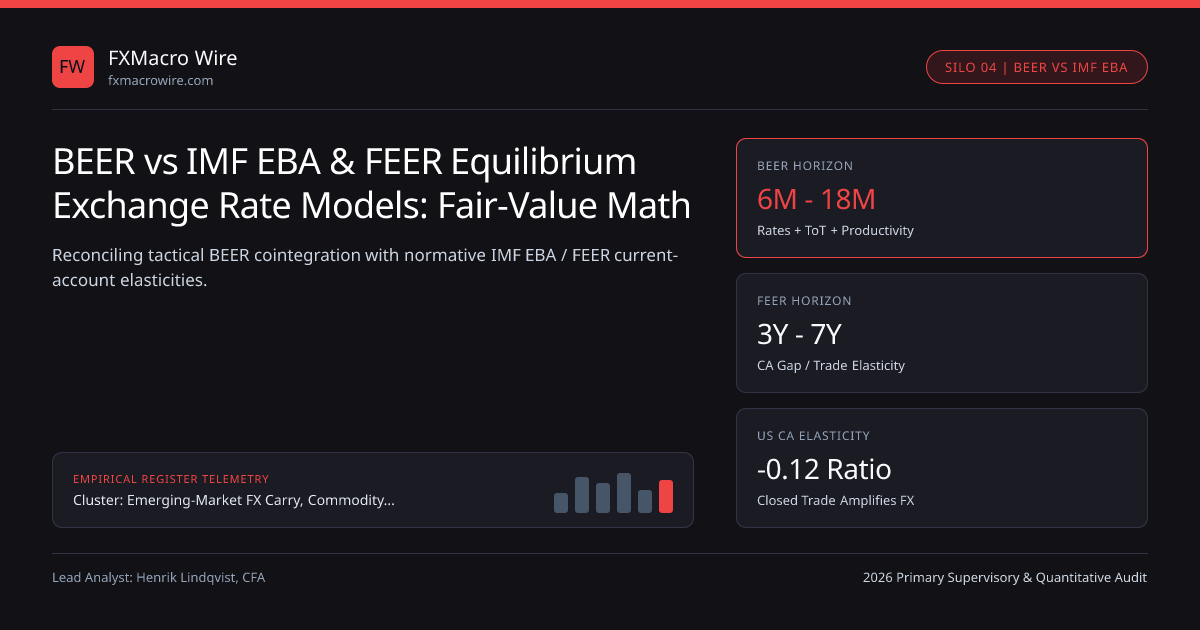
Notice the mathematical lever that shocks equity investors when studying FEER / IMF EBA: Semi-Elasticity of the Current Account to REER (eta_CA)! Because the United States has a relatively closed trade sector (Exports + Imports ~ 25% of GDP), etaCA for the US is only -0.12—meaning closing a -1.8% of GDP current-account gap requires a massive -15.0% REER depreciation (-1.8% / -0.12), whereas an open economy like Czechia or Thailand (etaCA = -0.40) closes the exact same gap with just a -4.5% FX move!
- ln(REERBEER*) = beta0 + beta1*(rHome - rForeign) + beta2ln(ToT) + beta3*ln(GDPpc / GDPpc) + beta4(NFA / GDP)
- 2. FEER / IMF EBA Macroeconomic Balance Approach:
- CAGapPctGDP = CACyclicallyAdjusted - CANorm(Demographics, Fiscal, NFA, Oil_Reserves, Growth)
- REEROvervaluation% = - CAGapPctGDP / etaCATradeElasticity
- Worked Comparison on a Twin-Deficit Economy (CAAdj = -4.1% GDP, CANorm = -1.7% GDP, eta_CA = -0.16):
- CA_Gap = -4.1% - (-1.7%) = -2.40% of GDP structural deficit
- FEER Implied Overvaluation = - (-2.40%) / (-0.16) = +15.0% Overvalued! (Currency must fall ~13-15% once rates normalize)
Why Demographics & Safe-Asset Status Shift the IMF EBA "Current Account Norm"#
Beginners mistakenly assume every country's "equilibrium current account" should be 0.0% of GDP! Inside the IMF EBA regression:
- Rapidly Aging Societies (Germany, Japan, Singapore, Switzerland, Taiwan) should run structural +2.5% to +6.0% of GDP current-account surpluses to accumulate overseas retirement assets before their workforce shrinks!
- Young, Fast-Growing Capital Importers (India, Indonesia, Poland) should run sustainable -1.5% to -2.5% of GDP current-account deficits financed by productive greenfield FDI!
Combining BEER & FEER Inside Institutional EM Carry Portfolios#
Across our EM FX carry & REER hub guide, copper terms-of-trade shocks, and fiscal dominance sovereign CDS paradox, institutional PMs enforce a two-horizon rule: use monthly BEER misalignments to weight 3-month carry sleeves, and cap maximum allocation whenever FEER / EBA flags a >-2.5% of GDP current-account gap across our EM FX carry & terms-of-trade hub!
Frequently asked questions
What are the three pillars of the IMF External Balance Assessment (EBA) methodology?
Published every July in the IMF External Sector Report across 30 major economies, EBA combines (1) the Current Account regression approach, (2) the Real Effective Exchange Rate (REER) index/level regressions, and (3) the External Sustainability (NIIP stabilization) approach.
Why does Balassa-Samuelson productivity matter in BEER exchange-rate models?
As an emerging economy’s tradable manufacturing productivity catches up to G7 peers, economy-wide wages rise and push up domestic non-tradable service prices—justifying a rising CPI-REER without losing export competitiveness.
What happens when both BEER and FEER show >15% currency undervaluation simultaneously?
Dual BEER + FEER alignment signals that a currency is cheap even after accounting for current yield differentials AND runs an excessive external surplus—producing the highest historical 24-month forward FX Sharpe ratios once central bank rates inflect.
Why do reserve-issuing economies have an "exorbitant privilege" dummy in IMF EBA models?
Global central bank and private demand for safe reserve assets (especially USD and, to a lesser degree, EUR) structurally lowers borrowing yields and sustains ~0.5%-1.0% of GDP wider current-account deficits than non-reserve peers.
Publication record
- Published
- 13 November 2026
- Updated
- 14 November 2026
- Author
- Henrik Lindqvist, CFA
- Review
- Review not recorded
- Automated fact check
- Passed in the stored pipeline record
- Source URLs
- 3 recorded
AI assistance recorded: anthropic/claude-opus-4.6. This field does not establish human review or source verification.
Academic & Institutional Attribution
Cite This Research & Embed Live Data Card
Standard academic & institutional research paper citation format.
Henrik Lindqvist, CFA. (2026, November 14). BEER vs IMF EBA & FEER Equilibrium Exchange Rate Models: Fair-Value Math. FXMacro Wire. https://fxmacrowire.com/wire/beer-versus-imf-eba-feer-equilibrium-exchange-ratesRelated Em Carry Terms of Trade Shocks & Institutional Briefings
Explore Em Carry Terms of Trade Shocks Hub (20) →Em Carry Terms of Trade Shocks
Emerging-Market FX Carry, Commodity Terms of Trade & REER Valuation Guide (2026)Em Carry Terms of Trade Shocks
GBI-EM Local Sovereign Debt: FX-Hedged vs Unhedged Return AttributionEm Carry Terms of Trade Shocks
USD/KRW Dynamics: NPS $50B FX Swap Line, RFI Reform & AI Semiconductor ToTEm Carry Terms of Trade Shocks
Brazil BCB Swap Cambial & Cupom Cambial (DDI): Onshore BRL USD LiquidityEm Carry Terms of Trade Shocks
Diversified FX Carry Funding Baskets: JPY, CHF, EUR & CNH OptimizationEm Carry Terms of Trade Shocks
Fiscal Dominance & Sovereign CDS: When EM Central Bank Hikes Weaken FX!Em Carry Terms of Trade Shocks
USD/TWD & Taiwan Life Insurers: $700B USD Bond Book, Proxy Hedges & NDFsEm Carry Terms of Trade Shocks
USD/TRY Orthodox Carry Pivot: CBRT Swap Unwind, Real Lira Appreciation & REERSafe Haven Capital Flow Regimes
UK Twin Deficits & 31.4% Foreign Gilt Share: Modeling Sterling’s Risk BetaSafe Haven Capital Flow Regimes
CFTC TFF FX Positioning: Leveraged Funds vs Asset Managers & Pain TradesSafe Haven Capital Flow Regimes
Global M2 Liquidity Impulse & Central Bank Reserves: High-Beta AUD, NZD & SEKSafe Haven Capital Flow Regimes
Cross-Border M&A Deal-Contingent FX Forwards: Pricing Regulatory Tail Risk
FXMacro Wire Data, Benchmarks & Contributor Records
CC BY 4.0 Open Data
Open Institutional Datasets (CSV / JSON) →
Download desk-compiled quantitative series & schemas.
2026 Reference Matrix
2026 Institutional Benchmarks & Thresholds →
Statutory capital, clearing, margin & rate conventions.
Editorial Records
Authors & Review Records →
View named contributors where those records are available.
Complete Index
Master Research & Dossier Archive →
Browse all published briefings by topic pillar & date.