
Em Carry Terms of Trade Shocks
GBI-EM Local Sovereign Debt: FX-Hedged vs Unhedged Return Attribution
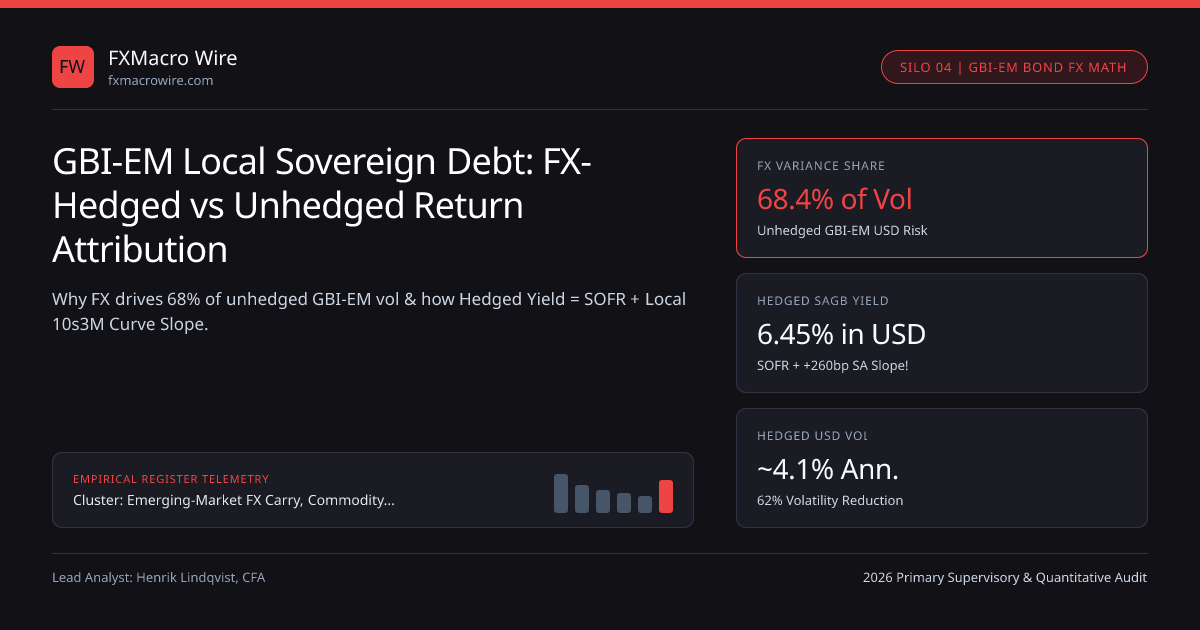
In emerging-market local-currency sovereign debt, spot currency volatility generates nearly 70% of unhedged US dollar return variance—yet fully hedging currency exposure via 3-month NDFs surrenders almost the entire yield pickup over US Treasuries.
Over $240 billion of global pension, insurance, and sovereign institutional capital benchmarks emerging-market local-currency fixed income against the J.P. Morgan GBI-EM Global Diversified Index (spanning 19–20 sovereign issuers capped at 10% country weight each: China, India, Indonesia, Mexico, Brazil, Malaysia, Thailand, Poland, South Africa, Czechia, Hungary, Colombia, Chile, Romania, and peers).
Every fixed-income asset allocator faces a foundational portfolio-construction dilemma: hold GBI-EM bonds FX-unhedged (accepting 10.5%–12.0% annualized USD return volatility, nearly 70% of which comes purely from spot FX!), OR overlay rolling 1M–3M FX forwards / NDFs inside global OTC FX swap markets to eliminate currency risk? Walk through the exact four-factor attribution math, and you will immediately see why naive 100% FX hedging destroys EM local-bond coupon carry—unless the local yield curve is steep AND the central bank is actively cutting rates!
Four-Component Return Decomposition of an EM Local-Currency Bond#
For a USD- or EUR-based institutional mandate regulated under ECB, EIOPA / BaFin, AFM Netherlands, or CSSF Luxembourg UCITS rules (executing FX overlays across Blocksize Capital, BGK, and Alior Trader), total return on a 7-year Brazilian NTN-F, Mexican Mbono, or Indian FAR IGB (India FAR 10% GBI-EM weight) splits into four additive engines:
- Local Bond Yield + Roll-Down (y10YLocal + Roll): Running sovereign yield plus capital gain as a 10Y bond rolls down a positively sloped 10s2s curve.
- *Duration Mark-to-Market (- ModDur Delta y10YLocal)**: Pure capital gain/loss from domestic central bank rate cuts or fiscal term-premium shifts.
- Spot FX Translation (Delta s_FX) (Unhedged Only): Direct translation against USD or EUR.
- 3M Forward / NDF Hedge Cost (- (y3MNDF - i3MUSD)) (FX-Hedged Only): Covered Interest Parity dictates that selling high-yield EM currency forward pays away the short-rate differential plus offshore NDF basis (onshore-vs-NDF basis drag)!
Mathematical Identity Every Sovereign PM Must Memorize!#
Look closely at Step 4 above—it reveals the single most powerful algebraic shortcut in global fixed income! When a USD investor buys a 10Y Mexican Mbono yielding 9.10% and hedges MXN via 3M FX forwards where 3M MXN implied yield is 9.60% vs USD SOFR 3.85% (-5.75% hedge cost), what is the investor's net hedged USD carry? 9.10% - (9.60% - 3.85%) = 3.85% + (9.10% - 9.60%) = USD SOFR - 0.50%!!
Universal Theorem: FX-Hedged Foreign Bond Yield = Domestic Cash Rate + Foreign Curve Slope (10Y - 3M) - NDF Basis! The foreign country's high short-term policy rate cancels out 100% in the FX hedge!
| GBI-EM Country Market (10% Cap Peers) | 10Y Local Bond Yield | 3M NDF / Forward Yield | Local 10s3M Slope | USD FX-Hedged Running Yield (SOFR 3.85%) |
|---|---|---|---|---|
China CGBs (Inverted Low-Rate) | 2.10% | 1.55% (CNH ~1.95%) | +0.15% to +0.55% | 4.00% – 4.40% (+FX hedge PICKUP into USD!) |
Indonesia IndoGBs (Steep Curve) | 6.85% | 6.25% NDF | +0.60% positive | 4.45% + bull-steepening duration upside |
South Africa SAGBs (Ultra-Steep!) | 10.15% | 7.55% Fwd | +2.60% steep! | 6.45% USD-Hedged! (#1 curve-slope carry!) |
Mexico Mbonos (Inverted Hawkish) | 9.35% | 9.75% Fwd | -0.40% inverted | 3.45% USD-Hedged (Negative carry unless Banxico cuts!) |
Worked Attribution Formula: Unhedged vs Selective-Hedged GBI-EM Portfolio#
Let's formalize the exact attribution identity used by institutional fixed-income performance engines:
- RHedgedUSD = i3MUSDSOFR + ( y10YEM - y3MNDFEM ) + Roll10Y - ModDur * Deltay10YEM
- Worked 12-Month Cutting-Cycle Scenario (Banxico/BCB cut rates -> 10Y Mbono yield drops -90 bps, ModDur = 5.8 yrs):
- Even on a slightly inverted curve (y10Y = 9.35%, y3M_NDF = 9.75% -> Hedged Running Yield = 3.45%):
- Duration Capital Gain = - 5.8 * (-0.90%) = +5.22% + Roll (+0.18%) = +5.40% price gain!
- Total FX-Hedged USD Return = 3.45% + 5.40% = +8.85% USD Return with ZERO peso depreciation risk!
Positive Bond-FX Pro-Cyclicality in Emerging Markets!#
Notice a crucial correlation difference vs US Treasuries or German Bunds: in G10 safe havens, sovereign bonds rally when the currency weakens (or rallies on flight-to-safety). In emerging markets, foreign bond inflows simultaneously bid up local bonds (yields fall) AND strengthen spot FX (Corr(Bond Price, Spot EM FX) ~ +0.45!)—amplifying unhedged bull-market upside while doubling bear-market drawdowns!
Best-Practice Institutional Mandate: Separated Currency & Duration Alpha#
Rather than blindly running 0% hedged or 100% hedged across all 20 GBI-EM countries, top sovereign debt funds integrate our EM FX carry & REER hub guide, BIS Broad REER valuation z-scores, and South Africa SAGB & ZAR dynamics—hedging FX in low-carry or REER-overvalued issuers (CNY, THB, CZK) while running unhedged FX where real carry + REER undervaluation align (BRL, INR, MXN, PLN) across our EM FX carry & terms-of-trade hub!
Frequently asked questions
Why doesn’t buying a 12% Brazilian bond and hedging BRL into USD earn 12% in dollars?
Because selling BRL 3-month NDFs against USD costs roughly the 3-month BRL-minus-USD interest differential (~8%+ annualized), leaving the hedged USD investor with US SOFR plus the slope between 10Y Brazilian bonds and 3M BRL rates.
Why does FX-hedged Chinese sovereign debt (CGBs) yield MORE in USD than in CNY?
Because US SOFR (~3.85%) sits ~200 bps above Chinese 3-month CNH/CNY money-market rates (~1.85%); selling CNH forward to buy USD earns ~+200 bps/yr in positive forward points on top of the 2.10% CGB yield.
What is the maximum single-country weight cap in J.P. Morgan’s GBI-EM Global Diversified Index?
Each eligible sovereign issuer is capped strictly at 10.0% of index market value (currently capping giants like China, India, Indonesia, Mexico, Brazil, Thailand, Malaysia, and Poland) to prevent concentration in mega-issuers.
Why do European insurers under Solvency II almost always hedge GBI-EM currency exposure?
Under Solvency II Standard Formula rules, unhedged foreign-currency exposure incurs a punitive 25% Solvency Capital Requirement (SCR) charge, making rolling 3-month EUR NDF hedges mandatory for capital efficiency.
Publication record
- Published
- 13 November 2026
- Updated
- 14 November 2026
- Author
- Henrik Lindqvist, CFA
- Review
- Review not recorded
- Automated fact check
- Passed in the stored pipeline record
- Source URLs
- 3 recorded
AI assistance recorded: anthropic/claude-opus-4.6. This field does not establish human review or source verification.
Academic & Institutional Attribution
Cite This Research & Embed Live Data Card
Standard academic & institutional research paper citation format.
Henrik Lindqvist, CFA. (2026, November 14). GBI-EM Local Sovereign Debt: FX-Hedged vs Unhedged Return Attribution. FXMacro Wire. https://fxmacrowire.com/wire/gbi-em-sovereign-debt-fx-hedged-unhedged-attributionRelated Em Carry Terms of Trade Shocks & Institutional Briefings
Explore Em Carry Terms of Trade Shocks Hub (20) →Em Carry Terms of Trade Shocks
Emerging-Market FX Carry, Commodity Terms of Trade & REER Valuation Guide (2026)Em Carry Terms of Trade Shocks
USD/KRW Dynamics: NPS $50B FX Swap Line, RFI Reform & AI Semiconductor ToTEm Carry Terms of Trade Shocks
Brazil BCB Swap Cambial & Cupom Cambial (DDI): Onshore BRL USD LiquidityEm Carry Terms of Trade Shocks
Diversified FX Carry Funding Baskets: JPY, CHF, EUR & CNH OptimizationEm Carry Terms of Trade Shocks
Fiscal Dominance & Sovereign CDS: When EM Central Bank Hikes Weaken FX!Em Carry Terms of Trade Shocks
USD/TWD & Taiwan Life Insurers: $700B USD Bond Book, Proxy Hedges & NDFsEm Carry Terms of Trade Shocks
USD/TRY Orthodox Carry Pivot: CBRT Swap Unwind, Real Lira Appreciation & REEREm Carry Terms of Trade Shocks
China Credit Impulse, CFETS RMB Basket & ASEAN / LatAm EM FX SpilloversSafe Haven Capital Flow Regimes
CFTC TFF FX Positioning: Leveraged Funds vs Asset Managers & Pain TradesSafe Haven Capital Flow Regimes
Global M2 Liquidity Impulse & Central Bank Reserves: High-Beta AUD, NZD & SEKSafe Haven Capital Flow Regimes
Cross-Border M&A Deal-Contingent FX Forwards: Pricing Regulatory Tail RiskSafe Haven Capital Flow Regimes
Solvency II 25% FX Capital Charge: Why European Insurers Hedge 95% of USD
FXMacro Wire Data, Benchmarks & Contributor Records
CC BY 4.0 Open Data
Open Institutional Datasets (CSV / JSON) →
Download desk-compiled quantitative series & schemas.
2026 Reference Matrix
2026 Institutional Benchmarks & Thresholds →
Statutory capital, clearing, margin & rate conventions.
Editorial Records
Authors & Review Records →
View named contributors where those records are available.
Complete Index
Master Research & Dossier Archive →
Browse all published briefings by topic pillar & date.