
G10 Central Bank Rate Divergence
Bank of Japan JGB Rinban Tapering, Yield Curve Steepening & Yen Convexity
Bank of Japan quarterly reductions of ~JPY 400 billion in monthly JGB Rinban bond purchases restore private price discovery across 5-to-20-year tenors, reshaping domestic repatriation hurdles and yen convexity.
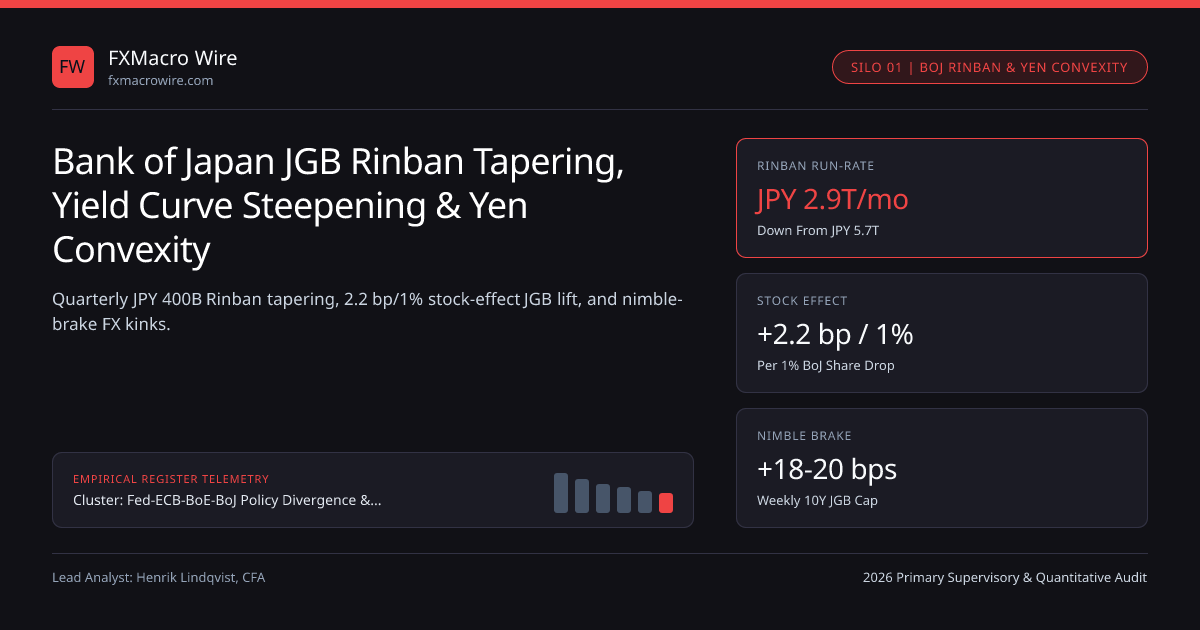
Quarterly step-down reductions of roughly JPY 400 billion in Bank of Japan (BoJ) monthly outright Japanese Government Bond (Rinban) purchases—compressing gross monthly buying from JPY 5.7 trillion in mid-2024 toward JPY 2.9 trillion by Q1 2026—systematically dismantle a decade of Yield Curve Control (YCC) suppression. Because the Bank of Japan still holds close to 48% of outstanding JGBs across 5-year and 10-year tenors, shifting marginal duration absorption back onto Japanese regional banks, trust accounts, and foreign dealers alters USD/JPY carry and TONA swap spreads through nonlinear convexity channels.
Predictable Rinban Tapering Versus Nimble Fixed-Rate Brakes#
When Governor Kazuo Ueda's Policy Board replaced discretionary daily Rinban tweaks with a pre-announced multi-quarter tapering roadmap, Tokyo separated short-term interest-rate policy (overnight TONA) from balance-sheet duration normalization. However, the BoJ retained an emergency circuit breaker—"nimble responses" including unscheduled Rinban increases or fixed-rate purchase operations—reserved strictly for disorderly 10-year JGB yield spikes exceeding 15 to 20 bps inside a single week.
That conditional put creates a kinked payoff in USD/JPY, mapped inside our G10 central bank rate divergence hub: gradual JGB yield rises driven by wage inflation strengthen the yen smoothly by narrowing US-Japan 10-year spreads, whereas disorderly JGB selloffs that provoke an unscheduled BoJ Rinban intervention instantly slam the yen lower as markets price central-bank balance-sheet re-expansion!
Belly vs Super-Long Steepening: Why 2s20s JGB Slope Drives Repatriation#
During the YCC era, pinning 10-year JGBs near 0.00%-1.00% created an artificial kink between the 10-year point and unanchored 20-year/30-year tenors. As Rinban tapering trimmed buying most aggressively in the 1-to-3-year, 3-to-5-year, and 5-to-10-year buckets, domestic Japanese mega-banks (MUFG, SMBC, Mizuho)—whose yen loan-to-deposit ratios sit near 56%—began rotating trillions out of overnight BoJ current accounts into 5-year JGBs once yields cleared 0.90%-1.10%.
Meanwhile, life insurers focused on 20Y-30Y duration—as quantified in USD/JPY SOFR-TONA hedging costs and Tokyo lifer hurdles and EUR/JPY OAT-versus-JGB yield competition. European macro volatility desks supervised by BaFin and CSSF, trading yen gamma and curve-correlated FX options across institutional desks tracked alongside Bequant and AlphaPro FX, price 1-month USD/JPY digital puts keyed to BoJ interim Rinban review meetings.
| JGB Maturity Bucket | BoJ Rinban Taper Intensity | Primary Domestic Buyer Cohort | Target Hurdle Yield | Spot USD/JPY & Cross-Rate Channel |
|---|---|---|---|---|
| 1Y - 5Y Short Belly | High reduction; rapid turnover | Mega-banks & regional shinkin banks | 0.85% - 1.15% | Direct lift to 2Y-5Y TONA swaps; narrows carry |
| 5Y - 10Y Benchmark | CoreJPY 400B/qtr step-down focus | Domestic trust banks & CTA futures | 1.20% - 1.55% | Watchlist for BoJ nimble fixed-rate brake |
| 10Y - 25Y Super-Long | Lighter reduction; preserved liquidity | GPIF & corporate pension ALM books | 1.85% - 2.15% | Triggers French OAT & UST sales (EURJPY-SYNTHETIC) |
| 25Y - 40Y Ultra-Long | Minimal BoJ footprint (<15% share) | Major seiho life insurers | 2.20% - 2.55% | AlphaPro FX / long-horizon JPY repatriation |
Stock-Effect Duration Supply Model of JGB Term Premia and Yen Beta#
Using Bank of Japan Monetary Affairs Department stock-effect estimates under the USDJPY-CARRY-TONA 2026 framework, every 1 percentage point reduction in the BoJ's share of total marketable JGBs restores roughly 2.2 bps of 10-year term premium—provided weekly yield velocity stays beneath the nimble-intervention cap:
- Delta ln(USDJPYt) = -lambda{orderly} * Delta y^{JGB,10Y}{stock} * I(|Delta{5d} y^{JGB}| < 18bp) + lambda_{brake} * I(NimbleOp = 1)
- Worked 4-Quarter Rinban Runoff Impact (BoJ Share Drops 4.8 Percentage Points; Terminal TONA +25 bps):
- Calibrated parameters: theta{stock} = 2.2 bps per 1% share drop; beta{TONA} = 0.65; lambda_{orderly} = 0.95% per 10 bps
- Stock-effect yield lift = 2.2 * 4.8 = +10.56 bps on 10Y JGB
- Terminal TONA pass-thru = 0.65 * 25.0 = +16.25 bps on 10Y JGB -> Total 10Y JGB rise = +26.8 bps (orderly over 4Q)
- Model USD/JPY impact = -0.95% * (26.8 / 10) = -2.55% structural yen appreciation (e.g., 151.00 -> 147.15)
Interim Rinban Plan Reviews and JGB Futures Cheapest-to-Deliver Squeezes#
Even as BoJ ownership recedes from 53% toward 48%, specific 7-year cheapest-to-deliver (CTD) JGB issues backing Osaka Exchange 10-year JGB futures remain over 70% locked inside the BoJ's SOMA-equivalent book, causing episodic repo specialness through the Securities Lending Facility (SLF).
Structuring Yen Options Around Kinked BoJ Reaction Functions#
Because an uncontrolled global bond rout can paradoxically trigger a BoJ fixed-rate buying operation that weakens the yen, outright long JPY calls underperform reverse knock-out (RKO) USD/JPY puts or 1x2 put ratios conditioned on orderly US yield declines. Strategists in our G10 policy divergence hub pair Rinban schedule audits with EUR/JPY synthetic spread monitors ahead of June interim taper reviews.
Frequently asked questions
What are Rinban operations at the Bank of Japan?
Rinban refers to the Bank of Japan regular scheduled outright purchases of Japanese Government Bonds across defined maturity buckets via competitive multi-price auctions with primary financial institutions to manage yield-curve liquidity and monetary base.
Why does an unscheduled BoJ bond-buying operation cause the yen to weaken immediately?
An unscheduled Rinban or fixed-rate purchase signals that the Policy Board prioritizes capping domestic government bond yields over tightening monetary conditions, expanding yen base money and widening US-Japan real yield differentials.
How much of the Japanese Government Bond market does the Bank of Japan still own?
Even after initiating quarterly Rinban tapering, the Bank of Japan holds roughly 47% to 49% of total outstanding JGBs (excluding Treasury Discount Bills), with ownership exceeding 65% in several legacy 7-to-10-year CTD issues.
How does the BoJ Securities Lending Facility (SLF) prevent JGB futures settlement failures?
Because the BoJ owns a dominant share of cheapest-to-deliver 7-year JGBs, dealers shorting Osaka Exchange JGB futures borrow scarce cash bonds overnight from the BoJ via the SLF at a penalty repo fee floor to complete physical delivery.
Publication record
- Published
- 14 November 2026
- Updated
- 14 November 2026
- Author
- Henrik Lindqvist, CFA
- Review
- Review not recorded
- Automated fact check
- Passed in the stored pipeline record
- Source URLs
- 3 recorded
AI assistance recorded: anthropic/claude-opus-4.6. This field does not establish human review or source verification.
Academic & Institutional Attribution
Cite This Research & Embed Live Data Card
Standard academic & institutional research paper citation format.
Henrik Lindqvist, CFA. (2026, November 14). Bank of Japan JGB Rinban Tapering, Yield Curve Steepening & Yen Convexity. FXMacro Wire. https://fxmacrowire.com/wire/boj-rinban-jgb-tapering-yield-curve-yen-convexityRelated G10 Central Bank Rate Divergence & Institutional Briefings
Explore G10 Central Bank Rate Divergence Hub (20) →G10 Central Bank Rate Divergence
G10 Central Bank Policy Divergence & Two-Year OIS Spreads: 2026 Foreign Exchange GuideG10 Central Bank Rate Divergence
ECB 15 bps Operational Corridor Narrowing, ESTR Excess Liquidity & Euro FXG10 Central Bank Rate Divergence
Shadow Short Rates & Quantitative Tightening Hike Equivalents in G10 Spot FXG10 Central Bank Rate Divergence
Central Bank Meeting-Day Intraday FX Event Volatility & Term-Structure WeightsG10 Central Bank Rate Divergence
State-Contingent vs Calendar Forward Guidance: OIS Volatility & FX Pass-ThroughG10 Central Bank Rate Divergence
MiFID II OTC FX Liquidity & Execution Slippage Around Central Bank DecisionsG10 Central Bank Rate Divergence
EUR/USD Two-Year ESTR-SOFR OIS Spread Elasticity Across Macro RegimesG10 Central Bank Rate Divergence
ECB Transmission Protection Instrument, BTP-Bund Spreads & Euro FX RiskFX Swap Basis Dollar Funding
US Treasury TGA Rebuilds, ON RRP Exhaustion & Offshore FX Swap Basis SpikesFX Swap Basis Dollar Funding
SA-CCR Counterparty Credit Capital Charges on Institutional FX Swap BooksFX Swap Basis Dollar Funding
UMR Phase 6 Initial Margin Rules: FX Forwards vs Cross-Currency SwapsFX Swap Basis Dollar Funding
SOFR-ESTR Mark-to-Market Resetting Cross-Currency Basis Swap Conventions
FXMacro Wire Data, Benchmarks & Contributor Records
CC BY 4.0 Open Data
Open Institutional Datasets (CSV / JSON) →
Download desk-compiled quantitative series & schemas.
2026 Reference Matrix
2026 Institutional Benchmarks & Thresholds →
Statutory capital, clearing, margin & rate conventions.
Editorial Records
Authors & Review Records →
View named contributors where those records are available.
Complete Index
Master Research & Dossier Archive →
Browse all published briefings by topic pillar & date.