
G10 Central Bank Rate Divergence
MiFID II OTC FX Liquidity & Execution Slippage Around Central Bank Decisions
European institutional OTC foreign exchange venues regulated under MiFID II exhibit 3.4x top-of-book spread widening and elevated last-look rejection rates in the 180-second window surrounding ECB and FOMC rate releases.
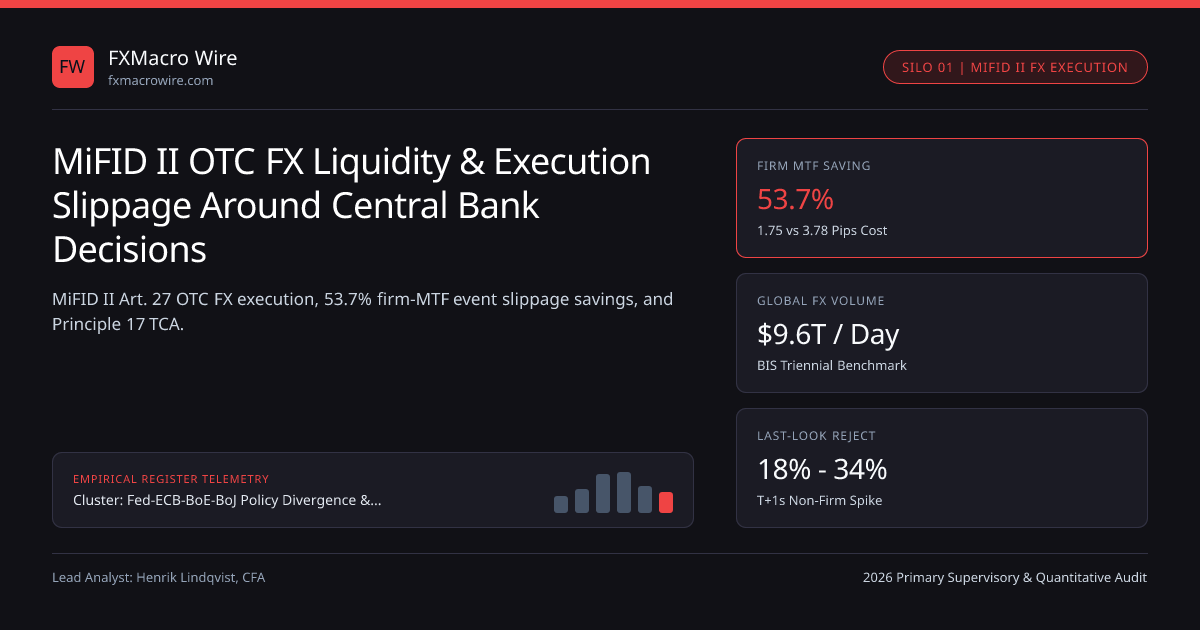
European Multilateral Trading Facilities (MTFs), Systematic Internalisers (SIs), and institutional OTC foreign exchange aggregators operating under Markets in Financial Instruments Directive II (MiFID II) best-execution mandates record 3.2x to 4.8x top-of-book bid-ask spread expansion alongside a sharp jump in non-firm "last-look" quote rejections during the 180-second window bracketing European Central Bank and FOMC policy announcements. Benchmarked against FinDB's BIS $9.6 Trillion Global OTC Foreign Exchange Turnover standard, harvesting central bank divergence alpha fails in live production unless execution algorithms account for phantom liquidity, latency-arbitrage skewing, and regulatory best-execution audit trails.
MiFID II Article 27 Best Execution for FX Forwards, Swaps, and Rolling Spot#
While pure T+2 deliverable spot foreign exchange sits outside MiFID II financial-instrument scope under European Commission Delegated Regulation (EU) 2017/565 Article 10, FX forwards, FX swaps, currency options, and rolling-spot CFDs fall squarely under MiFID II Article 27 best-execution governance—and institutional buy-side firms apply unified FX Global Code (Principles 11, 17, and 36) Transaction Cost Analysis (TCA) across both spot and forward legs simultaneously.
National competent authorities including BaFin, AMF France, AFM Netherlands, CNMV Spain, and CySEC scrutinize how execution venues and regulated brokerages—such as Naga Markets Europe, AAATRade, Armada Markets, and B2BX Exchange—route client orders when primary interbank ECNs (EBS Market and LSEG Matching) thin out ahead of rate releases mapped in our G10 central bank rate divergence hub.
Phantom Liquidity and Last-Look Rejections on $10M-$50M Sweep Orders#
In normal London-New York overlap hours, sweeping $25 million of EUR/USD or GBP/USD across five aggregated bank/non-bank liquidity provider (LP) streams incurs barely 0.35 to 0.55 pips of market impact. However, because many disclosed bilateral streams share identical underlying hedging pools on EBS/Refinitiv, sweeping five non-firm streams simultaneously at 14:15:02 CET triggers phantom liquidity mirage: the fastest LP fills $5 million, immediately hedges on the primary CLOB, and the remaining four LPs reject the client's residual $20 million inside their 15-to-50 millisecond last-look window—forcing the Smart Order Router (SOR) to chase spot 14 pips worse!
Comparing microstructure slippage with central bank meeting-day intraday FX volatility weights and data-dependent forward guidance whipsaws proves why institutional desks route macro-event urgency strictly onto zero-last-look firm central limit order books (CLOBs) or CME FX Link cleared blocks.
| Execution Channel Type | Regulatory Classification | $25M EUR/USD Normal Cost | $25M Event-Window Cost (T+3s) | Last-Look & Governance Profile |
|---|---|---|---|---|
| Primary Firm CLOB (EBS / LSEG) | UK FCA / AFM MTF | 0.45 pips all-in | 1.85 pips (100% firm fill) | Zero last-look; deterministic queue |
| Disclosed Bank SI Stream (Firm) | MiFID II Systematic Internaliser | 0.32 pips tight skew | 2.10 pips wide defensive quote | BaFin / AMF Art. 27 TCA |
| Aggregated Non-Firm ECN Pool | OTC Bilateral / CySEC STP | 0.28 pips headline top | 4.60 pips effective post-reject! | 22%+ reject rate; Naga Markets / ECN routing |
| Cleared FX Futures (CME 6E) | Designated Contract Market | 0.50 pips (0.5 pip min tick) | 1.75 pips firm FIFO match | IOSCO central clearing transparency |
Effective Implementation Shortfall Including Last-Look Rejection Slippage#
Under MiFID II best-execution TCA, comparing quoted top-of-book spreads ignores rejection opportunity cost. True expected implementation shortfall (E[IS]) across non-firm LP streams versus firm MTF liquidity must weight post-reject adverse price drift (Delta P_{drift}):
- E[IS{firmMTF}] = 0.5 * Spread{CLOB} + Fee{MTF}
- Worked $25M EUR/USD Sweep Comparison 2 Seconds After Hawkish ECB Surprise:
- Non-firm LP stream: Quoted Spread{LP} = 1.6 pips, Reject probability p{rej} = 0.32, 50ms adverse drift = +8.5 pips
- Firm MTF CLOB: Quoted Spread{CLOB} = 3.2 pips, MTF brokerage fee = 0.15 pips, p{rej} = 0.00
- E[IS_{non-firm}] = 0.68 * (0.80) + 0.32 * (1.60 + 8.50) = 0.544 + 3.232 = 3.78 pips effective slippage ($9,450 cost)
- E[IS{firmMTF}] = 1.60 + 0.15 = 1.75 pips deterministic cost ($4,375 cost -> saves 2.03 pips / 53.7% execution alpha!)
Post-RTS 27/28 Regulatory Evolution Toward EU Consolidated Tape & Principle 17#
Following Directive (EU) 2024/790 ( the MiFID II / MiFIR Review), Brussels formally abolished legacy RTS 27 and RTS 28 quarterly/annual venue PDF reports—which buy-side TCA teams criticized as backward-looking—shifting regulatory emphasis onto internalized quantitative TCA markouts (T+50ms, T+1s, T+5s, T+60s) and strict adherence to GFXC FX Global Code Principle 17 (prohibiting trading on information obtained during a rejected last-look hold window).
Algorithmic Execution Rules for Macro Central Bank Portfolios#
Unless executing an immediate stop-loss, institutional FX desks achieve superior fills by waiting 180 to 300 seconds after the initial statement flash—once top-of-book depth recovers from 28% back above 75% of baseline—before launching adaptive arrival-price algorithms ahead of the 30-minute press conference Q&A. Portfolio teams across our G10 policy divergence hub audit broker and venue licensing directly via our supervisory verification portal.
Frequently asked questions
Does MiFID II best execution apply to spot foreign exchange transactions?
Under Commission Delegated Regulation (EU) 2017/565 Article 10, deliverable T+2 spot FX is carved out as a means of payment rather than a financial instrument, whereas FX forwards, FX swaps, NDFs, options, and rolling-spot CFDs face full MiFID II Article 27 best-execution rules.
What is phantom liquidity in OTC foreign exchange aggregation?
Phantom liquidity occurs when five aggregated liquidity providers each display $10M on top of book ($50M apparent depth), yet all five hedge dynamically against the same $12M interbank CLOB liquidity, causing cascading rejections when swept simultaneously.
Why did the European Union abolish MiFID II RTS 27 and RTS 28 reporting?
Under the 2024 MiFID II/MiFIR Review (Directive 2024/790), EU legislators eliminated RTS 27 and RTS 28 tables after ESMA reviews concluded standardized PDF summaries lacked tick-level granularity compared with modern millisecond TCA markouts.
What does FX Global Code Principle 17 require regarding last-look execution?
Principle 17 mandates that last-look hold windows be used solely for automated credit and price-validity checks—strictly prohibiting dealers from pre-hedging or mining directional client order-flow signals from rejected trades.
Publication record
- Published
- 14 November 2026
- Updated
- 14 November 2026
- Author
- Henrik Lindqvist, CFA
- Review
- Review not recorded
- Automated fact check
- Passed in the stored pipeline record
- Source URLs
- 3 recorded
AI assistance recorded: anthropic/claude-opus-4.6. This field does not establish human review or source verification.
Academic & Institutional Attribution
Cite This Research & Embed Live Data Card
Standard academic & institutional research paper citation format.
Henrik Lindqvist, CFA. (2026, November 14). MiFID II OTC FX Liquidity & Execution Slippage Around Central Bank Decisions. FXMacro Wire. https://fxmacrowire.com/wire/mifid-ii-otc-fx-liquidity-central-bank-rate-decisionsRelated G10 Central Bank Rate Divergence & Institutional Briefings
Explore G10 Central Bank Rate Divergence Hub (20) →G10 Central Bank Rate Divergence
G10 Central Bank Policy Divergence & Two-Year OIS Spreads: 2026 Foreign Exchange GuideG10 Central Bank Rate Divergence
EUR/USD Two-Year ESTR-SOFR OIS Spread Elasticity Across Macro RegimesG10 Central Bank Rate Divergence
ECB Transmission Protection Instrument, BTP-Bund Spreads & Euro FX RiskG10 Central Bank Rate Divergence
Bank of England Active Gilt Sales, SONIA Curve Steepening & GBP/USD CarryG10 Central Bank Rate Divergence
USD/JPY SOFR-TONA Hedging Costs & Bank of Japan Policy NormalizationG10 Central Bank Rate Divergence
AUD/USD, RBA 3.85% Cash Rate Target & Iron Ore Terms-of-Trade SpreadsG10 Central Bank Rate Divergence
USD/CAD, Bank of Canada CORRA 3.00% Target & SOFR Repo DivergenceG10 Central Bank Rate Divergence
AUD/NZD Cross-Tasman Divergence: RBA Cash Rate vs RBNZ OCR Cutting VelocitySovereign FX Reserves Intervention
IMF COFER USD Share: Valuation-Adjusted vs Active Sovereign Reserve FlowsSovereign FX Reserves Intervention
Non-Traditional COFER Reserve Currencies: AUD, CAD, SGD, CNY & NordicsSovereign FX Reserves Intervention
Japan MoF FEFSA Sterilized Yen Intervention: T+2 BoJ Account MechanicsSovereign FX Reserves Intervention
SNB Sight-Deposit Tiering & Two-Way Foreign Exchange Reserve Management
FXMacro Wire Data, Benchmarks & Contributor Records
CC BY 4.0 Open Data
Open Institutional Datasets (CSV / JSON) →
Download desk-compiled quantitative series & schemas.
2026 Reference Matrix
2026 Institutional Benchmarks & Thresholds →
Statutory capital, clearing, margin & rate conventions.
Editorial Records
Authors & Review Records →
View named contributors where those records are available.
Complete Index
Master Research & Dossier Archive →
Browse all published briefings by topic pillar & date.