
G10 Central Bank Rate Divergence
EUR/JPY Synthetic Cross-Rate & Eurozone-Japan Sovereign Yield Spreads
Anchored by a +125 bps ECB-over-BoJ policy spread under EURJPY-SYNTHETIC benchmarks, EUR/JPY blends triangular USD/JPY and EUR/USD liquidity with French OAT versus 10-year JGB yield competition.
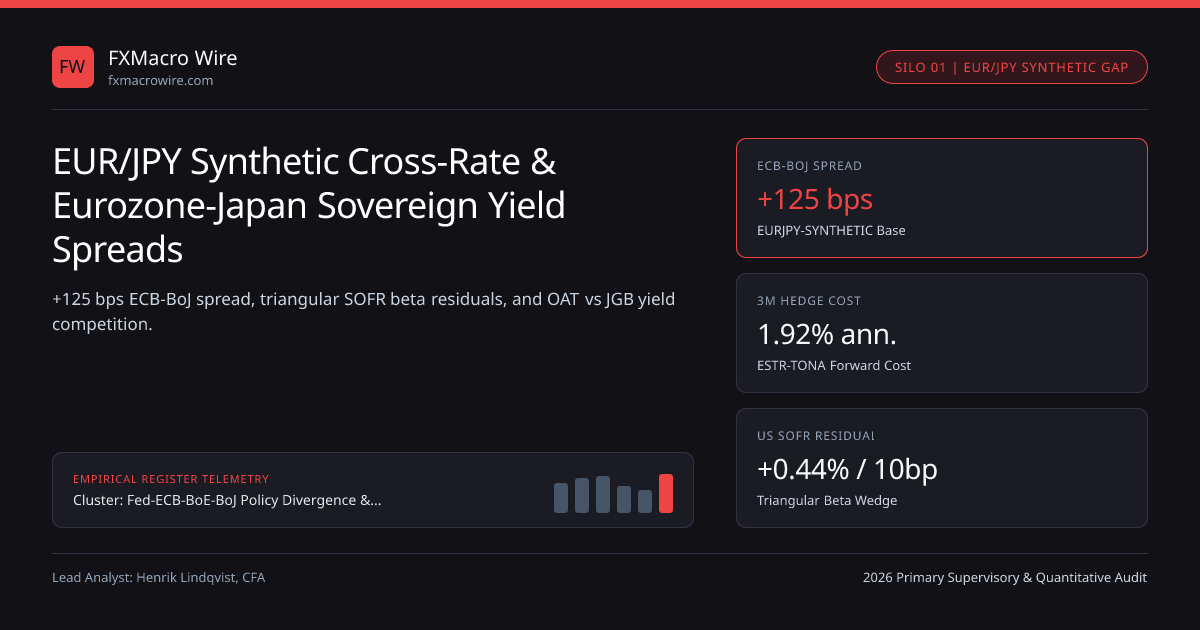
Anchored by a +125 bps European Central Bank over Bank of Japan policy rate differential under FinDB's EUR/JPY Cross-Rate & Eurozone-Japan Sovereign Yield Spread benchmark, EUR/JPY functions simultaneously as a triangular microstructure product of spot EUR/USD multiplied by spot USD/JPY and as a standalone macro barometer of Japanese real-money appetite for European sovereign debt. Because EUR/JPY hedging costs roughly 185 to 195 bps less than USD/JPY hedging, Tokyo institutional investors historically favored 10-year French OATs, Spanish Bonos, and supranational EU bonds over US Treasuries—until rising domestic JGB yields began eroding that pickup.
Triangular No-Arbitrage Microstructure vs Autonomous Cross Flows#
On interbank ECNs (EBS and LSEG Matching), automated triangular arbitrage engines keep direct EUR/JPY quotes within 0.2 to 0.5 pips of EUR/USD * USD/JPY. Yet directional causality rotates across global trading sessions. During New York hours, US Treasury moves drive both dollar legs, leaving EUR/JPY determined by whether USD/JPY's 2Y rate beta (1.12) outpaces EUR/USD's inverse dollar beta (-0.68).
During Tokyo morning and Frankfurt overlap hours, genuine bilateral flows take command: Japanese trust banks rebalancing eurozone sovereign bond portfolios and European exporters hedging yen receivables execute directly in EUR/JPY or via ESTR-TONA swaps, propagating price discovery back into the dollar legs as documented in our G10 central bank rate divergence hub.
Why French OATs and Spanish Bonos Dominated Japanese Euro Bond Books#
Japan Ministry of Finance International Transactions in Securities filings confirm that French OATs accounted for over 45% of total Japanese institutional eurozone sovereign holdings over the past decade, dwarfing lower-yielding German Bunds. With 10-year Bunds yielding ~2.30% and 3-month ESTR-TONA hedging costing ~1.92%, FX-hedged Bunds return barely +0.38% in yen—unattractive against 10-year JGBs near 1.18%. Semi-core OATs (+75 bps over Bunds) and BBB+/A-rated Spanish Bonos offered the sole positive hedged pickup, until French fiscal deficits widened OAT-Bund volatility (compare ECB TPI fragmentation and semi-core OAT-Bund risk and USD/JPY SOFR-TONA lifer hedge hurdles).
European clearing and brokerage entities supervised by AMF France, Banco de Espana, and BaFin—alongside institutional liquidity venues such as Boursorama and Aglaia Capital—track Japanese monthly net OAT liquidations as a leading indicator of medium-term EUR/JPY tops.
| Sovereign Bond Benchmark | Gross 10Y Yield | 3M JPY Hedge Cost | Net JPY-Hedged Return | Japanese Institutional Flow Stance |
|---|---|---|---|---|
| 10Y German Bund (AAA) | 2.30% | 1.92% (ESTR-TONA) | +0.38% net JPY | Net sellers; inferior to 10Y JGB (1.18%) |
| 10Y French OAT (AA-) | 3.05% | 1.92% (ESTR-TONA) | +1.13% net JPY | AMF / Selective hold; fiscal cap risk |
| 10Y Spanish Bono (A) | 3.12% | 1.92% (ESTR-TONA) | +1.20% net JPY | BdE / Outperforms OAT on macro momentum |
| 10Y US Treasury (AA+) | 4.18% | 3.82% (SOFR-TONA) | +0.36% net JPY | Unhedged dip-buying only; hedged book cut |
| 20Y Domestic JGB (A+) | 1.88% | 0.00% (Domestic JPY) | +1.88% net JPY | Core reallocation magnet for Tokyo lifers |
Decomposition of EUR/JPY Sensitivity to US, Eurozone, and Japanese Rate Shocks#
Under the EURJPY-SYNTHETIC 2026 standard, triangular log-additivity (ln(EURJPY) = ln(EURUSD) + ln(USDJPY)) reveals why US Treasury rallies (falling SOFR) paradoxically pull EUR/JPY lower even though neither Frankfurt nor Tokyo moved:
- = beta^{EU}{2Y} * (Delta ESTR^{2Y}t - Delta SOFR^{2Y}t) + beta^{JP}{2Y} * (Delta SOFR^{2Y}t - Delta TONA^{2Y}t)
- = beta^{EU}{2Y} * Delta ESTR^{2Y}t - beta^{JP}{2Y} * Delta TONA^{2Y}t + (beta^{JP}{2Y} - beta^{EU}{2Y}) * Delta SOFR^{2Y}_t
- Worked US-Driven Cross Spillover (-25 bps Dovish FOMC Shock; ESTR and TONA Unchanged):
- Empirical 2Y betas (per 10 bps): beta^{EU}{2Y} = 0.68%, beta^{JP}{2Y} = 1.12%
- Net US SOFR coefficient = (1.12% - 0.68%) = +0.44% per 10 bps SOFR shift
- For Delta SOFR^{2Y} = -2.5 units (-25 bps):
- EUR/USD rises: +0.68% * 2.5 = +1.70%; USD/JPY drops: -1.12% * 2.5 = -2.80%
- Net EUR/JPY cross move = +1.70% - 2.80% = -1.10% (e.g., 164.50 -> 162.69)
Option Skew Asymmetry and Global Equity Pro-Cyclicality#
Because EUR/JPY combines a pro-cyclical European manufacturing currency with a positive-NIIP Asian funding haven, 1-month 25-delta EUR/JPY risk reversals trade at a persistent -1.60 to -2.20 vol put skew—steeper than either EUR/USD or USD/JPY individually.
Structuring Dual-Catalyst Downside Hedges With EUR/JPY Put Spreads#
Zero-cost risk reversals often overpay for wing convexity when EUR/JPY skew sits near -2.0 vol, making 3-month 25-delta/10-delta put spreads superior carry-efficient structures. Portfolio managers consulting the G10 policy divergence research hub frequently utilize EUR/JPY put spreads rather than USD/JPY puts to hedge simultaneously against Bank of Japan rate hikes and US growth slowdowns.
Frequently asked questions
Why does EUR/JPY fall when US Treasury yields drop sharply on weak US economic data?
By triangular arbitrage, EUR/JPY equals EUR/USD times USD/JPY. Because USD/JPY falls roughly 1.12% per 10 bps drop in 2-year US yields while EUR/USD rises only 0.68%, the yen appreciation leg outweighs the euro gain by 0.44% per 10 bps.
Why did Japanese institutional investors historically hold more French OATs than German Bunds?
After deducting ESTR-TONA FX hedging costs (~1.92%), German Bunds yielded less than domestic JGBs, whereas French OATs offered a 50-80 bps semi-core credit spread pickup inside deep AAA/AA repo markets.
Where can FX strategists track Japanese institutional buying or selling of eurozone bonds?
Japan Ministry of Finance publishes weekly aggregate foreign bond flows and monthly country-by-country International Transactions in Securities tables breaking out net purchases across Germany, France, Italy, Spain, and the United States.
How does BoJ JGB tapering affect EUR/JPY differently from ECB rate cuts?
ECB cuts narrow front-end 3-month carry gradually, whereas BoJ JGB tapering lifts 10-year and 20-year domestic yen yields, triggering structural multi-quarter portfolio repatriation out of European sovereign debt regardless of overnight spreads.
Publication record
- Published
- 14 November 2026
- Updated
- 14 November 2026
- Author
- Henrik Lindqvist, CFA
- Review
- Review not recorded
- Automated fact check
- Passed in the stored pipeline record
- Source URLs
- 3 recorded
AI assistance recorded: anthropic/claude-opus-4.6. This field does not establish human review or source verification.
Academic & Institutional Attribution
Cite This Research & Embed Live Data Card
Standard academic & institutional research paper citation format.
Henrik Lindqvist, CFA. (2026, November 14). EUR/JPY Synthetic Cross-Rate & Eurozone-Japan Sovereign Yield Spreads. FXMacro Wire. https://fxmacrowire.com/wire/eurjpy-synthetic-cross-rate-ecb-boj-sovereign-gapRelated G10 Central Bank Rate Divergence & Institutional Briefings
Explore G10 Central Bank Rate Divergence Hub (20) →G10 Central Bank Rate Divergence
G10 Central Bank Policy Divergence & Two-Year OIS Spreads: 2026 Foreign Exchange GuideG10 Central Bank Rate Divergence
Inertial Taylor-Rule FX Fair-Value Gaps & G10 Exchange Rate Mean ReversionG10 Central Bank Rate Divergence
FOMC Dot-Plot Neutral r-Star Drift & ICE U.S. Dollar Index (DXY) BetaG10 Central Bank Rate Divergence
Swiss National Bank 0.00% Rate Floor, SARON-ESTR Spreads & EUR/CHF CapsG10 Central Bank Rate Divergence
GBP/EUR +125 bps SONIA-ESTR Spread & UK Services Wage PersistenceG10 Central Bank Rate Divergence
Bank of Japan JGB Rinban Tapering, Yield Curve Steepening & Yen ConvexityG10 Central Bank Rate Divergence
ECB 15 bps Operational Corridor Narrowing, ESTR Excess Liquidity & Euro FXG10 Central Bank Rate Divergence
Shadow Short Rates & Quantitative Tightening Hike Equivalents in G10 Spot FXFX Swap Basis Dollar Funding
Covered Interest Parity Deviations & Basel III Leverage Ratio Shadow CostsFX Swap Basis Dollar Funding
Yankee CDs, Commercial Paper & US Money-Market Fund FX Swap SpreadsFX Swap Basis Dollar Funding
NY Fed FIMA Repo Facility vs Central Bank FX Swap Lines: Sovereign USD PlumbingFX Swap Basis Dollar Funding
CLS PvP Settlement Cutoffs & North American T+1 FX Swap Liquidity Compression
FXMacro Wire Data, Benchmarks & Contributor Records
CC BY 4.0 Open Data
Open Institutional Datasets (CSV / JSON) →
Download desk-compiled quantitative series & schemas.
2026 Reference Matrix
2026 Institutional Benchmarks & Thresholds →
Statutory capital, clearing, margin & rate conventions.
Editorial Records
Authors & Review Records →
View named contributors where those records are available.
Complete Index
Master Research & Dossier Archive →
Browse all published briefings by topic pillar & date.