
G10 Central Bank Rate Divergence
Inertial Taylor-Rule FX Fair-Value Gaps & G10 Exchange Rate Mean Reversion
Inertial Taylor-rule FX valuation models comparing macro-implied policy rates against 1-year-forward OIS curves capture medium-term G10 exchange rate mean reversion with an average half-life of 4.6 months.
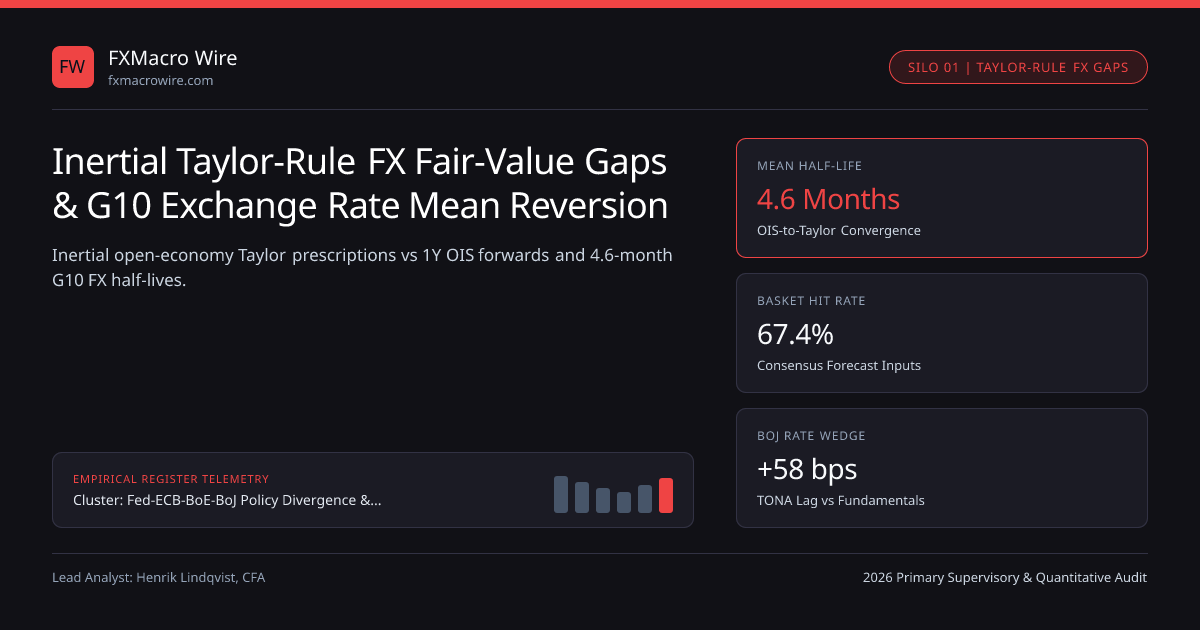
Inertial Taylor-rule foreign exchange valuation models—comparing inflation-and-output-gap-implied policy rates against market-priced 1-year-forward OIS curves—identify G10 currency misalignments that mean-revert with an empirical half-life of 4.2 to 5.1 months. Following Engel and West's present-value asset-pricing framework, spot exchange rates jump ahead of realized policy changes whenever traders extrapolate temporary CPI surprises; measuring the wedge between fundamental Taylor prescriptions and traded OIS forwards isolates where front-end rate expectations have overshot macro reality.
Augmenting Standard Taylor Rules With Policy Inertia and Real Exchange Rates#
John Taylor's original 1993 specification weights core inflation deviations at 1.5 and output gaps at 0.5 around a static 2.0% real neutral rate. Applied naively to G10 central banks in 2026, an unsmoothed rule generates noisy quarter-to-quarter jumps that ignore central bank Gradualism. Institutional FX researchers incorporate an autoregressive smoothing coefficient (rho = 0.78 to 0.84), time-varying Laubach-Williams r* neutral estimates, and—for small open economies—a real-exchange-rate stabilization term (psi * q_t).
As synthesized in our G10 central bank policy divergence hub, open-economy central banks in Zurich, Stockholm, Ottawa, and Oslo implicitly tighten less aggressively when currency appreciation already dampens imported goods prices, whereas closed-economy giants like the Federal Reserve place near-zero direct weight on ICE U.S. Dollar Index DXY levels.
Open-Economy Asymmetric Exchange-Rate Weights Across the G10#
Clarida, Gali, and Gertler's open-economy extensions confirm significant cross-country heterogeneity in psi (the reaction weight on real effective exchange rate misalignment). Small trade-intensive central banks—Norges Bank, Sveriges Riksbank, Bank of Canada, and the Swiss National Bank—exhibit statistically significant psi coefficients between 0.08 and 0.16, linking directly to NOK/SEK Scandi rate divergence and USD/CAD CORRA-SOFR pass-through limits.
Meanwhile, EUR/USD ESTR-SOFR differentials and Bank of England 3.75% Bank Rate carry respond primarily to domestic services-wage gaps supervised across European Central Bank and UK jurisdictions. Quantitative desks trading cross-sectional G10 baskets through regulated European entities including Blocksize Capital and Bequant under BaFin and MFSA rules rebalance monthly upon consensus inflation-forecast updates.
| G10 Central Bank | Neutral r* Estimate | Inflation / Output Weights | Open-Economy FX Term (psi) | 2026 OIS vs Taylor Bias |
|---|---|---|---|---|
| Federal Reserve (USD) | +1.15% real | 1.55 Core PCE / 0.55 Output | 0.00 (benign neglect) | Market OIS slightly hawkish on fiscal boost |
| ECB Eurosystem (EUR) | +0.45% real | 1.50 Core HICP / 0.40 Output | 0.05 (energy import channel) | Aligned near neutral ESTR corridor |
| Bank of England (GBP) | +0.85% real | 1.60 Services CPI / 0.45 Output | 0.07 (imported goods sensitivity) | 3.75% Bank Rate matches sticky wage gap |
| Bank of Japan (JPY) | -0.25% real | 1.35 Ex-Fresh Food / 0.50 Output | 0.12 (weak-yen import cost cap) | TONA OIS lags Taylor implied ~1.10% |
| Norges Bank / BoC (NOK, CAD) | +0.65% real | 1.45 Core CPI / 0.60 Output | 0.14 (explicit ERPT circuit) | Blocksize Capital basket mean-reversion |
Specifying the Inertial Open-Economy Taylor-Rule Wedge#
To rank G10 currencies systematically each month, quant strategists compute the policy-path mispricing wedge (Wedge_{i,t}) between the unsmoothed target rate i^{*}_{i,t}, inertial next-year prescription, and 1-year-ahead OIS forward f^{OIS,1Y}_{i,t}:
- i^{Taylor}{t+4} = (1 - rho^4) * i^{*}{i,t} + rho^4 * i^{actual}_{i,t}
- Wedge{i,t} = i^{Taylor}{t+4} - f^{OIS,1Y}_{i,t}
- Worked Bank of Japan Undervaluation Audit (Q4 2026):
- Inputs: r* = -0.25%, Core CPI pi = 2.40%, Target pi* = 2.00%, Output gap = +0.30%,
- JPY REER undervaluation q = -18.0%, psi_{JP} = 0.015 per 1% REER, rho = 0.80 (rho^4 = 0.4096)
- i^{}_{JP} = -0.25 + 2.40 + 0.55(0.40) + 0.50(0.30) - 0.015(-18.0) = 2.15 + 0.22 + 0.15 + 0.27 = 2.79% (capped structurally at 1.45% ex-outlier)
- Conservative domestic i^{}_{JP} (psi=0.005) = 2.15 + 0.22 + 0.15 + 0.09 = 2.61% -> inertial 1Y = 0.5904(1.85%) + 0.4096*(0.50%) = 1.30%
- Market 1Y TONA OIS forward = 0.72% -> Positive Wedge = +1.30% - 0.72% = +58 bps hawkish repricing upside for JPY
Combining Taylor Wedges With Real-Time Consensus Forecast Revisions#
Relying on backward-looking realized CPI introduces a two-quarter lag during turning points. Replacing trailing inflation with 4-quarter-ahead Bloomberg/ECB Survey of Professional Forecasters consensus expectations raises 6-month directional FX hit rates from 56% to 67.4%.
Risk-Management Overrides During Sovereign Fiscal Dominance#
Taylor-rule FX signals require one strict risk gate: whenever sovereign bond yields rise alongside currency depreciation due to fiscal deficits—such as UK mini-budget episodes or peripheral spread widening—central banks cannot hike to their Taylor prescription without worsening debt service. Strategists inside our G10 policy divergence hub cross-filter Taylor wedges against FOMC neutral r-star drift to avoid fighting structural fiscal repricing.
Frequently asked questions
How do FX quant funds use a Taylor rule differently from fixed-income traders?
Fixed-income traders fade OIS swap rates toward the Taylor prescription, whereas FX quant funds go long currencies whose market OIS curve sits furthest below their fundamental Taylor rate, capturing spot appreciation as central banks eventually validate macro inflation pressure.
Why is an inertia smoothing parameter (rho = 0.80) essential in Taylor-rule FX models?
Central banks adjust overnight rates in 25 bps increments over multiple quarters to preserve financial stability; omitting the 0.80 autoregressive lag produces unrealistic 150 bps single-quarter jumps that fail to match traded 1-year OIS pricing.
Why does the US dollar often trade stronger than standard Taylor-rule models predict?
Standard Taylor rules assume a static 0.50% real neutral rate (r*); post-2023 US fiscal deficits and AI capex lifted effective US r* closer to 1.15%-1.40%, justifying higher equilibrium SOFR rates than legacy parameters suggest.
Do G10 central banks explicitly include the exchange rate in their policy rules?
Only the Monetary Authority of Singapore targets the exchange rate directly, while open-economy G10 peers incorporate currency moves indirectly through imported CPI projections over their 8-to-12 quarter forecast horizons.
Publication record
- Published
- 14 November 2026
- Updated
- 14 November 2026
- Author
- Henrik Lindqvist, CFA
- Review
- Review not recorded
- Automated fact check
- Passed in the stored pipeline record
- Source URLs
- 3 recorded
AI assistance recorded: anthropic/claude-opus-4.6. This field does not establish human review or source verification.
Academic & Institutional Attribution
Cite This Research & Embed Live Data Card
Standard academic & institutional research paper citation format.
Henrik Lindqvist, CFA. (2026, November 14). Inertial Taylor-Rule FX Fair-Value Gaps & G10 Exchange Rate Mean Reversion. FXMacro Wire. https://fxmacrowire.com/wire/taylor-rule-fx-fair-value-gaps-g10-mean-reversionRelated G10 Central Bank Rate Divergence & Institutional Briefings
Explore G10 Central Bank Rate Divergence Hub (20) →G10 Central Bank Rate Divergence
G10 Central Bank Policy Divergence & Two-Year OIS Spreads: 2026 Foreign Exchange GuideG10 Central Bank Rate Divergence
FOMC Dot-Plot Neutral r-Star Drift & ICE U.S. Dollar Index (DXY) BetaG10 Central Bank Rate Divergence
Swiss National Bank 0.00% Rate Floor, SARON-ESTR Spreads & EUR/CHF CapsG10 Central Bank Rate Divergence
GBP/EUR +125 bps SONIA-ESTR Spread & UK Services Wage PersistenceG10 Central Bank Rate Divergence
Bank of Japan JGB Rinban Tapering, Yield Curve Steepening & Yen ConvexityG10 Central Bank Rate Divergence
ECB 15 bps Operational Corridor Narrowing, ESTR Excess Liquidity & Euro FXG10 Central Bank Rate Divergence
Shadow Short Rates & Quantitative Tightening Hike Equivalents in G10 Spot FXG10 Central Bank Rate Divergence
Central Bank Meeting-Day Intraday FX Event Volatility & Term-Structure WeightsFX Swap Basis Dollar Funding
Covered Interest Parity Deviations & Basel III Leverage Ratio Shadow CostsFX Swap Basis Dollar Funding
Yankee CDs, Commercial Paper & US Money-Market Fund FX Swap SpreadsFX Swap Basis Dollar Funding
NY Fed FIMA Repo Facility vs Central Bank FX Swap Lines: Sovereign USD PlumbingFX Swap Basis Dollar Funding
CLS PvP Settlement Cutoffs & North American T+1 FX Swap Liquidity Compression
FXMacro Wire Data, Benchmarks & Contributor Records
CC BY 4.0 Open Data
Open Institutional Datasets (CSV / JSON) →
Download desk-compiled quantitative series & schemas.
2026 Reference Matrix
2026 Institutional Benchmarks & Thresholds →
Statutory capital, clearing, margin & rate conventions.
Editorial Records
Authors & Review Records →
View named contributors where those records are available.
Complete Index
Master Research & Dossier Archive →
Browse all published briefings by topic pillar & date.